
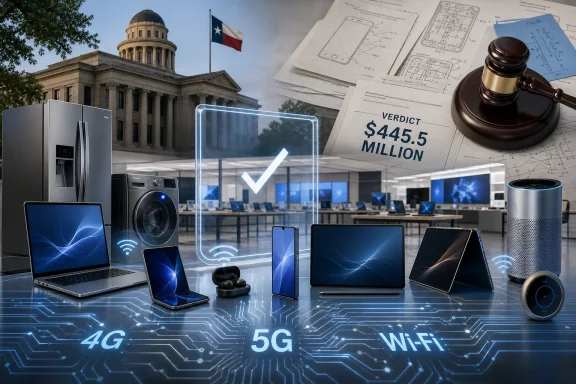
California Globe’s account correctly identifies the core event in Collision Communications Inc. v. Samsung Electronics Co.: an Eastern District of Texas jury found Samsung had willfully infringed four wireless-communications patents and awarded Collision Communications $445,494,160 on October 10, 2025. That is $445.5 million—not “$445,494,160 million,” which would be a vastly different, erroneous figure. The verdict was entered as a reasonable royalty structured as a running royalty rather than a lump-sum damages award.
Reuters, Bloomberg Law, Law360, and Germany’s Golem independently reported the verdict at the time. The patents cover techniques for handling interference and multi-user detection in 4G, 5G, and Wi-Fi communications—technology allegations that reached Samsung Galaxy phones, tablets, PCs, and a broad range of connected appliances. For Windows and PC buyers, this is not a finding that a Windows feature is faulty or that Samsung Galaxy Book systems are being recalled. It is a high-stakes patent dispute over radio technology embedded below the operating-system layer.
 Four patents won at trial, but only one mattered for a sales ban
Collision originally asserted six patents after filing suit on December 12, 2023. By trial, it had narrowed the case to four: U.S. Patent Nos. 7,463,703; 7,920,651; 7,593,492; and 6,947,505. The jury found infringement of the asserted claims in all four patents, rejected Samsung’s invalidity defense, and found the infringement willful.
The post-verdict injunction motion tells the more important story. Collision did not ask Judge Rodney Gilstrap to bar Samsung products based on the entire four-patent verdict. It sought an injunction only under Patent No. 7,593,492, because the court record says the remaining terms of the other three patents were negligible.
That substantially changes the consumer-facing stakes. The case did not produce an order requiring Samsung to pull Galaxy phones, Galaxy Books, tablets, or appliances from U.S. shelves. Nor did it produce a technical mandate requiring Samsung to disable Wi-Fi, 4G, or 5G functions. The injunction request was focused on the one patent Collision said remained commercially consequential.
Samsung therefore avoided the remedy that would have created immediate supply-chain and product-support consequences. A damages judgment can be costly; an injunction can force redesigns, licensing negotiations, inventory disruptions, or an end to sales of identified products. Samsung is facing the former, not the latter—at least for now.
Judge Gilstrap rejected neither the patents nor injunctions for licensing companies
Judge Gilstrap denied the permanent injunction on May 18, 2026. California Globe dates the decision May 17, but the published order is dated May 18. The court’s reasoning also does not support the broader conclusion that patent owners lacking their own finished consumer products cannot obtain injunctions.
Under the Supreme Court’s 2006 decision in eBay v. MercExchange, a patent owner must establish four elements: irreparable harm, inadequacy of money damages, a favorable balance of hardships, and consistency with the public interest. Collision cleared the first two hurdles. The court found it had shown irreparable harm and that ordinary monetary remedies were inadequate under the circumstances.
The request failed on the remaining analysis. Judge Gilstrap found Collision had not carried its burden on the balance of hardships and public-interest factors. Samsung argued that an injunction could disrupt employees, suppliers, retailers, customers, and consumer choice. The court also criticized Collision’s attempt to treat injunctions as near-automatic once infringement had been found.
The ruling is significant precisely because it is less sweeping than either side’s preferred narrative. The court expressly declined Samsung’s proposed categorical rule that a plaintiff that licenses patents and does not compete directly with the defendant can never show that money is inadequate. In other words, Collision’s business model did not automatically disqualify it from injunctive relief. It still had to prove why this particular sales prohibition was equitable.
That distinction will matter to patent holders pursuing device makers, but it does not make the order a general win for non-practicing entities. Collision lost the remedy it requested. The court did not create a shortcut around eBay; it applied the existing four-factor test and found the evidentiary showing incomplete.
The Justice Department’s intervention was policy advocacy, not a verdict on Samsung’s conduct
The Justice Department and U.S. Patent and Trademark Office filed a Statement of Interest on February 27, 2026, urging the court not to weaken patent owners’ ability to seek injunctions through broad categorical rules. The agencies argued that preserving incentives to innovate supports competition and that injunctions remain part of a patent’s exclusionary right.
That intervention was notable. Federal antitrust and patent officials rarely become involved in an ordinary private infringement case, and the filing placed Collision’s motion inside a wider policy fight over whether patent owners should normally be limited to damages after eBay.
But the federal statement did not find that Samsung committed theft, espionage, or any national-security violation. It did not validate the politically charged claim that Samsung used Russian researchers or universities to recreate Collision’s technology. The available court orders and the Justice Department’s statement address patent remedies and the four-factor injunction test; they do not make factual findings on those allegations.
California Globe attributes part of that account to Collision’s litigation position and quotes a statement reported by Law360. Readers should keep that separation clear. A jury found willful patent infringement. That is a consequential civil finding. It is not the same thing as a judicial determination that Samsung transferred U.S. technology to Russia, committed criminal IP theft, or created a national-security breach.
The damages award is still growing, but newer products were not automatically swept in
Final judgment on the jury verdict was entered November 12, 2025. Samsung’s exposure did not stop there. On July 16, 2026, Judge Gilstrap awarded Collision prejudgment interest at the five-year Treasury bill rate, compounded quarterly as the royalty accrued, and confirmed Collision’s entitlement to statutory post-judgment interest.
The same July order also contains a warning for plaintiffs trying to convert a large verdict into a blanket royalty on future product generations. Collision requested supplemental damages for sales after the verdict and for products allegedly “not more than colorably different” from products litigated at trial. The court granted relief in part but refused to apply the jury’s royalty rate automatically to products that were never part of the trial record.
The judge highlighted Collision’s use of the Galaxy S24 as an example. Because that phone launched in January 2024—soon after the lawsuit began—the court concluded Collision could have tried to add it to the case, taken discovery, and included it in its infringement contentions. It did not. The court would not treat the jury’s rate as a ready-made tax on unspecified later devices.
For IT managers and procurement teams, that means the verdict does not establish a simple per-device surcharge that can be calculated across every current Samsung endpoint. The financial exposure remains substantial, but it depends on the accused products, the time period, the surviving patent claims, and the scope of any later proceedings.
What this means for Samsung Galaxy PCs and enterprise fleets
There is no user action for owners of Galaxy Book laptops, Galaxy phones, Samsung tablets, or Samsung Wi-Fi-connected appliances. No patch, firmware rollback, Windows configuration change, or wireless setting can address a patent dispute of this kind. The underlying technology is implemented through device hardware, modem and wireless software stacks, and product designs—not through a setting an administrator can safely alter.
The case is still relevant to enterprise buyers in two ways. First, Samsung’s PCs and mobile devices are part of the product categories implicated by Collision’s allegations, making the litigation a potential financial and supply-chain risk rather than a cybersecurity risk. Second, the July order shows that a winning patent holder cannot simply assume that each newer model is covered by a past verdict. That reduces the immediate likelihood of a court order suddenly disrupting every Samsung product line.
The record also does not support treating the $445.5 million award as a finalized payment already in Collision’s hands. Samsung urged the court to defer interest questions pending appeal-related proceedings, and the case has continued to generate post-trial litigation. Until appellate and remaining post-judgment issues are resolved, the verdict remains a major legal liability—not a completed transfer of $445.5 million.
For now, Samsung keeps selling its products in the United States, Collision keeps its infringement verdict and accruing interest, and the central commercial weapon Collision wanted—a court order forcing Samsung to stop infringing—remains unavailable.
