
Machine Maker and Convergence Now reported that Samsung’s FläktGroup has opened a Pune facility to produce cooling systems for AI data centres and other critical installations. FläktGroup’s primary announcement, however, dates to May 27, 2026, describes the project as “Project GAGAN,” and says the site was scheduled to become fully operational by June 2026. The official record makes clear that Pune was not a sudden August expansion; it was a plant already expected to be in production by mid-year.
That timing correction matters. A plant being opened and a plant being available at planned capacity are different milestones for operators buying precision cooling equipment. FläktGroup says the factory will ramp to up to 6,500 units annually, but does not say how many units it is producing today, which product lines have completed qualification, what portion is allocated to domestic buyers, or how long orders will take to ship. Those are the figures that determine whether a new factory changes a data-centre project schedule.
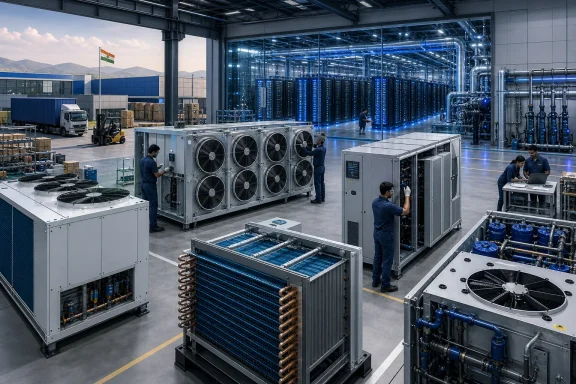 What the Pune factory is expected to make
The Pune site sits in Bhadalwadi in Maharashtra’s Maval area and represents a €5.7 million investment, according to FläktGroup. The company says the facility has 13,826 square metres of shop-floor space, with more than 12,000 square metres reserved for production, alongside engineering, offices and support functions.
Its planned catalogue is much broader than conventional commercial air conditioning. FläktGroup identifies air-handling units, fan-wall units, computer-room air handlers and computer-room air conditioners, coolant distribution units, and heating and cooling coils. That mix is relevant because AI facilities are steadily moving away from the assumptions behind traditional enterprise server-room cooling.
Air-handling units condition and move air through a wider building system. Fan-wall systems use arrays of fans that can offer redundancy and higher airflow in large halls. CRAH equipment typically uses chilled water to regulate temperature and humidity in the white space, while CRAC systems are self-contained, direct-expansion precision air-conditioning units. Coolant distribution units occupy a different place in the stack: they isolate and manage the liquid loop supplying direct-to-chip cooling equipment.
For Windows Server, Hyper-V, Azure Stack HCI and enterprise GPU clusters, the distinction is not academic. An office-server-room design based around a handful of rack-mounted servers has little in common with an AI deployment where racks can concentrate far more power and produce correspondingly harder-to-remove heat. The Pune plant’s product list signals that FläktGroup wants to sell into both the conventional air-cooled estate and the emerging liquid-assisted or liquid-cooled data-centre buildout.
Convergence Now describes the plant as producing AHUs, fan-wall units and CRAHs, but FläktGroup’s May announcement lists additional planned output, including CRACs, CDUs, and coils. Buyers should therefore avoid treating the narrower published list as the plant’s confirmed day-one production lineup. FläktGroup has not publicly broken down which products are currently on the line, which are being ramped later, or which are approved for export.
Samsung bought the capability before it expanded it
Samsung completed its acquisition of FläktGroup on November 6, 2025, after announcing the €1.5 billion deal in May that year. Samsung said it would retain FläktGroup as an independent subsidiary, including its existing name, leadership, staff and facilities, while using the group’s production and sales operation to expand research and strengthen its supply chain.
The Pune investment is one of the first tangible tests of that strategy. Samsung is widely known to IT buyers for devices, displays, storage and semiconductor components; FläktGroup gives it a route into the less visible but increasingly valuable physical infrastructure behind data centres. A company selling components to AI systems can gain more influence over deployments when it also sells the environmental systems needed to keep those systems online.
Samsung’s acquisition announcement explicitly identified commercial HVAC and data-centre cooling as expansion targets. It also pointed to potential integration between FläktGroup’s FläktEdge HVAC controls and Samsung’s b.IoT building-management platform, as well as SmartThings Pro. The Pune announcement itself does not establish that any such integrated monitoring or control offering is shipping from India, nor does it provide interoperability details, security documentation, supported protocols, or availability dates.
That absence deserves more attention than broad “AI cooling” language. Facilities teams integrating cooling controls into an enterprise management network will need to know whether a given deployment supports BACnet, Modbus, SNMP, vendor APIs or segregated management networks; how remote access is secured; how firmware is maintained; and whether alarms can be correlated with data-centre infrastructure management systems. Samsung’s ownership does not automatically create a unified control plane.
The local-manufacturing promise is real, but lead times remain unproven
FläktGroup says Pune will serve India, Asia and Southeast Asia, while its established Greater Noida operation continues to serve the Indian market. The stated benefit is faster response to demand, more customization and locally manufactured equipment for next-generation data centres. That is plausible: producing large air-handling and precision-cooling equipment closer to a customer can reduce transport complexity, import exposure and the time required to replace damaged or late-arriving hardware.
But neither FläktGroup nor Samsung has published the operational data needed to measure that claim. There is no stated baseline lead time from the existing production network, no promised improvement in delivery time, no public list of locally sourced components, and no public warranty or field-service expansion tied specifically to Pune. An annual ceiling of 6,500 units also cannot be translated into cooling capacity without a model-level breakdown; one compact unit and a large custom air handler are not comparable measures of output.
The distinction is important for enterprise procurement. A factory capacity announcement is not a commitment that a particular project will receive equipment faster. Operators should seek written answers on factory allocation, model availability, spare-parts stocking, commissioning support, service coverage, controls integration and replacement-unit turnaround before assuming Pune eliminates supply risk.
The official May announcement also says the company set up a hiring and training programme that included exposure at its global headquarters and existing Indian sites, practical manufacturing training, standard operating procedures and systems training. That is useful evidence that FläktGroup is trying to transfer established manufacturing processes rather than simply add floor space. It is not, however, a published quality-performance record for equipment produced at the new facility.
India’s data-centre buildout gives the plant a clear target
The factory’s commercial logic is stronger than the thin August coverage suggests. India’s Ministry of Electronics and Information Technology said in March that national data-centre capacity had risen from roughly 375 MW in 2020 to about 1,500 MW by 2025. It projected data-centre electricity demand could reach 13.56 GW by 2031–32. The ministry also said operators are adopting direct-to-chip liquid cooling, adiabatic cooling and immersion cooling to reduce water use.
Pune is not India’s largest data-centre cluster, but it is an established IT market with a growing cloud and colocation presence. Cushman & Wakefield estimated Pune had 112 MW of operational data-centre capacity in the first half of 2025, plus 36 MW under construction and 154 MW of planned supply. Those figures are estimates, not government statistics, but they illustrate why a cooling manufacturer would position a factory there rather than treat it purely as a domestic commercial-HVAC play.
The more consequential demand signal comes from the density of AI infrastructure. General-purpose cloud capacity can often use familiar cooling architectures, even if at large scale. GPU-heavy training and inference installations push rack densities upward, force closer attention to heat rejection and water usage, and raise the cost of a cooling fault. Hardware refreshes that add accelerators can turn facilities engineering into the gating item for a server deployment.
For Windows administrators and infrastructure architects, the practical lesson is to bring facilities requirements into the design stage much earlier. A virtualisation or GPU project may be technically ready long before its rack power, cooling topology, floor loading, chilled-water capacity, control-network access and emergency-response plan are ready. The server, storage and networking bill of materials is only part of the deployment.
The August reports leave the key operating facts unanswered
The two submitted reports confirm that the Pune development is being promoted as part of Samsung’s AI-data-centre push, and their core details align with FläktGroup’s original plan: the 13,826-square-metre site, regional export ambitions and eventual 6,500-unit annual capacity. Yet their most newsworthy-sounding additions need more care.
Convergence Now says equipment installation moved to mass production in six months and reports an inauguration attended by Samsung Digital Appliance executive vice president Cheolgi Kim and FläktGroup chief executive David Dorney. FläktGroup’s May release does not mention either a six-month installation-to-production schedule or that later ceremony, and Samsung’s global newsroom does not appear to have published a matching August announcement. The report may be describing a real internal milestone, but it remains single-source reporting rather than independently documented evidence of the plant’s present output.
More significantly, neither report answers the questions data-centre customers need answered: whether the facility is operating at partial or full capacity; which models are currently shipping; whether CDUs are in local production; where key components are sourced; how export allocations will be prioritized; and whether the factory has altered quoted lead times. Until Samsung or FläktGroup releases those details, the factory should be viewed as new capacity being ramped, not as a proven remedy for cooling-equipment shortages.
The Pune plant gives Samsung a physical foothold in one of the fastest-growing markets for AI infrastructure. Its real test begins when customers can measure the promised improvements in availability, delivery and service—not when another outlet republishes the opening announcement.