
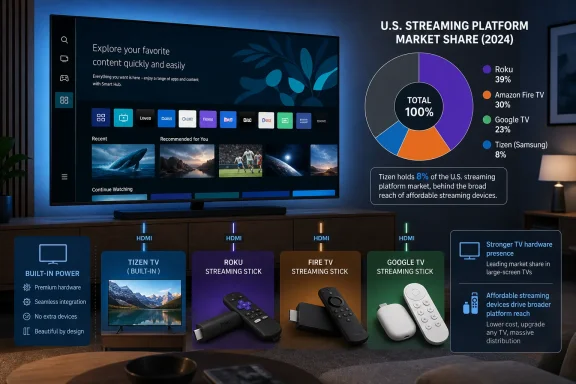
The result is a useful reminder that TV hardware leadership and living-room software reach are no longer the same contest. Samsung ships Tizen exclusively with its own televisions; Roku, Fire TV and Google TV can reach consumers through both TV maker partnerships and inexpensive HDMI streaming sticks, boxes and dongles.
 Dedicated streamers change the math
Roku’s first-place position reflects distribution as much as the interface itself. A low-cost Roku Streaming Stick can turn an older television, a basic hotel set, or a display with a weak built-in smart-TV platform into a streaming endpoint without replacing the screen.
Amazon and Google follow a similar model. Fire TV is available in Amazon’s own devices and licensed televisions, while Google TV spans Chromecast-class hardware and sets from multiple vendors. That gives each platform an upgrade path separate from the TV replacement cycle.
Tizen has no equivalent mass-market add-on device. Buying a Samsung TV means buying Tizen, but a household that already owns a Samsung set can still connect a Roku, Fire TV Stick, Google TV device, Apple TV, game console, or Windows PC to an HDMI port and largely bypass the built-in platform.
Samsung’s TV footprint still matters
The 8% figure should not be read as a count of Samsung television sales, nor as a verdict on Tizen’s app availability. It measures platform share across a broader U.S. installed base that includes standalone streaming hardware, where competing operating systems have an advantage.
For Windows users, that fragmentation is familiar: the display may be Samsung hardware, while the actual media experience is driven by another device. A compact Windows 11 PC, for example, can coexist with—or replace—the TV’s native apps, particularly for local media libraries, browser-based services, emulation, and software unavailable in a TV app store.
Samsung remains a major force in the television business, but The Streamable’s analysis suggests that the strategic value is shifting toward the software layer viewers use every day. Without a standalone Tizen streaming device or wider third-party TV licensing, Samsung’s operating system is likely to remain tied closely to the company’s own TV shipment volume rather than the full U.S. streaming market.
