
The partnership arrives as the United States confronts a long-running gap between its strategic need for more naval and commercial vessels and the practical limits of its domestic shipbuilding base. Saronic brings expertise in autonomous surface vessels and a fast-growing Gulf Coast manufacturing footprint. Samsung Heavy Industries brings decades of experience in large-scale ship design, vessel construction, production automation, and industrial engineering.
Together, the companies intend to explore next-generation maritime platforms for government and commercial customers, while also improving the infrastructure required to build them in meaningful volume. Their stated focus includes maritime autonomy, AI-powered digital tools, and robotics-based production automation across Saronic facilities.
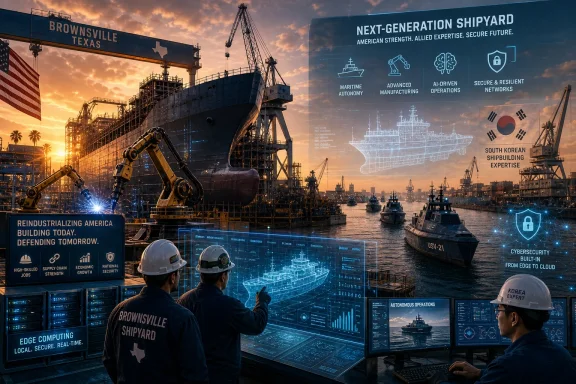
For the Windows and enterprise IT communities, the announcement matters because the modern shipyard is becoming a deeply connected industrial computing environment. A vessel may still begin with steel, welding, machining, pipes, engines, and electrical systems, but its design, manufacture, testing, maintenance, and operation are increasingly defined by software platforms, edge computing, data systems, robotics, simulation tools, and cyber-resilient networks.
 A Partnership Built Around Two Different Strengths
Saronic has positioned itself as a specialist in autonomous maritime systems, particularly unmanned and autonomy-capable surface vessels. Its core proposition is not simply to build boats that use software. It is to develop vessels in which sensing, navigation, mission systems, communications, remote supervision, and manufacturing practices are designed together from the beginning.
Samsung Heavy Industries, meanwhile, represents the other side of the equation: industrial scale. Large vessels are among the most complex manufactured products in the world. Building them reliably requires a supply chain, production planning discipline, fabrication capacity, workforce depth, and quality-control culture that cannot be created overnight.
The value of the partnership rests on whether those strengths can be made complementary rather than merely adjacent.
Saronic’s Autonomy-First Approach
An autonomy-first maritime company approaches vessel design differently from a traditional shipbuilder adding automation at the end of a program. Software requirements affect hull configuration, power distribution, sensor placement, communications architecture, onboard computing, maintenance access, and even the physical layout of production.
That approach can offer important benefits:
- Faster upgrade cycles for mission software and autonomy algorithms.
- Reduced crew requirements for certain missions and vessel classes.
- Persistent operations in roles that are dangerous, repetitive, or resource-intensive.
- More flexible fleet designs, potentially using combinations of crewed, optionally crewed, and uncrewed vessels.
- A stronger link between manufacturing data and operational data, allowing feedback from deployed vessels to inform future production.
The difficult part is that autonomy at sea is not a consumer technology problem. Maritime systems must deal with rough weather, saltwater corrosion, intermittent connectivity, crowded waterways, sensor uncertainty, electronic interference, changing regulations, and the high consequence of navigation failures.
A vessel that performs well in a controlled test environment is not necessarily ready for sustained operation in congested ports, contested waters, offshore energy zones, or commercial shipping lanes.
Samsung Heavy Industries’ Industrial Foundation
Samsung Heavy Industries has experience in the kind of high-volume, high-complexity shipbuilding that Saronic needs as it expands from smaller autonomous platforms toward larger maritime systems. The company’s expertise in vessel design and production automation could help Saronic establish more standardized, repeatable manufacturing processes.
This is especially significant because the U.S. shipbuilding challenge is not limited to innovation. The harder problem is repeatable output.
America can produce highly sophisticated vessels, but programs often face delays, workforce constraints, supply bottlenecks, and cost escalation. A new shipbuilding strategy needs to deliver both technical capability and predictable throughput. That means treating the shipyard as a digitally managed production system rather than a collection of isolated trades and equipment.
Samsung Heavy Industries’ role could extend beyond advisory support. If the collaboration becomes operationally deep, it may influence production-line design, modular construction methods, robotics deployment, automated inspection, material flow, and industrial data standards.
Port Alpha Is the Centerpiece of Saronic’s Expansion Strategy
The Samsung partnership builds on Saronic’s broader effort to create a new U.S. shipbuilding ecosystem. Its most visible project is Port Alpha, a planned multi-billion-dollar next-generation shipyard in Brownsville, Texas.
The site is intended to become a major production hub for autonomous and autonomy-capable vessels, with the ability to expand as demand grows. The project is expected to create up to 10,000 jobs over the next decade, spanning traditional shipyard trades and advanced technical disciplines.
Those roles are expected to include:
- Welders, machinists, electricians, pipefitters, and crane operators.
- Production planners and quality-assurance specialists.
- Naval architects and marine engineers.
- Robotics technicians and industrial automation engineers.
- Software developers, data engineers, and systems architects.
- Cybersecurity professionals and network administrators.
- Supply-chain, logistics, and procurement specialists.
- Test engineers and autonomous-systems operators.
The scale of the workforce target deserves careful attention. A promise of 10,000 jobs is economically significant, especially for the Rio Grande Valley. But a headline figure is not the same as an instantly available workforce. Shipbuilding labor takes time to develop, and advanced manufacturing positions require structured training, competitive compensation, reliable career paths, and relationships with technical schools, colleges, unions, contractors, and regional employers.
A Shipyard Designed as a Digital Manufacturing Platform
The phrase “AI shipyard” can sound like marketing shorthand, but it describes a genuine industrial shift when used precisely. A modern digital shipyard connects design data, production planning, material tracking, robotic equipment, inspection systems, maintenance records, and operational feedback into a common information environment.
In practical terms, that could involve:
- Digital twins that model vessels, production equipment, workflows, and facility capacity.
- Computer-aided design and manufacturing systems that send engineering changes directly into fabrication planning.
- Robotic welding, cutting, painting, and material-handling systems that improve repeatability and reduce hazardous manual work.
- Machine-vision inspection for weld quality, dimensional accuracy, surface defects, and component identification.
- Industrial Internet of Things sensors that monitor tools, cranes, machinery, inventory, energy consumption, and environmental conditions.
- Predictive maintenance platforms that identify equipment problems before they disrupt critical production schedules.
- Secure edge-computing infrastructure that processes high-volume operational data close to the factory floor.
- AI-assisted scheduling tools that help manage component availability, labor allocation, production bottlenecks, and delivery timelines.
Windows-based enterprise systems are likely to remain important throughout this environment. Industrial facilities commonly rely on a combination of Windows workstations, engineering applications, manufacturing execution systems, industrial PCs, identity platforms, endpoint-management tools, and hybrid cloud services.
That dependence creates opportunity, but it also creates a security obligation. A connected shipyard cannot treat cybersecurity as a separate IT department concern. It has to be embedded in engineering, operations, procurement, and executive planning.
The $300 Million Franklin Investment Provides a Near-Term Test Bed
While Port Alpha represents the long-term vision, Saronic’s Franklin, Louisiana, shipyard provides a more immediate manufacturing proving ground. The company is investing an additional $300 million to expand capacity at that facility.
The expansion is expected to add significant production space, new assembly capability, and increased room for large-vessel work. It also gives Saronic a functioning industrial site where advanced manufacturing techniques can be tested and refined before being applied at a far larger Texas operation.
This matters because greenfield megaprojects carry substantial execution risk. Designing a new shipyard is easier than making it productive. The Franklin site offers a way to gain practical experience with workforce development, automated processes, digital production management, component supply, quality systems, and autonomous-vessel integration.
Why Incremental Scale Matters
The most credible path toward a high-output American shipyard is not to wait for a giant facility to open and then attempt to solve every problem at once. It is to build operational knowledge at smaller or existing sites, establish suppliers, train teams, validate workflows, and gradually standardize production.
Franklin can play that role for Saronic. Its expansion may offer a useful test of several key questions:
- Can the company recruit and retain skilled maritime workers?
- Can it adapt autonomous-vessel designs for repeatable production?
- Can robotics and digital tools improve output without creating new bottlenecks?
- Can suppliers deliver components at the speed required?
- Can production data be collected, protected, and used effectively?
- Can the company maintain quality as vessel size and complexity rise?
The answers will be more important than promotional language. If Saronic can show reliable production performance in Louisiana, it will strengthen the case that Port Alpha can become a durable industrial asset rather than an ambitious concept dependent on future financing and future demand.
Reindustrialization Will Depend on More Than Automation
The partnership has been framed as part of a broader effort to rebuild American maritime power and the domestic maritime workforce. That framing is reasonable, but it needs to be understood in concrete terms.
Reindustrialization is not simply the installation of robots inside a shipyard. It requires an entire ecosystem: trained people, equipment makers, component suppliers, software vendors, ports, dry docks, transportation links, educational partnerships, financing, regulatory alignment, and long-term customer commitments.
Automation can expand capacity and improve quality, but it cannot eliminate the need for skilled workers. In fact, highly automated shipbuilding often increases demand for workers who can install, operate, maintain, calibrate, program, secure, and troubleshoot complex industrial systems.
The Workforce Will Be Hybrid by Design
The most successful workforce model for an autonomy-focused shipyard will combine established maritime trades with digital disciplines.
A welder may work alongside a robotic welding cell. A naval architect may rely on digital-twin data to resolve production issues before physical construction begins. A maintenance technician may use augmented instructions or machine telemetry to diagnose a problem. A cybersecurity analyst may need to understand how endpoint security choices affect a production line that cannot tolerate downtime.
That hybrid structure creates a compelling opportunity for communities around Brownsville and Franklin. It also creates a training challenge.
The relevant skills are likely to include:
- Advanced welding and precision fabrication.
- Industrial electrical systems and controls.
- Programmable logic controllers and robotics.
- Computer-aided design and digital manufacturing.
- Marine systems integration.
- Network administration and industrial cybersecurity.
- Data analysis and quality-management platforms.
- Autonomous-systems operations and testing.
If the partnership is to create sustained economic value, the training pipeline must start early. High schools, technical colleges, universities, veterans’ programs, and local employers will need to coordinate around credentials that lead to actual jobs rather than generic workforce-development promises.
AI-Enabled Shipbuilding Brings a New Cybersecurity Threat Model
A digitally connected shipyard creates a much broader attack surface than a traditional facility. The same systems that improve productivity can become pathways for disruption if they are poorly secured.
In an advanced shipyard, attackers may target business systems, engineering workstations, supplier portals, cloud accounts, software repositories, industrial controllers, remote-support tools, or vessel test networks. The consequences can range from stolen intellectual property and delayed production to physical damage, compromised quality records, or manipulation of safety-critical systems.
The Risks Are Not Theoretical
Autonomous maritime platforms combine several sensitive technology domains:
- Navigation and positioning.
- Machine vision and sensor fusion.
- Communications links.
- Onboard computing.
- Remote command interfaces.
- Mission-planning software.
- Software update mechanisms.
- Industrial production systems.
Each one must be protected from unauthorized access, data poisoning, spoofing, ransomware, software supply-chain attacks, and insider threats. A vulnerability in a factory network can affect production. A vulnerability in a vessel’s software stack can affect mission reliability. A weak link between the two could expose both.
For a company operating in defense-adjacent markets, zero-trust architecture, strong identity management, segmented networks, code-signing controls, security monitoring, secure software development practices, and rigorous vendor assessment are no longer optional best practices. They are foundational requirements.
Windows Environments Need Special Attention
Windows will almost certainly remain prevalent across the business and engineering sides of advanced shipbuilding, from office productivity and enterprise resource planning to CAD workstations, device management, developer tools, and manufacturing-adjacent systems.
That makes disciplined Windows management essential. Organizations involved in industrial modernization should prioritize:
- Rapid deployment of security updates and vulnerability mitigations.
- Hardware-backed identity protections and multifactor authentication.
- Privileged-access controls for engineers, administrators, and contractors.
- Application allowlisting on high-value operational workstations.
- Network segmentation between corporate IT and operational technology.
- Continuous endpoint detection and response coverage.
- Immutable backups and tested recovery plans.
- Controlled access to removable media and engineering laptops.
- Detailed asset inventories that include unmanaged industrial endpoints.
The productivity advantage of connected manufacturing disappears if an incident stops production for days or forces a facility to operate manually. Cybersecurity therefore has to be measured not only as a compliance requirement, but as a direct contributor to manufacturing resilience.
The Strategic Promise Is Real, but So Are the Execution Risks
The Saronic-Samsung Heavy Industries partnership makes strategic sense on paper. Saronic needs industrial scale, advanced production methods, and global shipbuilding experience. Samsung Heavy Industries gains an opportunity to help shape a growing U.S. market for autonomous maritime systems and digitally integrated shipbuilding.
But the distance between a partnership announcement and an operationally successful shipyard is substantial.
The Most Important Strengths
The deal has several notable advantages.
- Complementary capabilities: Saronic’s autonomy focus and Samsung’s shipbuilding experience address different parts of the same industrial challenge.
- Clear alignment with market trends: Navies, coast guards, offshore operators, and commercial maritime organizations are all evaluating more automated and data-driven vessel operations.
- Domestic capacity expansion: New U.S. shipyard investment could relieve pressure on an industry where capacity is constrained.
- Workforce upside: The planned jobs combine established skilled trades with higher-value technical roles.
- Manufacturing modernization: Robotics, digital tools, and improved production management can potentially improve schedule performance and quality.
- Allied industrial collaboration: Cooperation between U.S. and South Korean companies can strengthen supply-chain knowledge sharing and maritime technology ties.
The Risks That Cannot Be Ignored
The project also carries meaningful risks.
- Capital intensity: Shipyards require enormous upfront investment in land, docks, fabrication equipment, cranes, buildings, utilities, workforce training, and supplier integration.
- Schedule risk: Construction, permitting, equipment delivery, hiring, and production ramp-up can all delay output.
- Labor shortages: Skilled welders, electricians, naval architects, machinists, automation engineers, and cybersecurity specialists are already in high demand.
- Supply-chain exposure: A modern vessel depends on specialized components that may have limited domestic sources or long lead times.
- Autonomy certification and regulation: Autonomous vessels must satisfy evolving operational, legal, safety, and insurance requirements.
- Cybersecurity exposure: Expanded connectivity creates more pathways for espionage, sabotage, ransomware, and software compromise.
- Demand uncertainty: Government procurement priorities can shift, while commercial customers may take time to adopt new maritime operating models.
- Technology integration complexity: Combining shipbuilding processes with robotics, AI tools, and autonomy software is harder than implementing any one component independently.
The job projections should also be read as targets, not guarantees. Major industrial developments often create optimism long before full operations begin. Their ultimate local impact depends on project delivery, wages, local hiring, retention, training quality, housing availability, infrastructure, and whether the company can sustain a production backlog.
What Success Would Look Like
A successful outcome would not be measured solely by the opening of Port Alpha or by the number of jobs announced. It would be visible in a series of practical achievements.
First, Saronic would demonstrate that it can produce autonomous and autonomy-capable vessels on a predictable schedule. Second, it would establish a reliable supply chain that can support repeated builds rather than one-off demonstrations.
Third, the company would prove that its digital tools improve quality and cycle time instead of adding layers of complexity. Fourth, it would cultivate a stable regional workforce with credible advancement opportunities for both traditional trades and technical professionals.
Finally, it would build cybersecurity and software assurance into every stage of vessel and shipyard design. In a world of increasingly connected production systems, secure operations are inseparable from industrial competitiveness.
From Prototype Thinking to Fleet Thinking
The larger strategic shift is from prototype thinking to fleet thinking. A prototype proves a concept. A fleet requires production capacity, field support, secure updates, spare parts, trained operators, maintenance plans, reliable communications, and the ability to evolve technology without grounding the entire program.
That is where the Saronic-Samsung partnership could become meaningful. If it helps translate autonomous maritime capability from a startup-led innovation model into a repeatable industrial system, it could influence how the United States approaches future naval and commercial shipbuilding.
The opportunity is not simply to build more vessels. It is to build a more adaptable maritime industrial base—one that uses software, AI, robotics, and skilled labor as integrated parts of the same production strategy.
The Bottom Line
Saronic’s partnership with Samsung Heavy Industries represents an ambitious bid to connect maritime autonomy with industrial-scale shipbuilding in the United States. The combination of Port Alpha in Brownsville, expanded capacity in Franklin, and access to Samsung’s shipbuilding and production-automation experience creates a potentially significant platform for growth.
Its success, however, will depend on execution rather than aspiration. Saronic must turn investment announcements into functioning facilities, workforce pipelines, dependable suppliers, secure digital infrastructure, and vessels that can perform reliably in real operating conditions.
For the technology sector, the announcement is another reminder that AI is moving beyond desktops, data centers, and chat interfaces. It is becoming part of how physical infrastructure is designed, manufactured, secured, and operated. In the shipbuilding industry, that change may determine not only how quickly vessels are built, but whether the United States can restore the industrial capacity needed to build them at scale.
