
That warning is particularly striking coming from Nadella. Microsoft is not an outside critic of the frontier-model economy. It remains one of its most important participants, with Azure serving as a major enterprise AI platform, Microsoft Foundry offering a broad model catalog, and Microsoft maintaining deep commercial relationships across the AI ecosystem. Yet the company’s chief executive is now arguing that the ultimate enterprise asset may not be the model itself, but the private learning loop that develops around it. Microsoft’s recent work with Mistral reinforces that direction: model choice, controlled deployment environments, and governance are being positioned as central enterprise requirements rather than secondary implementation details.
For Windows administrators, CIOs, security teams, developers, and business leaders, this is not merely a philosophical debate about open source. It is a practical architecture issue involving data governance, vendor lock-in, identity controls, observability, cloud contracts, model routing, and the future value of proprietary business processes.
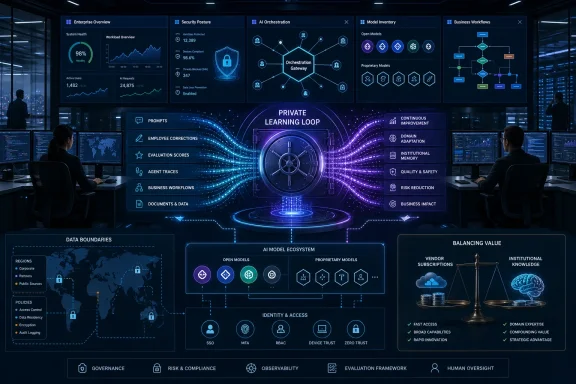 The Real Asset Is No Longer Just the Data
For years, enterprise technology strategy focused on collecting, securing, classifying, and extracting value from data. Customer records, source code, manufacturing logs, financial models, contracts, clinical documents, and internal knowledge bases were understood as strategic assets. The cloud era made those assets more accessible, but it also made governance more complicated.
Generative AI adds a new category of corporate value: the record of how an organization applies judgment.
A single prompt may be mundane. A single model response may be disposable. But the aggregate of thousands or millions of interactions can reveal far more:
- Which customer issues require escalation.
- Which legal clauses the organization accepts or rejects.
- Which product defects matter most.
- Which engineering tradeoffs experienced staff consistently choose.
- Which sales objections convert into successful deals.
- Which compliance rules override a seemingly helpful model answer.
- Which internal tools, documents, databases, and workflows are needed to complete a task.
- Which responses employees correct—and why they correct them.
Nadella’s concern is that these interactions should not be treated as digital exhaust. In reporting on his comments, the Microsoft CEO describes prompts, tool use, and especially human corrections as the material from which models and AI systems learn; a correction can encode institutional know-how that took years to acquire. Fortune’s account of the argument captured the core contention: an enterprise can expose value not only by uploading documents, but by repeatedly demonstrating what a “good” answer looks like inside its own business.
That distinction matters. Traditional data-loss prevention programs are designed to detect obvious sensitive content: Social Security numbers, payment card data, protected health information, customer identifiers, or confidential documents. They are less prepared to identify the strategic value embedded in a sequence of nuanced corrections to an AI assistant.
An employee who tells a coding assistant, “Use our service layer, never call this legacy API directly, add this audit event, and handle these exceptions according to the regulatory workflow,” may not have copied a secret document into the conversation. But they have communicated a distilled version of internal architecture, operational constraints, and accumulated engineering judgment.
In other words, the sensitive material may be the pattern of work itself.
Nadella’s “Pay Twice” Argument—and Its Important Limits
Nadella’s warning is compelling because it identifies a genuine long-term issue: the economic value generated by enterprise AI does not automatically remain with the enterprise. If a company’s staff continuously refine agent workflows, create evaluations, annotate outputs, and document preferred decisions, that process can become a strategic asset. The organization should be able to preserve, reuse, audit, and improve that asset independently of any one model provider.
His criticism of restrictive distillation terms also goes to the heart of the new AI power imbalance. In machine learning, distillation generally means using the behavior or outputs of a stronger model to help train a smaller or different model. Academic work has shown both the appeal and the limits of this approach; imitating a proprietary model can improve a weaker system in some contexts, but it does not reliably reproduce the original model’s broader capabilities. A widely cited research paper on proprietary-model imitation makes clear that distillation is not a magic shortcut to frontier performance.
Still, Nadella’s policy point is broader than copying a competitor’s model. He is arguing that businesses should be able to capture the knowledge generated through their own usage: their prompts, evaluations, feedback, workflows, retrieval patterns, tool calls, and successful outcomes. They should not be forced into a future where the model vendor owns the durable intelligence while the customer only rents access to it.
That position deserves attention—but it also requires precision.
Enterprise prompts are not automatically training data
The most serious version of the “Trojan horse” concern suggests that every interaction with a proprietary model is automatically absorbed into the vendor’s training corpus. That is too broad, particularly for properly configured business services.
OpenAI states that it does not train its models on organization data from ChatGPT Enterprise, ChatGPT Business, ChatGPT Edu, or its API platform by default; training use requires an explicit opt-in. OpenAI’s enterprise data privacy statement and its API data-controls documentation also describe retention and abuse-monitoring controls that enterprise buyers should evaluate carefully.
Microsoft makes similarly strong statements for Azure Direct Models in Microsoft Foundry. Its documentation says customer prompts, completions, embeddings, and training data are not available to other customers or to model providers, and are not used to train generative foundation models without customer permission or instruction. Microsoft Foundry’s data privacy documentation also states that customer data is not used to improve Microsoft or third-party products without explicit permission.
These commitments matter. Enterprises should not ignore them, and it would be inaccurate to imply that using a commercial AI API necessarily means a vendor is secretly retraining on every customer interaction.
The risk is broader than model training
Nadella’s larger point remains relevant even where the contract prohibits foundation-model training. Data can still be processed, logged, retained, monitored for abuse, stored in stateful features, sent to connected tools, or handled under different regional and product-specific conditions. OpenAI’s API documentation, for example, explains that abuse-monitoring logs can contain customer content and associated metadata, with default retention periods that may vary under approved controls and legal requirements. OpenAI’s data-control documentation is therefore not a reason to skip due diligence; it is a reason to conduct it at a feature-by-feature level.
The same principle applies to Azure-hosted third-party models. Microsoft’s documentation for Claude models in Foundry distinguishes between models hosted on Azure infrastructure and models hosted on Anthropic infrastructure, while noting that Anthropic may review customer content on an exceptions-only basis for potential safety violations, subject to applicable terms. Microsoft’s Claude data-handling guidance shows why the phrase “we use a model through Azure” is not enough by itself to describe a workload’s data path.
The practical risk is therefore not limited to unauthorized training. It includes:
- Retention risk: prompts or outputs may persist longer than architects assume.
- Feature risk: assistants, threads, file storage, memory, evaluation, fine-tuning, and tracing features can have distinct data lifecycles.
- Access risk: safety monitoring and abuse investigation may involve automated analysis or authorized human review under defined circumstances.
- Integration risk: agents may pass sensitive context to SaaS tools, internal APIs, retrieval systems, or external services.
- Lock-in risk: model-specific prompt formats, tool schemas, agent behavior, and evaluation data may become difficult to move.
- Strategic risk: an organization may fail to retain the feedback data necessary to improve its own systems over time.
The central lesson is simple: “not used for training” is essential, but it is not the same as “fully controlled by the customer.”
Proprietary Learning Environments: A Better Enterprise Pattern
Nadella’s answer is to build proprietary learning environments—private spaces in which the enterprise owns the operational memory and feedback that make AI useful. This is a more useful framing than a simplistic cloud-versus-on-premises argument.
A proprietary learning environment does not necessarily mean training a massive foundation model from scratch. For most organizations, that would be unnecessarily expensive and technically unrealistic. It means creating a controlled system around models where the business retains its own context, evaluations, agent traces, policies, and improvement data.
What the learning environment should contain
A mature enterprise AI environment should keep the following assets under company governance:
- Prompt and policy libraries
System instructions, reusable task templates, safety rules, tone guidelines, and domain constraints should live in version-controlled repositories—not only inside a vendor console. - Private retrieval and grounding data
Documents, databases, tickets, product specifications, and knowledge graphs should remain governed by the organization’s access controls, retention policies, and classification rules. - Evaluation datasets
A private collection of representative tasks and expected outcomes is one of the strongest defenses against model churn. It defines what “good” means for the company. - Feedback and correction traces
When a subject-matter expert corrects an AI response, that feedback should enrich an enterprise-owned dataset or workflow, subject to privacy and labor policies. - Agent workflow definitions
Tool permissions, approval requirements, escalation paths, and business rules should be portable artifacts rather than opaque provider-specific behavior. - Observability records
Organizations need to know which model was used, which prompt version ran, what data was retrieved, which tools were called, how much the task cost, and whether the output met quality standards. - Security and identity controls
A learning environment must integrate with existing identity systems, conditional access rules, least-privilege permissions, endpoint controls, and auditing.
For Windows-centered enterprises, this naturally connects with familiar management disciplines. Microsoft Entra ID, Microsoft Purview, Defender, Intune, Azure policy controls, and Windows endpoint management are not substitutes for AI governance, but they can become important components of an AI control plane when correctly integrated.
Tenant boundaries matter—but architecture still matters more
The phrase “within the tenant boundary” has become appealing because it suggests a recognizable control perimeter. Yet a tenant boundary alone does not solve the problem. An agent may remain inside a Microsoft tenant while still using external model APIs, third-party plugins, public web tools, shared SaaS applications, or vendor-operated storage features.
The more meaningful question is whether the enterprise can answer, with evidence:
- Where does each class of data travel?
- Which systems persist it?
- Who can access it?
- Which features create copies?
- How long are those copies retained?
- Can the organization export, delete, and audit the resulting records?
- Can the model be replaced without rebuilding the business logic and losing the learning history?
If the answer is unclear, the organization does not yet have a proprietary learning environment. It has a collection of AI experiments.
Orchestration Is Becoming the New Control Plane
Nadella’s second major recommendation is the use of orchestration layers that separate enterprise applications from any one AI provider. This is among the most practical parts of his argument.
An orchestration layer can route requests to different models based on task type, cost, latency, regional requirements, safety needs, or availability. A short document classification job may not need an expensive frontier model. A sensitive legal summarization task may require a controlled deployment and a model with an approved data-handling configuration. A complex coding task may justify using a premium model, but only after security checks and contextual filtering.
This creates a model portfolio rather than a single-vendor dependency.
Vercel’s AI Gateway illustrates the direction of the market. Its platform presents access to hundreds of models through a unified interface and supports routing choices based on availability, cost, or latency; it also advertises failover and compatibility with widely used API formats. Vercel’s AI Gateway documentation shows how gateways are turning model switching from a major rewrite into a configuration and routing decision.
The company also promotes controls such as zero-data-retention provider routing, configurable per request or across teams. Those capabilities do not eliminate the need for independent validation, contract review, and security assessment, but they demonstrate why gateways have become strategically important. A gateway can turn a model from a permanent platform dependency into an interchangeable component.
OpenRouter’s growth reflects the same shift. Its own research platform describes a unified inference layer spanning hundreds of models, while an associated academic analysis examined more than 100 trillion tokens of real-world usage metadata to study demand, substitution, and model choice. OpenRouter’s usage-data overview and the related research paper reinforce the idea that AI buyers are increasingly multi-homing—using more than one model or provider rather than committing to a single permanent default.
A gateway is not a governance strategy
There is a temptation to treat an AI gateway as a turnkey answer to lock-in. It is not.
A gateway can centralize routing, observability, spend controls, and API compatibility. But it can also become another critical dependency. Organizations should assess whether the gateway itself stores prompts, metadata, traces, credentials, or files; whether it supports customer-managed keys; which providers it can route to; how it handles outages; and whether logs are exportable in open formats.
The correct objective is not simply to add another intermediary. It is to ensure that the enterprise owns the policies and data required to make AI decisions—regardless of which gateway, cloud, or model is active.
Why Open Models Are Gaining Enterprise Attention
Nadella did not frame his message as a direct call to abandon proprietary models. In fact, Microsoft’s strategy remains fundamentally multi-model, and its Foundry platform is designed to give customers access to proprietary and open-weight options. But his emphasis on control is likely to accelerate enterprise interest in open models, self-hosted inference, and private deployments.
The reasons are straightforward:
- Data locality: an organization can run inference in its own environment, subject to its own network and access controls.
- Cost predictability: high-volume, repetitive tasks may be cheaper on efficiently deployed open-weight models than on per-token frontier APIs.
- Customization: organizations can fine-tune, adapt, evaluate, and integrate models around domain-specific work.
- Portability: a model can be moved between supported infrastructure providers or deployed on-premises where appropriate.
- Resilience: enterprises can reduce dependence on a single provider’s pricing, rate limits, model withdrawals, or policy changes.
The trend should not be overstated. Frontier proprietary models often retain meaningful advantages in reasoning, multimodal capability, reliability, tool use, safety research, and managed-service convenience. Open models are not automatically cheaper once GPU capacity, networking, patching, monitoring, inference optimization, compliance, and incident response are included.
The right question is not whether an open model can replace every commercial model. It is whether it can handle a defined class of workloads well enough to justify the added control.
A sensible model portfolio may look like this:
- Open-weight, privately deployed models for routine internal classification, extraction, retrieval, summarization, and document workflows.
- Commercial API models for high-complexity reasoning, advanced coding, multimodal analysis, or capacity bursts.
- Specialized fine-tuned models for repeatable, high-volume domain tasks.
- Human approval workflows for decisions involving legal, financial, clinical, safety, or personnel consequences.
That approach fits Nadella’s larger point: the enterprise should own the intelligence-producing system even when it rents a portion of the intelligence supply.
Microsoft’s Incentive Cannot Be Ignored
Nadella’s argument is strategically sound, but it is not commercially neutral.
Microsoft benefits when enterprises locate their AI governance, identity, storage, monitoring, and orchestration layers in Azure. A customer that uses several different models may reduce dependence on a single AI laboratory, yet still deepen its dependence on Microsoft’s cloud, security tools, and management plane.
That does not invalidate the warning. It simply means enterprises should separate the principle from the vendor prescription.
The principle is that organizations should control their learning loop, data boundaries, evaluations, and portability. The prescription may involve Azure for many Windows-centric enterprises, particularly those already standardized on Microsoft identity and security services. But the same design logic can be applied with other clouds, private infrastructure, hybrid architectures, or a combination of all three.
Microsoft’s recent partnership expansion with Mistral is informative here. The companies say they are enabling AI deployments ranging from cloud-scale use to customer-controlled and fully disconnected operations, while emphasizing model flexibility and control over where data is processed. Microsoft’s Mistral announcement demonstrates that Microsoft sees controlled, multi-environment AI as a product opportunity—not merely as a warning about competitors.
For enterprise buyers, that means scrutinizing Microsoft offerings by the same standards applied to every other provider:
- Can data be exported in usable formats?
- Can evaluations and traces move with the application?
- Can policies be represented outside proprietary tooling?
- Can the organization use third-party or self-hosted models?
- What happens if a model is withdrawn or materially changed?
- Which controls are included, and which require higher-tier licensing?
- Are sovereignty, regional processing, and retention commitments contractually enforceable?
A healthy architecture treats every vendor—including Microsoft—as valuable but replaceable where possible.
A Practical Enterprise AI Control Checklist
The transition from scattered AI pilots to a durable enterprise learning environment should be deliberate. The following priorities can help IT teams translate Nadella’s warning into actionable controls.
1. Inventory every AI entry point
Do not limit the review to the official company chatbot. Map AI features across Microsoft 365, Windows applications, developer tools, CRM platforms, contact-center systems, collaboration suites, browser extensions, code assistants, and employee-created API integrations.
Shadow AI remains a major blind spot because users often paste sensitive context into consumer tools when approved alternatives are slower or less capable.
2. Classify the learning artifacts
Treat the following as potentially valuable corporate assets:
- Prompt templates.
- System prompts.
- Retrieval queries.
- Evaluation datasets.
- User feedback.
- Correction histories.
- Agent traces.
- Tool-call sequences.
- Workflow policies.
- Fine-tuning data.
- Model performance results.
Not every artifact requires the same protection level, but none should be assumed to be worthless.
3. Read data terms at the feature level
Ask more than whether a provider trains on customer content. Review:
- Default and optional retention periods.
- Abuse-monitoring practices.
- Human-review conditions.
- Cross-region processing.
- Data residency options.
- Stateful API behavior.
- File and vector-store retention.
- Customer-managed key support.
- Deletion procedures.
- Subprocessor arrangements.
- Export mechanisms.
Microsoft’s own documentation is a useful illustration of why these details matter: Azure Direct Models can provide strong customer-data protections, but services may still process prompts for safety and abuse monitoring under documented safeguards. Microsoft Foundry’s data privacy documentation makes clear that privacy engineering is about the complete processing lifecycle, not one marketing statement.
4. Build a private evaluation suite before scaling
An evaluation suite should reflect the real work that matters to the business. It should test correctness, safety, tone, citations, data leakage, tool use, latency, cost, and escalation behavior.
Without private evaluations, organizations are largely dependent on vendor benchmarks and employee impressions. With them, they can compare models objectively, identify regressions, and switch providers with far less risk.
5. Use model routing, but keep the router accountable
Route workloads according to sensitivity and value. Cheap or open models may be appropriate for low-risk repetitive work; premium models can be reserved for tasks where the performance benefit is measurable.
Require logs that show why the system selected a model, what data it accessed, what policy applied, and how the result was evaluated. Routing without observability is merely automated guesswork.
6. Separate model capability from enterprise memory
Keep core business knowledge, user permissions, workflow rules, and evaluations outside the base model wherever possible. A model should be able to change without forcing the business to surrender its accumulated organizational memory.
This is the architectural heart of the reverse information paradox. The company should not lose its “veteran” expertise simply because it replaces a general-purpose model.
The Competitive Question Enterprises Must Answer
Nadella’s warning is not really an argument against proprietary AI models. It is an argument against building an AI strategy that ends at the model API.
The most capable frontier model may be the right choice for many tasks. Managed services can dramatically reduce operational burden. Enterprise privacy commitments from leading providers are significant and should be recognized. But a company that only rents model access, while allowing its prompts, corrections, evaluations, and workflow intelligence to remain fragmented or inaccessible, may fail to build a lasting advantage.
The organization that wins with AI will not necessarily be the one using the most famous model. It will be the one that can continuously convert employee expertise into reusable, governed, measurable, and portable systems of intelligence.
That is the durable message behind Nadella’s “pay twice” warning. Enterprises should pay for useful AI capability when it creates value. But they should keep ownership of the learning created in the process—because that learning, not the latest model name, is what can become the business’s next competitive moat.
Update: Nadella expands warning to single-provider AI dependence (July 28, 2026)
In a follow-up CNN interview, Nadella reportedly broadened his earlier concern beyond proprietary learning data: enterprises that place core operations behind one AI provider risk effectively outsourcing their thinking.
As reported by the Eastern Herald, he urged companies to retain metadata and operational records, use AI gateways, spread workloads across multiple models, and avoid vendor-controlled development stacks by keeping coding agents independently governed.
For IT leaders, the practical addition is clear: portability must cover more than prompts and evaluation data. Model-routing decisions, agent telemetry, tool permissions, coding workflows, and associated metadata should remain exportable and under enterprise control so a provider change does not mean rebuilding the organization’s AI operating model.
Update: Nadella ties multi-model AI to business continuity (July 31, 2026)
On Microsoft’s fourth-quarter earnings call, Nadella reinforced the argument that enterprise knowledge should remain outside any single model, describing models as “an input” rather than an extraction of a company’s expertise. As reported by CRN, he said Microsoft is separating the AI “harness,” context, memory, and action space from individual model families so customers can substitute models without losing their operational learning.
Microsoft says its catalog now includes more than 11,000 models, and the number of customers using models from multiple providers has increased fivefold since the start of 2026. Nadella framed that flexibility as a resilience requirement as well as a cost-control measure: organizations should be able to continue cyber operations or other critical workflows if a model becomes unavailable, changes behavior, or refuses a task.
He also cited internal Microsoft-model examples, claiming MAI-Code-1-Flash delivered higher acceptance rates with 10 percent lower median token use in GitHub Copilot workloads. For enterprise architects, the practical implication is that portability must include the surrounding harness: retained context, evaluation data, permissions, tool integrations, traces, and workflow logic must remain independent of the selected model.
Update: Additional details (August 3, 2026)
TechGig reports that Nadella also described Copilot as evolving into a unified “super app” spanning chat, coding, agents, and collaborative workflows. The outlet says Microsoft has more than 30 million paid Microsoft 365 Copilot seats, while GitHub Copilot has reached 50 million users; it also reported that one in three GitHub pull requests now involves an AI agent.
The report adds that Microsoft is pursuing “seat plus consumption” pricing for AI services, combining per-user licensing with usage-based charges. It also says Azure revenue grew 43% for the quarter and that Microsoft plans to double capacity within two years after adding 31 data centers and another gigawatt of capacity.
