
That makes the Magoroku a product with a sharply defined use case rather than a broadly attractive budget dual tower. It can help a high-speed DDR5 build keep memory temperatures in check without forcing buyers into low-profile DIMMs. But builders pairing a 16-core Ryzen 9 9950X3D with an aggressive PBO profile should spend their cooling budget elsewhere.
Tom’s Hardware published the review on August 14 after testing the 155 mm-tall, six-heatpipe Magoroku in a closed Tryx FLOVA F50 case with a Ryzen 9 9950X3D, MSI X870E Carbon WiFi motherboard, and TeamGroup DDR5-7200 memory. Scythe’s own product page calls the cooler a class-leading design in its price category. The external test record does not support applying that claim to every workload or platform.
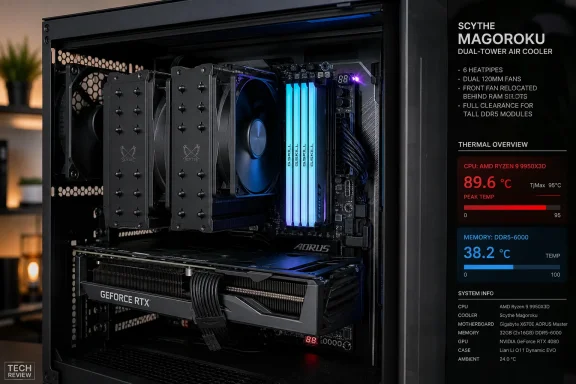 The fan placement is the real compatibility feature
Scythe officially specifies support for memory modules up to 57 mm tall. In the conventional configuration, the front 120 mm Wonder Tornado fan sits above the memory area, so tall DIMMs can require raising that fan. Raising it changes the airflow path and can add to the cooler’s effective height, an easy clearance issue to overlook in a case with a tight 155 mm CPU-cooler limit.
Tom’s Hardware found the more useful arrangement is to relocate the front fan to the rear tower, above the motherboard’s VRM heatsinks. That removes the overhang from the DIMM slots altogether and, in its test, provided the better of the Magoroku’s two CPU-cooling results. The supplied third pair of fan clips means this is an intended-enough configuration mechanically, even if it is not the layout buyers will infer from the product photos.
This is a practical advantage for Windows PC builders using tall RGB memory or heavily finned DDR5 kits. It also keeps future memory upgrades simple: the CPU cooler does not have to come off, nor does a front fan have to be remounted higher, merely to replace a RAM kit.
There is a wording problem in the review’s headline, however. The Magoroku does not actively cool RAM through a dedicated heatsink or fan aimed solely at the modules; it benefits memory through case airflow from its conventional air-cooler fans. Still, the measured benefit is real. In Tom’s Hardware’s Karhu DDR5 stress test, it held system memory to a 43°C average, or 21°C above ambient. That tied it for second place once a SilverStone liquid cooler with extra VRM fans was excluded.
For builders tuning DDR5 stability, that is useful data. Memory temperatures can matter when a system is loaded for long periods, especially with dense, high-speed DIMMs and a GPU dumping heat into the case. But it should not be confused with proof that the Magoroku is a high-end CPU cooler.
Ryzen 9 9950X3D exposes the Magoroku’s ceiling
Tom’s Hardware allowed the Ryzen 9 9950X3D to use PBO, a scenario in which the processor drew more than 260 W and reached its 95°C thermal ceiling with most tested coolers. AMD rates the 16-core 9950X3D at 170 W by default, but motherboard PBO behavior can move real package power far beyond that nominal figure. A CPU touching 95°C in this test does not by itself prove a cooling failure; the relevant comparison is how much power the processor can sustain at that limit.
Here, the Magoroku did badly. Tom’s Hardware measured two results, one for each fan layout, and called both the worst on its latest AM5 test bench. At a 200 W Cinebench R23 load using default motherboard settings, the reviewer again placed it second-warmest among the coolers tested.
The gaming-adjacent test was more concerning. With Cinebench limited to 150 W while FurMark loaded an MSI RTX 4070 Ti Super at roughly 295 W, the Magoroku left the CPU at 69.9°C, or 47.9°C above ambient, in last place. Noise was reasonable at 39.6 dBA, but quiet operation is not a compensating strength if a cooler gives a premium CPU less thermal room than similarly priced alternatives.
The reviewer also reported seeing the 9950X3D repeatedly approach its thermal limit in Assassin’s Creed: Odyssey. That observation is one outlet’s experience rather than a repeatable cross-publication benchmark, but it is consistent with the controlled results: this cooler has little reserve capacity for an AM5 flagship in a real enclosed system.
At equalized noise of 38.9 dBA, Tom’s Hardware measured average package power of 228.7 W under PBO after the chip reached its thermal ceiling. Its full-speed result exceeded 236 W, while maximum fan noise was a relatively restrained 43.4 dBA. In other words, Scythe’s two 120 mm fans are not trying to win a brute-force fan-speed contest. That keeps the Magoroku civil acoustically but leaves it behind where sustained CPU heat is the priority.
Other test beds produce a more limited, more favorable picture
Independent testing suggests the Magoroku is not simply defective; its results depend heavily on the processor, power target, and test environment. Hardwareluxx tested the cooler with an Intel Core i5-14600K limited to the chip’s 181 W maximum turbo level in a spacious Corsair 7000D Airflow case. It recorded 84°C at maximum fan speed and 92°C with fan speed set to 1,000 RPM. Hardwareluxx judged it close to the similarly positioned be quiet! Pure Rock Pro 3 while running more quietly than many competitors.
MYC Media also characterized the Magoroku as a strong performer in its own testing and said its shortened lower fins accommodated memory with tall heat spreaders. XFastest, using an open-frame Windows 11 25H2 test system, reported that the cooler could run a Ryzen 7 9800X3D at stock settings, though its AIDA64 FPU test pushed the processor to 92°C at roughly 130 W.
Those results should not be treated as a rebuttal of Tom’s Hardware. They are answers to different questions. Hardwareluxx’s 14600K platform, XFastest’s Ryzen 7 9800X3D test, and Tom’s Hardware’s PBO-enabled Ryzen 9 9950X3D system have materially different thermal demands. Open-frame testing also removes the case airflow restriction that a normal desktop imposes.
The shared conclusion is narrower and more useful: the Magoroku is adequate for mainstream processors and stock, gaming-oriented CPUs, but the evidence does not establish it as the budget dual tower to buy for unrestricted high-power AM5 workloads.
Scythe’s design trade-off has shifted
Scythe previewed the Magoroku well before retail availability as a successor-style design aimed at improving on the Fuma line. Gamers Nexus reported in 2024 that Scythe attributed a claimed 6% thermal-conductivity gain to straighter heatpipes versus the more curved pipes used in the Fuma family. The company also paired the new cooler with 26 mm-thick Wonder Tornado fans rather than the thinner front fan used on some Fuma models.
The retail Magoroku keeps the headline mechanics: two towers, six 6 mm heatpipes, two 120 mm fans, AM4 and AM5 support, and compatibility with Intel LGA 115x, 1200, 1700, and 1851 sockets. At 1,036 grams and 155 mm tall, it avoids the bulk of larger flagship coolers. The trade is evident in the testing: its airflow improves DDR5 and surrounding board-component conditions, but it does not translate into leading heat removal from AMD’s most demanding desktop CPU.
Scythe also offers only a one-year warranty. That is short for an air cooler, a category with few failure points beyond fans and mounting hardware. The cooler includes a screwdriver, thermal paste, mounting parts, and three fan-clip sets, so installation support is not skimpy; warranty coverage is.
Buy for clearance and memory airflow, not Ryzen 9 headroom
The Magoroku makes sense in a 155 mm-clearance mid-tower build using a Ryzen 7, Core i5, Core Ultra 7-class processor, or a Ryzen 9 configured to stay near its stock power envelope. Put both fans behind the memory slots if the DIMMs are tall; that arrangement is the most defensible default based on Tom’s Hardware’s test.
For a Ryzen 9 9950X3D with PBO enabled, choose a stronger dual tower or a capable liquid cooler instead. Tom’s Hardware specifically recommends Thermalright’s Royal Pretor 130 at the Magoroku’s price level for AMD users, though its exact performance should be evaluated under the same case and power settings as the intended build.
The Magoroku’s strongest result—43°C average DDR5 under Karhu—will matter to a subset of memory-focused builders. For the far larger group buying a dual-tower cooler to keep a flagship CPU boosting hard through long renders, compiles, simulations, or gaming sessions, the new Scythe lands on the wrong side of the trade-off.
