
ServiceNow’s advice for becoming an AI “pacesetter” — integrate AI into cross-functional workflows, unify data, train staff, govern deployments and measure returns — is sound as far as it goes. But the Technology Record article published on August 7, 2026 presents a two-year-old ServiceNow and Microsoft 365 Copilot integration as though it were a new starting point, while leaving out the deployment, licensing and data-access work that determines whether such an integration produces value or simply puts another chatbot in Microsoft Teams.
The article draws its central numbers from ServiceNow and Oxford Economics’ 2024 Enterprise AI Maturity Index: a survey of 4,470 executives at organizations already using AI. The research did find that 18% of respondents met ServiceNow’s definition of “Pacesetters,” and that 61% of that group reported using an enterprise platform with built-in AI capabilities, versus 46% of other respondents.
Those are useful signals, not a recipe. The study classifies organizations by a score built from five dimensions — strategy and leadership, workflows, talent, governance and investment — then describes the highest-scoring group’s common traits. In other words, ServiceNow’s “Pacesetters” are organizations that already report stronger strategy, integration, training, governance and measurement. The research shows correlation between those behaviors and higher maturity; it does not establish that buying a single unified platform caused the better outcomes.
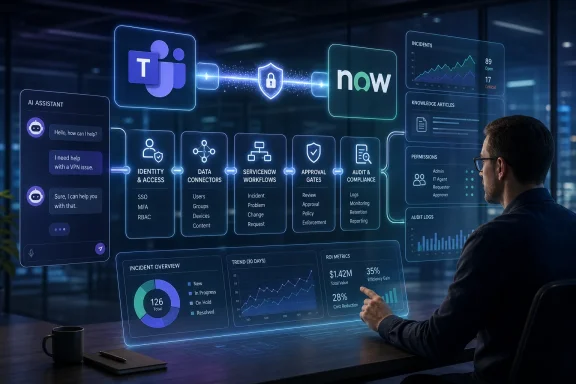
For Windows administrators and IT leaders, the practical conclusion is narrower and more useful: the gap is less about access to generative AI than about whether an organization can safely connect AI to authoritative knowledge and controlled actions. A Copilot prompt that summarizes an incident is easy to pilot. An agent that can retrieve only the right ServiceNow knowledge article, create the correct service request, respect user entitlements, route an exception and leave an auditable record is a systems-integration project.
The article’s 4,470-executive sample, 18% Pacesetter figure and 61% platform-approach figure all trace directly to the 2024 edition of the Enterprise AI Maturity Index. Oxford Economics published that study on July 23, 2024, and ServiceNow’s detailed results described Pacesetters as companies with the highest scores across the five dimensions.
The distinction is material because ServiceNow has issued newer versions of the index. Its 2025 report said the average maturity score had fallen from 44 to 35 as the technology and expectations moved faster than organizations’ capacity to deploy it. It still identified roughly 18% of respondents as Pacesetters, but its scoring and headline findings centered on a different problem: organizations struggling to turn expanding AI experimentation into governed, measurable deployment.
That later result undercuts any simplistic reading of the earlier data. More enterprise AI products, more pilots and more “agentic” features have not automatically raised organizational maturity. ServiceNow itself reported that fewer than 1% of respondents in its 2025 study scored above 50 on its 100-point scale.
The useful lesson is not “platforms win.” It is that a platform is an enabling layer only if it reduces duplicated identity management, conflicting permissions, disconnected process ownership and unmeasured work. An enterprise can centralize AI procurement and still fail at all four.
ServiceNow’s own 2024 data is more specific than the promotional summary. Pacesetters were more likely to have executives and boards involved in AI strategy, to report the right mix of skills, to run reskilling programs, to make progress connecting operational silos and to define performance metrics. They were also substantially more likely to report significant returns across productivity, customer experience, innovation and risk-management outcomes.
Those are operating disciplines. The model choice and chat interface come later.
ServiceNow said the Now Assist integration with Microsoft Copilot for Microsoft 365 reached general availability with the Xanadu platform release on September 10, 2024. The initial scope was employee and IT-service work in Microsoft Teams: searching a ServiceNow knowledge base, submitting guided catalog requests, receiving conversational help, and escalating an issue to a live agent when automation could not resolve it.
The core proposition remains practical. A staff member working in Teams should not need to find the ServiceNow portal, identify the appropriate catalog item, understand the service taxonomy and manually transcribe details from a chat. Likewise, an IT administrator should be able to obtain ServiceNow context and turn it into an incident summary, report or stakeholder communication without jumping among Teams, ServiceNow, Word, Excel and Outlook.
But calling this “two AI assistants working together” risks overstating what the integration delivers. The important component is not an assistant-to-assistant conversation. It is the controlled handoff from a natural-language request to a defined ServiceNow workflow. In a mature deployment, the language model identifies intent and gathers context; ServiceNow business rules, catalog logic, approvals, role controls and audit records determine what actually happens.
That division of labor should reassure administrators. It also explains why the integration cannot be evaluated from a product demonstration alone. A fluent response is not evidence that the underlying workflow is safe, accurate or authorized.
Microsoft’s current documentation for its ServiceNow Knowledge connector makes the constraint explicit. The connector remains a preview component in the Employee Self-Service agent scenario, and Microsoft says attachments are not indexed. Organizations using ServiceNow’s User Criteria — common in HR, IT and employee self-service deployments — must give the connector’s ServiceNow account access to the
That is a more consequential implementation detail than the promise of “contextual intelligence.” A missing article is a frustrating search failure; an overly broad article is a potential information-governance incident.
Microsoft also requires a ServiceNow administrator, Microsoft 365 or Entra administrator, and an environment maker to configure the current Employee Self-Service deployment. The integration spans ServiceNow permissions, OAuth registration, Enterprise Application and SAML configuration, connector setup, Copilot Studio configuration, and ongoing index and access-control maintenance. Those are normal enterprise requirements, but they are absent from the high-level account.
The same gap applies to the article’s assurance that security is preserved through access controls, encryption, monitoring and privacy compliance. Those are categories of control, not proof that a particular tenant has implemented them correctly. Security depends on the actual design: whether the connector uses least privilege, whether ServiceNow knowledge is classified and current, whether HR and security content are segmented, whether chat logs are retained appropriately, and whether privileged workflows require confirmation or human approval.
The pacesetter behavior is to treat identity, entitlement and auditability as product requirements before enabling action-taking agents. The alternative is to build a polished front door that either exposes too much or is too constrained to help.
That omission matters because the economic case differs sharply by use case. Password resets, software requests, access requests and knowledge retrieval can deliver measurable deflection if the source material is reliable and the workflow is deterministic. Generating an incident report from existing records may save analyst time but does not reduce incident volume. Asking Copilot to draft an email about a ServiceNow issue is convenient, but it is difficult to distinguish from the productivity benefit already expected from a Microsoft 365 Copilot deployment.
ServiceNow’s 2024 maturity research itself contains a warning against taking returns on faith. It found that about two-thirds of surveyed leaders believed their AI investments were delivering positive ROI, while only 35% said they had clear metrics for measuring the impact. Pacesetters were more likely to have those metrics, but even among that group only about one-third reported returns of 15% or more in a given business area.
IT leaders should therefore separate the integration into outcomes that can be tested:
However, the answer is not to grant a broad agent access to every collaboration record, knowledge base and workflow. Start with a small number of high-volume, low-risk requests: VPN setup guidance, approved software requests, managed-device replacement, account unlocks or standard access requests. Give each workflow an owner, define the authoritative data source, test permission boundaries, and publish a success measure before moving on.
ServiceNow and Microsoft have provided a real integration, and both companies have continued updating its Teams and Copilot components since its September 2024 general availability. The August 2026 article is right that AI value comes from integrating work rather than bolting chat onto disconnected systems. What it leaves unsaid is the hard part: integration is valuable only when the organization has made its data, permissions, workflows and measurements trustworthy enough for an AI agent to act on them.
Those are useful signals, not a recipe. The study classifies organizations by a score built from five dimensions — strategy and leadership, workflows, talent, governance and investment — then describes the highest-scoring group’s common traits. In other words, ServiceNow’s “Pacesetters” are organizations that already report stronger strategy, integration, training, governance and measurement. The research shows correlation between those behaviors and higher maturity; it does not establish that buying a single unified platform caused the better outcomes.
For Windows administrators and IT leaders, the practical conclusion is narrower and more useful: the gap is less about access to generative AI than about whether an organization can safely connect AI to authoritative knowledge and controlled actions. A Copilot prompt that summarizes an incident is easy to pilot. An agent that can retrieve only the right ServiceNow knowledge article, create the correct service request, respect user entitlements, route an exception and leave an auditable record is a systems-integration project.
 The “Pacesetter” figures are from 2024, not fresh 2026 fieldwork
The article’s 4,470-executive sample, 18% Pacesetter figure and 61% platform-approach figure all trace directly to the 2024 edition of the Enterprise AI Maturity Index. Oxford Economics published that study on July 23, 2024, and ServiceNow’s detailed results described Pacesetters as companies with the highest scores across the five dimensions.The distinction is material because ServiceNow has issued newer versions of the index. Its 2025 report said the average maturity score had fallen from 44 to 35 as the technology and expectations moved faster than organizations’ capacity to deploy it. It still identified roughly 18% of respondents as Pacesetters, but its scoring and headline findings centered on a different problem: organizations struggling to turn expanding AI experimentation into governed, measurable deployment.
That later result undercuts any simplistic reading of the earlier data. More enterprise AI products, more pilots and more “agentic” features have not automatically raised organizational maturity. ServiceNow itself reported that fewer than 1% of respondents in its 2025 study scored above 50 on its 100-point scale.
The useful lesson is not “platforms win.” It is that a platform is an enabling layer only if it reduces duplicated identity management, conflicting permissions, disconnected process ownership and unmeasured work. An enterprise can centralize AI procurement and still fail at all four.
ServiceNow’s own 2024 data is more specific than the promotional summary. Pacesetters were more likely to have executives and boards involved in AI strategy, to report the right mix of skills, to run reskilling programs, to make progress connecting operational silos and to define performance metrics. They were also substantially more likely to report significant returns across productivity, customer experience, innovation and risk-management outcomes.
Those are operating disciplines. The model choice and chat interface come later.
The ServiceNow–Copilot integration is established technology
The Technology Record piece treats the ServiceNow Now Assist and Microsoft Copilot connection as “a first step toward this vision.” That was accurate language in May 2024, when ServiceNow and Microsoft announced the alliance expansion at ServiceNow’s Knowledge conference. It is not an accurate description of its status on August 7, 2026.ServiceNow said the Now Assist integration with Microsoft Copilot for Microsoft 365 reached general availability with the Xanadu platform release on September 10, 2024. The initial scope was employee and IT-service work in Microsoft Teams: searching a ServiceNow knowledge base, submitting guided catalog requests, receiving conversational help, and escalating an issue to a live agent when automation could not resolve it.
The core proposition remains practical. A staff member working in Teams should not need to find the ServiceNow portal, identify the appropriate catalog item, understand the service taxonomy and manually transcribe details from a chat. Likewise, an IT administrator should be able to obtain ServiceNow context and turn it into an incident summary, report or stakeholder communication without jumping among Teams, ServiceNow, Word, Excel and Outlook.
But calling this “two AI assistants working together” risks overstating what the integration delivers. The important component is not an assistant-to-assistant conversation. It is the controlled handoff from a natural-language request to a defined ServiceNow workflow. In a mature deployment, the language model identifies intent and gathers context; ServiceNow business rules, catalog logic, approvals, role controls and audit records determine what actually happens.
That division of labor should reassure administrators. It also explains why the integration cannot be evaluated from a product demonstration alone. A fluent response is not evidence that the underlying workflow is safe, accurate or authorized.
Contextual intelligence depends on permissions, not branding
The article correctly argues that AI is more useful when grounded in enterprise data. Yet its claims about seamless access and security skip the part administrators cannot skip: what data is indexed, what data the connector identity can see, and how that visibility is enforced for each employee.Microsoft’s current documentation for its ServiceNow Knowledge connector makes the constraint explicit. The connector remains a preview component in the Employee Self-Service agent scenario, and Microsoft says attachments are not indexed. Organizations using ServiceNow’s User Criteria — common in HR, IT and employee self-service deployments — must give the connector’s ServiceNow account access to the
user_criteria table, relevant groups and roles. Without that access, permission evaluation can be incomplete and knowledge articles may not appear even when employees can see them directly in ServiceNow.That is a more consequential implementation detail than the promise of “contextual intelligence.” A missing article is a frustrating search failure; an overly broad article is a potential information-governance incident.
Microsoft also requires a ServiceNow administrator, Microsoft 365 or Entra administrator, and an environment maker to configure the current Employee Self-Service deployment. The integration spans ServiceNow permissions, OAuth registration, Enterprise Application and SAML configuration, connector setup, Copilot Studio configuration, and ongoing index and access-control maintenance. Those are normal enterprise requirements, but they are absent from the high-level account.
The same gap applies to the article’s assurance that security is preserved through access controls, encryption, monitoring and privacy compliance. Those are categories of control, not proof that a particular tenant has implemented them correctly. Security depends on the actual design: whether the connector uses least privilege, whether ServiceNow knowledge is classified and current, whether HR and security content are segmented, whether chat logs are retained appropriately, and whether privileged workflows require confirmation or human approval.
The pacesetter behavior is to treat identity, entitlement and auditability as product requirements before enabling action-taking agents. The alternative is to build a polished front door that either exposes too much or is too constrained to help.
The missing business case is the real weakness
The article makes broad productivity claims but supplies no customer deployment metrics for the Now Assist–Copilot integration. It does not disclose license requirements, incremental ServiceNow costs, Microsoft 365 Copilot requirements, implementation effort, adoption targets, baseline ticket volumes or the rate at which users successfully complete tasks without human help.That omission matters because the economic case differs sharply by use case. Password resets, software requests, access requests and knowledge retrieval can deliver measurable deflection if the source material is reliable and the workflow is deterministic. Generating an incident report from existing records may save analyst time but does not reduce incident volume. Asking Copilot to draft an email about a ServiceNow issue is convenient, but it is difficult to distinguish from the productivity benefit already expected from a Microsoft 365 Copilot deployment.
ServiceNow’s 2024 maturity research itself contains a warning against taking returns on faith. It found that about two-thirds of surveyed leaders believed their AI investments were delivering positive ROI, while only 35% said they had clear metrics for measuring the impact. Pacesetters were more likely to have those metrics, but even among that group only about one-third reported returns of 15% or more in a given business area.
IT leaders should therefore separate the integration into outcomes that can be tested:
- Measure self-service containment rates, reopened tickets, time to correct resolution and escalation quality for each supported request type.
- Measure whether knowledge retrieval respects ServiceNow user criteria and whether restricted content is never returned to unauthorized users.
- Measure analyst time saved on summaries, triage and documentation against the cost of Now Assist, Microsoft 365 Copilot, implementation and governance overhead.
- Limit action-taking capabilities to catalog tasks and workflows with clear authorization, validation and reversal paths before expanding their scope.
What Windows and IT teams should take from the study
The most credible part of the Pacesetter argument is its rejection of isolated AI experiments. A Windows support organization gets little value from deploying a chatbot that can answer generic questions but cannot see the approved device catalog, the employee’s entitlement, the relevant Microsoft 365 guidance, the ServiceNow incident history or the correct escalation path.However, the answer is not to grant a broad agent access to every collaboration record, knowledge base and workflow. Start with a small number of high-volume, low-risk requests: VPN setup guidance, approved software requests, managed-device replacement, account unlocks or standard access requests. Give each workflow an owner, define the authoritative data source, test permission boundaries, and publish a success measure before moving on.
ServiceNow and Microsoft have provided a real integration, and both companies have continued updating its Teams and Copilot components since its September 2024 general availability. The August 2026 article is right that AI value comes from integrating work rather than bolting chat onto disconnected systems. What it leaves unsaid is the hard part: integration is valuable only when the organization has made its data, permissions, workflows and measurements trustworthy enough for an AI agent to act on them.
References
- Primary source: Technology Record
Published: August 7, 2026 at 8:49 AM UTC
Loading…
www.technologyrecord.com - Related coverage: learn.microsoft.com
Loading…
learn.microsoft.com - Related coverage: learn.microsoft.com
Loading…
learn.microsoft.com - Related coverage: servicenow.com
Loading…
www.servicenow.com