
The incident was detected on July 2, according to a customer notice reviewed by AFP and reported by TF1 Info, after an unauthorized party accessed an internal tool used to manage and analyze fibre connections. SFR says it disabled the account involved, blocked and monitored the relevant IP addresses, notified France’s data-protection regulator, the CNIL, and filed a complaint with the public prosecutor.
SFR has not published a total number of affected customers. The 2.1 million figure originated with a threat-actor claim reported by Cyberattaque.org on July 17; a regional CSIRT bulletin likewise describes it as an unconfirmed claim. That distinction has been blurred in headlines. The confirmed story is a breach affecting fibre-line data; the number of records, the completeness of the dataset, and whether the data was copied rather than merely accessed are still not public facts.
 What SFR has confirmed — and what it has not
SFR told AFP that the incident may have allowed temporary access to information associated with fibre subscribers, including postal addresses, email addresses, and telephone numbers. It said that passwords and banking data were not involved. The customer communication cited by TF1 says the compromised system was an “analysis and management” tool for fibre connections, which points to an operational environment rather than the customer-login system itself.
The supplied descriptions of the exposed fields go further, listing names, titles, contract identifiers, mobile numbers, addresses, and technical line information. Those details are plausible for a fibre provisioning or troubleshooting platform, but SFR’s public statement has been narrower. Until the company supplies a field-by-field breach notice, customers should assume that details used to identify and service their household connection may be known to an attacker, while avoiding the unsupported conclusion that every affected record contained every reported field.
The more important omission is the scope. SFR has not said how many fibre subscribers were notified, whether RED by SFR customers are included in the same population, whether former customers appear in the system, or whether the access window began before the July 2 detection date. Nor has it publicly said whether its investigators have evidence of data exfiltration. “Temporary accessibility” is careful language: it confirms unauthorized access but does not itself establish the volume copied by the intruder.
That gap matters because a breach count changes the operational response. A customer who knows only that “some” fibre data was exposed cannot tell whether an unexpected technician call is a broad scam attempting to exploit the news or a targeted contact built from a leaked address, contract reference, and line details.
The likely attack path is social engineering, not account takeover
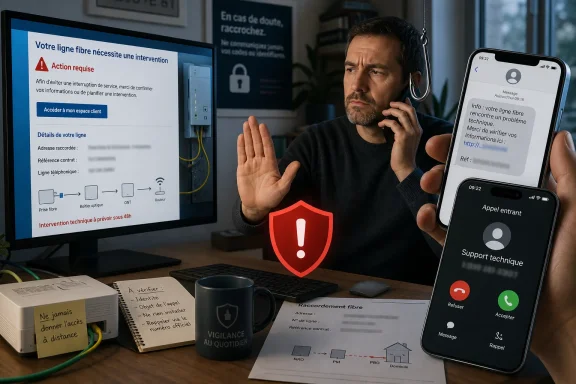
The absence of passwords and payment data reduces one set of dangers, but it does not make the incident harmless. An attacker with a customer’s name, address, phone number, email address, and technical context can build a convincing pretext: “Your fibre box needs a remote test,” “a technician must replace an optical terminal,” or “your line will be cut unless you confirm an appointment.”
For Windows users, the highest-risk scenario is a caller or email persuading someone to install a “support” tool, open Windows Quick Assist, run a PowerShell command, or disclose a one-time verification code. The attacker does not need an SFR password database if they can manipulate the customer into supplying the missing credential or granting remote access to a PC.
The warning signs are straightforward but easy to miss under pressure:
- SFR, a bank, Microsoft, or a delivery company will not need a customer to reveal a password, a banking code, or a multi-factor authentication code to validate a fibre repair.
- A genuine support interaction should be verified by ending the contact and initiating a new one through the telephone number or customer portal the subscriber already uses.
- A technician appointment should not require installing remote-control software on a Windows PC, permitting an unsolicited Quick Assist session, or paying a fee through a link in an unexpected text message.
- A caller knowing an address, customer name, or broadband provider is not proof that the caller works for SFR.
The practical effect of this incident may last longer than the first wave of scam messages. Phone numbers and addresses do not expire quickly, and fibre-line information can supply attackers with a reason to return months later with a new script, perhaps impersonating an internet provider, a bank responding to “suspicious account activity,” or Windows support responding to a fabricated security warning.
Customer notification is a useful signal, not a complete answer
SFR says it is contacting customers it believes were affected. Any subscriber who receives an authentic breach notice should preserve it, review the fields SFR says were involved, and treat subsequent contact about a box replacement, line repair, missed payment, or “security verification” with elevated suspicion.
France’s CNIL makes an important distinction often lost in breach coverage: notifying the regulator is not a certification that an organization has established the full scope of an intrusion. Under GDPR rules, an organization should notify the CNIL within 72 hours when a breach presents a risk to people’s rights and freedoms; it may submit more information later as its investigation develops. A notice to the CNIL therefore supports the conclusion that SFR identified a personal-data incident serious enough to report. It does not validate the 2.1 million-record claim or answer what was removed from the system.
SFR detected the incident on July 2, while public confirmation and customer letters emerged on August 20. The chronology leaves an unavoidable practical concern: subscribers may have had more than six weeks in which an attacker could use the data before many knew that their fibre information had been exposed. SFR has said it stopped the access immediately after detection, but it has not publicly explained why customer notifications were issued later or whether the company believes phishing attempts occurred during that period.
Actions worth taking on Windows and at home
Affected customers do not need to reset unrelated passwords solely because SFR says passwords were outside the compromised system. Resetting a password is appropriate if it has been reused elsewhere, if a suspicious link was opened, or if there is unusual activity in the SFR account. The more pressing task is preventing an attacker from converting contact information into access.
Start by checking the SFR customer account directly through a known bookmark or manually entered address. Review the email address, recovery phone number, postal address, linked payment method, recent orders, and any technician appointments. If a customer’s email address is in the exposed data, protecting that mailbox with a unique password and multi-factor authentication is especially important because email remains the usual route for password resets and impersonation.
On Windows PCs, family members should be told specifically not to accept unsolicited remote-support requests. Microsoft Quick Assist, AnyDesk, TeamViewer, Chrome Remote Desktop, and similar tools are legitimate products, but scammers regularly use them because the customer can grant access voluntarily. An unexpected request to open one of these tools is a stop sign, not a troubleshooting step.
Anyone who has already clicked a suspicious link, installed remote-access software at a caller’s request, or disclosed a verification code should act as though an account compromise may be underway. Disconnect the PC from the internet if an unauthorized remote session is active, remove the remote-access tool only after ending the session, run a full Microsoft Defender scan, change passwords from a known-clean device, and contact the relevant bank or service directly where payment details or authentication codes may have been provided.
A confirmed breach, but an unconfirmed headline number
The evidence now supports a clear conclusion: SFR suffered an unauthorized-access incident involving an internal fibre-management tool, and some subscriber contact and line-related data was exposed. The breach was serious enough for SFR to notify the CNIL, contact affected customers, and make a criminal complaint.
What the evidence does not support is treating 2.1 million stolen records as an established fact. That number is still a threat-actor claim, repeated by secondary reporting but not confirmed by SFR. Until the operator publishes its final scope, the sensible course for every SFR fibre customer is the same: verify any alleged service contact independently, protect the email account tied to the service, and never let a convincing caller turn leaked customer details into access to a Windows PC, an SFR account, or a bank account.