
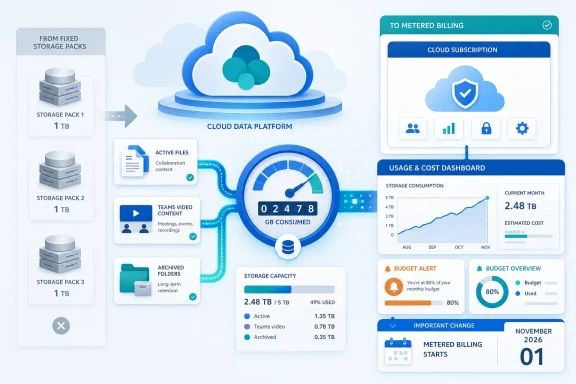
The change is administratively meaningful for organizations whose SharePoint consumption rises and falls with projects, migrations, video-heavy Teams workspaces, or long retention periods. Instead of asking procurement to add a fixed number of gigabytes before the tenant hits capacity, administrators would be able to attach an Azure subscription and pay according to measured overage use.
Microsoft says the meter will also integrate more smoothly with Microsoft 365 Archive. That is the important part of this roadmap item: it is not simply another payment option for the existing storage pool. Microsoft is moving active excess storage and archived SharePoint data toward a common consumption-billing model, though the company has not yet published the new active-storage rate, exact meter name, billing granularity, or the migration path for customers that already own Extra File Storage add-ons.
 A November target, with an overdue preview date
Microsoft’s roadmap lists Preview availability as June 2026 and general availability as November 2026. June has already passed, yet the item remains marked In development rather than Rolling out or Launched. That makes the preview date a planning signal rather than evidence that organizations can use the meter today.
Roadmap dates are targets, not contractual release commitments, and this entry contains no tenant-selection criteria, admin-center screenshots, regional rollout sequence, or Message Center announcement reference. Microsoft has said the feature applies to its Worldwide standard multi-tenant environment and lists both Preview and General Availability release rings, but has not said whether preview access is limited to Targeted Release tenants, whether it requires a support enrollment, or whether it will appear automatically after an Azure billing profile is linked.
For IT teams building their fiscal 2027 cloud budgets, November is therefore a reasonable point to prepare controls and forecasts—not a date to cancel purchased storage capacity. A tenant that exceeds its SharePoint quota can face service restrictions, including read-only behavior that prevents users from adding or editing content. Microsoft’s SharePoint documentation also says classic site creation and PowerShell-based site creation can be blocked once the tenant quota is exceeded.
What the new meter changes from storage packs
Today, SharePoint Online capacity is largely a pooled tenant allowance. For most commercial Microsoft 365 and Office 365 plans, Microsoft assigns 1 TB of base SharePoint storage plus 10 GB for each eligible purchased license. Organizations that outgrow that allocation can buy Office 365 Extra File Storage in 1 GB increments; the add-on expands the tenant’s available storage allocation.
The proposed pay-as-you-go option changes the commercial mechanism for the excess portion. Rather than increasing the tenant’s licensed allocation through a purchased pack, the organization would pay based on consumption after it crosses the included quota. Microsoft’s updated SharePoint storage-planning documentation now names both options: purchase additional capacity or configure “Microsoft 365 SharePoint Storage,” a pay-as-you-go solution for usage above the tenant quota.
This should reduce a familiar operational delay. SharePoint administrators see capacity decline in the SharePoint admin center, but purchasing an add-on can require a billing administrator, reseller, purchase approval, and an estimate of how much headroom to buy. Consumption billing does not eliminate the need for governance; it shifts the work toward Azure subscription ownership, budget alerts, chargeback practices, and ongoing cost monitoring.
Microsoft’s own pay-as-you-go terms make that division of responsibility clear. The feature is disabled by default, requires an Azure subscription and associated resource group, and needs a Microsoft 365 administrator role plus Azure Owner or Contributor permissions to configure. Costs are then monitored through Azure Cost Management rather than solely through traditional Microsoft 365 licensing views.
The result is faster capacity relief, but less price certainty. A fixed capacity purchase makes the monthly commitment apparent before the purchase. A metered service makes the bill dependent on actual storage growth, retention behavior, and cleanup discipline.
Archive already uses a related billing model
Microsoft 365 Archive provides the clearest indication of how Microsoft expects the new meter to fit into SharePoint operations. Archive already requires customers to link an Azure subscription for pay-as-you-go billing. Administrators enable it in the Microsoft 365 admin center, then manage archived SharePoint sites through SharePoint administration.
Microsoft’s Archive pricing documentation says archived storage is billed per GB per month only when a tenant’s combined archived and active SharePoint storage exceeds its included or licensed allocated SharePoint capacity. This detail is easy to miss: placing data into Archive does not automatically create an archive-storage charge if the tenant remains within its allocated SharePoint capacity.
Once the tenant is over its allowance, however, Archive storage is treated differently from active excess storage. Microsoft’s published billing examples describe a tenant that is 200 GB over quota: buying 200 GB of standard additional capacity is one option, while archiving that 200 GB moves the charge to Archive’s consumption model. Microsoft has previously set the Archive example at $0.05 per GB per month, but Roadmap 506743 does not publish a rate for the forthcoming active SharePoint Storage meter. Administrators should not assume that active storage will cost the same as Archive capacity.
That distinction affects the business case. Archive is designed for content that must be retained but is no longer actively worked on. Archived SharePoint sites and files remain governed content, but they are not interchangeable with live collaborative workspaces. A department using a project site daily cannot treat Archive as a transparent substitute for active capacity merely because both are ultimately measured in gigabytes.
Microsoft also removed the fee to reactivate archived SharePoint content on March 31, 2025, according to its Archive pricing guidance. But the company restricts re-archiving newly reactivated content for four months. That rule discourages using Archive as a short-cycle storage tier for sites that repeatedly swing between active and inactive status.
The missing pricing details are the real planning gap
The roadmap wording promises less overhead, but it leaves out the facts finance and platform teams need to calculate whether the meter is favorable. Microsoft has not disclosed the following for the new active-storage offering:
- Microsoft has not published the per-GB monthly price, whether prices will differ by billing currency or Azure geography, or whether discounts and commitments will apply.
- Microsoft has not stated how frequently usage will be sampled and billed, or whether storage growth and cleanup are reflected immediately or after the 24-to-48-hour reporting delay documented for SharePoint storage usage.
- Microsoft has not explained whether existing Extra File Storage add-ons can coexist with the meter, be converted to it, or remain the only option for some agreement types and cloud environments.
- Microsoft has not identified availability for GCC, GCC High, DoD, education, sovereign, or multi-geo tenants. The roadmap scope is explicitly Worldwide standard multi-tenant only.
- Microsoft has not said what guardrails will arrive with the service, such as tenant-level spending caps, alerts specific to this meter, automatic fallback behavior, or controls that prevent a linked Azure subscription from absorbing unexpected overages.
Those omissions do not weaken the announced direction, but they do mean this is not yet a rate-card decision. The new meter may be operationally simpler while being more expensive than a committed storage add-on for tenants with stable, predictable overage. Conversely, organizations that periodically spike above quota during migrations or seasonal workloads may benefit from avoiding permanently provisioned capacity that sits unused for much of the year.
SharePoint admins should prepare governance before enabling it
The practical preparation work is familiar, but it needs coordination between Microsoft 365 and Azure teams. Start by identifying the current total tenant allocation, active consumption, existing Extra File Storage purchases, and the sites responsible for recent growth. SharePoint’s storage reporting can lag by 24 to 48 hours, so capacity reviews should not be reserved for the day a tenant reaches its limit.
Next, separate data that must remain active from data that is merely retained. Retention policies, recycle bins, version histories, video assets, Teams-connected sites, and old project workspaces can all affect capacity, but they have very different remediation paths. Deleting content or trimming versions may be appropriate in some cases; archiving may preserve business records without consuming active quota; active data needs either sufficient pooled capacity or the forthcoming metered overage service.
Finally, nominate an Azure subscription and resource group deliberately rather than attaching the first available billing account. The owner of that subscription will need visibility into Microsoft 365 consumption charges, budget thresholds, and anomaly alerts. SharePoint administrators should have an escalation path if the storage meter begins rising quickly, while Azure cost owners need enough context to distinguish legitimate migrations from uncontrolled file growth.
Microsoft’s November 2026 target gives organizations time to set those controls. But until Microsoft publishes the active-storage rate and the rules for coexistence with Extra File Storage, the sensible move is preparation—not assuming that pay-as-you-go will automatically be the cheaper choice.