
That is a strong commercial signal, but it is not proof that AI referral traffic causes a 50% conversion lift. Shopify’s own analysis shows that more than half of AI-referred sessions began on a product page, versus about 20% of organic-search sessions. In other words, the AI cohort arrives at a later point in the buying process. It is a high-intent slice of traffic by design.
Shopify’s published figures are still meaningful because the platform can observe a large number of storefront sessions and orders. The company reports that AI-chatbot referrals from services including ChatGPT, Perplexity, Gemini, Copilot, Claude, and Grok rose more than eightfold year over year, while AI-referred orders rose nearly 13-fold. Yet the post does not disclose the merchant count, countries, categories excluded from the comparison, traffic thresholds, bot filtering, conversion baseline, or the attribution model used for the aggregate results.
For IT teams that operate commerce sites, analytics stacks, feeds, and product-data systems, the immediate lesson is not to declare SEO obsolete or move budgets on the basis of one platform study. It is to stop treating AI discovery as an unmeasurable curiosity—and to recognize that referral reporting is already lagging behind how the major platforms are wiring up shopping.
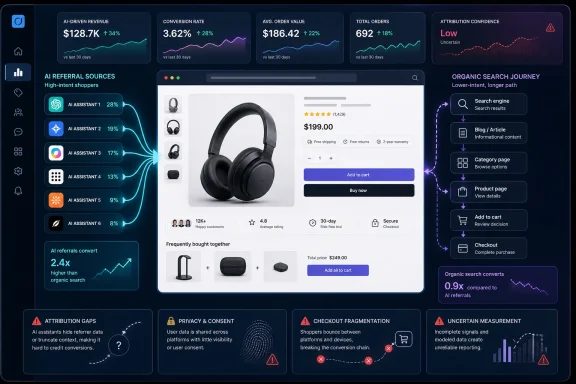 Shopify’s data describes the end of the journey
Shopify calls the pattern journey compression: a customer describes a need in a chat, refines requirements, sees a recommended item, and then lands directly on the merchant’s product page. The company reports that, when comparing sessions that begin on product-detail pages, AI-referred visitors converted at nearly 50% above organic-search visitors. It also says AI traffic outperformed organic traffic in 23 of 25 merchant categories, by an average of 56% within those categories.
The order-value figure has the same caveat. A shopper who asks an assistant to find, for example, a specific laptop dock with a certain port mix, delivery deadline, and price ceiling has already eliminated much of the browsing that appears in normal organic-search sessions. It should not be surprising if that shopper buys more often and chooses a more expensive product than someone who clicked a broad category result.
The practical implication is that the relevant optimization target is moving from the homepage toward the product page. A product-detail page must answer the questions an AI assistant may have surfaced but a human buyer still needs confirmed: exact variant, compatibility, stock status, shipping timing, returns, price, warranty, and the real differences between closely related models.
That is particularly relevant for Windows and PC hardware merchants. Listings for a USB-C dock, a mini PC, RAM kit, Wi-Fi adapter, docking station, SSD enclosure, or Windows license cannot rely on a broad marketing description when an assistant is trying to distinguish products by socket, wattage, PCIe generation, DisplayPort version, Windows compatibility, power-delivery behavior, or return conditions. Incomplete product attributes are no longer merely a catalog-quality problem; they can decide whether the item is suggested at all.
Shopify’s data therefore supports a simpler conclusion than its broader “next platform shift” argument: AI referrals currently behave more like a qualified recommendation click than a traditional top-of-funnel search click. Merchants should measure them accordingly.
The measurement problem is larger than Shopify’s headline
Shopify itself acknowledges a substantial blind spot: Google AI Overviews referrals may be classified as ordinary organic-search traffic in standard analytics. Google has since introduced dedicated Search Console reporting for generative-AI visibility, including AI Overviews and AI Mode, but it is being rolled out only to a subset of sites while Google gathers feedback.
This leaves merchants with two different questions that their dashboards may not answer cleanly:
- How often did an AI product or answer surface the merchant’s page?
- How often did a visit or sale originate from that AI surface?
Those are not the same metric, and a referrer field cannot reliably reconcile them. Google’s new reporting is about visibility—impressions, pages, countries, devices, and dates—not a universal sales-attribution system. Shopify’s own analytics documentation also makes clear that marketing reports can apply different attribution models, with last non-direct click as the default for marketing activity data. The model selected can materially change which channel receives credit.
The missing methodology in Shopify’s study matters here. The company states that its comparisons use Q1 2026 commerce data but does not specify whether its order figures are based on first click, last click, last non-direct click, or another model. Its help documentation says that average order value includes shipping, taxes, and discounts before returns, while canceled, pending, and unpaid orders can appear in reporting. Those definitions are reasonable, but they make the absence of a published study methodology more consequential.
A merchant should not try to reproduce Shopify’s topline claim with a single “AI answer engines” filter and call the result a channel-lift study. The appropriate internal comparison is more controlled: separate traffic by referrer, compare like-for-like landing-page types, segment new versus returning visitors, examine category and price-band effects, and track refund or cancellation rates after the fact. If AI referrals are producing high-value orders that later cancel, return, or trigger support costs, a conversion-rate dashboard will not reveal it.
ChatGPT, Copilot, Gemini, and AI Mode do not use one checkout path
Shopify’s announcement presents Agentic Storefronts as a central control layer for ChatGPT, Microsoft Copilot, Google AI Mode, and Gemini. The vendor’s current help documentation shows a more fragmented reality.
For ChatGPT, Shopify describes the channel as a discovery-focused referrer. The buyer completes the purchase through the merchant’s own online-store checkout in a ChatGPT in-app browser or a new browser tab. OpenAI independently confirms that Shopify merchant products can appear through Shopify Catalog and that checkout occurs on the merchant’s site.
That detail is important because OpenAI has changed course from its earlier emphasis on Instant Checkout. OpenAI now says it found the initial Instant Checkout implementation did not provide the flexibility it wanted and is concentrating its ChatGPT shopping effort on product discovery while allowing merchants to use their own checkout experiences. The platform still offers deeper native experiences through ChatGPT apps for merchants prepared to build them, but Shopify discovery is not equivalent to a completed in-chat transaction.
Google AI Mode and Gemini are different. Shopify’s documentation says direct checkout can happen inside those AI channels when it is activated, using Shopify-powered checkout. But Google AI Mode and Gemini support remains in early access for Shopify Agentic Storefronts and is not available to every store. Google also describes UCP-powered checkout features as rolling out, with availability varying by retailer, country, and product.
Microsoft Copilot is likewise positioned for embedded checkout through Shopify when direct checkout is enabled, rather than as a simple referral link. This means analytics, consent flows, fraud controls, and customer-support procedures must be tested by channel. A purchase completed in a merchant-hosted in-app browser has different instrumentation and failure modes from a transaction completed through a platform’s embedded checkout.
The vendor’s umbrella phrase—agentic commerce—obscures those operational differences. Merchants should inventory their actual channel settings and checkout paths rather than assuming that enabling discovery means enabling a uniform native-buying experience everywhere.
UCP is real infrastructure, but availability remains conditional
The Universal Commerce Protocol, co-developed by Shopify and Google, is not just a marketing label. Google describes it as a standard intended to let AI systems and merchant infrastructure work together across product discovery, cart, checkout, and payment-related flows. Shopify says UCP can support details conventional checkout integrations often struggle with, such as discounts, loyalty credentials, subscriptions, pre-orders, and varying payment processors.
The important caveat is that a protocol does not make every storefront transaction-ready overnight. Shopify’s own support pages say Agentic Storefronts are active by default only for eligible stores, require acceptance of supplemental terms, and offer per-channel controls. Shopify Catalog access can be enabled for discovery without enabling direct checkout; turning access off does not necessarily remove a product from web crawling or other Shopify Catalog uses.
That is a sensible control model, but it also creates a governance requirement. Someone has to own the decision to expose live product data—titles, descriptions, images, prices, availability, and, for direct checkout, customer order details—to each AI channel. That owner should be working with the teams responsible for security, privacy, customer service, tax configuration, inventory accuracy, and incident response.
An AI storefront that promotes stale availability or an incorrect compatibility claim does not become less damaging because a third-party assistant made the recommendation. OpenAI explicitly warns that shopping systems can still make mistakes about product details such as prices and availability. The merchant’s product data, policy data, and checkout controls remain the practical source of truth.
Product data is now a publishing system
Shopify’s strongest recommendation—maintain structured, detailed product information—is also the least speculative. Clean HTML, server-rendered product content, complete attributes, product schema, review schema, current inventory, and unambiguous policy pages help conventional search, shopping feeds, accessibility tooling, internal search, support automation, and AI retrieval.
The change is that products may now be selected before a user ever sees the rest of the site. A brand homepage, campaign landing page, and category navigation cannot correct a bad first impression if an assistant sends a buyer straight to a product page. For merchants with complex products, those pages need to carry the explanatory burden previously handled by sales staff or comparison articles.
Shopify’s Q1 data does not establish that every merchant should expect higher AI-attributed conversion or that AI referrals will soon rival organic search in volume. Shopify explicitly says organic search still sends more sessions than all tracked AI platforms combined, and that same-store organic sessions were up roughly 5% during the same period.
What the data does show is that AI referral traffic is already commercially distinct enough to warrant its own reporting, landing-page audits, and channel-specific checkout testing. The merchants that benefit first will not necessarily be those with the most fashionable AI strategy. They will be the ones whose inventory, product facts, compatibility information, policies, and checkout telemetry remain accurate when an assistant—not a browser search box—becomes the front door.
