
Silvaco has partnered with Nvidia to push physics-based digital twins deeper into semiconductor design and manufacturing, pairing Silvaco’s TCAD and multiphysics software with Nvidia’s accelerated computing and AI stack. The practical target is shorter simulation cycles for chip devices, processes, photonics and manufacturing systems—workloads that can otherwise consume vast compute time before a design reaches a fab.
Evertiq reported the announcement on July 29, while Silvaco’s own release dates the collaboration to July 26. The company says it will combine its simulation portfolio with Nvidia CUDA-X libraries, PhysicsNeMo, Omniverse libraries and Nemotron open models.
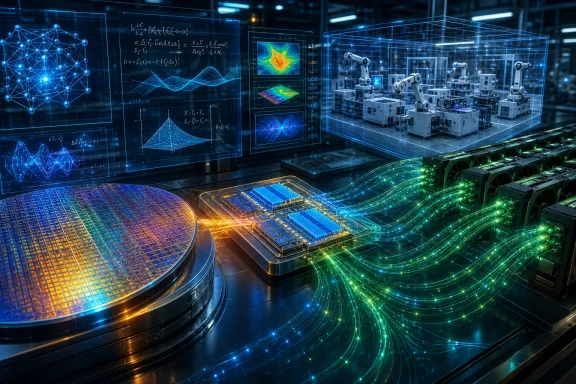
The partnership is not simply an Omniverse visualization exercise. Silvaco says it intends to accelerate semiconductor device, process, photonics and multiphysics calculations on Nvidia hardware, then use AI surrogate models to approximate expensive simulations when engineers need to explore many possible designs.
Silvaco offered an early benchmark involving a 3D finite-difference time-domain simulation of a photonic edge coupler. According to the company, the job used 3.2 billion mesh nodes across 32 Nvidia GPUs linked by NVLink and completed in under four hours; it said the same workload did not converge on CPUs. Silvaco also reported less than 0.15 dB difference between the simulated result and measurement.
That claim is vendor-supplied rather than an independently published comparison, but it illustrates why GPU acceleration matters in this corner of the semiconductor stack. As chips adopt more complex transistor structures, advanced packaging and optical interconnects, engineers must account for interactions across electrical, thermal, mechanical and optical domains rather than optimizing each in isolation.
For semiconductor teams, that could mean testing more variations in doping profiles, geometries, thermal limits or photonic structures before committing to lengthy verification runs. It also raises a familiar engineering requirement: surrogate models are only useful where their training data and validation envelope hold up. A fast estimate outside those bounds can be worse than no estimate at all.
Nvidia has made physics-based AI and industrial digital twins a central part of its enterprise software pitch in 2026, with other engineering software vendors pursuing similar integrations. The difference here is Silvaco’s focus on the semiconductor workflow, where process simulation and device behavior are tightly tied to manufacturing yield and qualification.
For Windows-based engineering environments, the near-term impact will depend on which Silvaco tools receive GPU-accelerated releases and how those workloads are packaged for on-premises Nvidia systems versus cloud deployments. The announcement establishes the technology direction, but it does not yet provide product release dates, supported GPU lists, licensing terms or measured gains across Silvaco’s broader TCAD portfolio.
GPU simulation is the immediate deliverable
The partnership is not simply an Omniverse visualization exercise. Silvaco says it intends to accelerate semiconductor device, process, photonics and multiphysics calculations on Nvidia hardware, then use AI surrogate models to approximate expensive simulations when engineers need to explore many possible designs.Silvaco offered an early benchmark involving a 3D finite-difference time-domain simulation of a photonic edge coupler. According to the company, the job used 3.2 billion mesh nodes across 32 Nvidia GPUs linked by NVLink and completed in under four hours; it said the same workload did not converge on CPUs. Silvaco also reported less than 0.15 dB difference between the simulated result and measurement.
That claim is vendor-supplied rather than an independently published comparison, but it illustrates why GPU acceleration matters in this corner of the semiconductor stack. As chips adopt more complex transistor structures, advanced packaging and optical interconnects, engineers must account for interactions across electrical, thermal, mechanical and optical domains rather than optimizing each in isolation.
PhysicsNeMo adds a faster path through design-space exploration
Nvidia’s PhysicsNeMo is expected to provide the AI component: models trained from high-fidelity simulation data that can estimate outcomes much more quickly than running the full physics solver every time. The aim is not to replace TCAD with a black-box model, but to retain physics-based results as the reference while using AI to search a much wider range of process and device parameters.For semiconductor teams, that could mean testing more variations in doping profiles, geometries, thermal limits or photonic structures before committing to lengthy verification runs. It also raises a familiar engineering requirement: surrogate models are only useful where their training data and validation envelope hold up. A fast estimate outside those bounds can be worse than no estimate at all.
From component models to fab-scale digital twins
Silvaco says it plans to connect its digital-twin environment with Nvidia Omniverse libraries and Nvidia Cosmos for collaborative, real-time visualization and simulation spanning fabs, manufacturing systems, robotics and infrastructure. That broadens the proposition from designing an individual transistor or photonic coupler to modeling how equipment, process conditions and factory operations affect output.Nvidia has made physics-based AI and industrial digital twins a central part of its enterprise software pitch in 2026, with other engineering software vendors pursuing similar integrations. The difference here is Silvaco’s focus on the semiconductor workflow, where process simulation and device behavior are tightly tied to manufacturing yield and qualification.
For Windows-based engineering environments, the near-term impact will depend on which Silvaco tools receive GPU-accelerated releases and how those workloads are packaged for on-premises Nvidia systems versus cloud deployments. The announcement establishes the technology direction, but it does not yet provide product release dates, supported GPU lists, licensing terms or measured gains across Silvaco’s broader TCAD portfolio.
References
- Primary source: Evertiq
Published: 2026-07-29T08:00:00+00:00
Silvaco partners with Nvidia to advance physics-based digital twins
Together, Silvaco’s physics-based simulation portfolio and Nvidia accelerated computing and AI will help customers design, simulate and optimize increasingly complex semiconductor technologies.evertiq.com - Related coverage: investors.silvaco.com
Silvaco to Accelerate Physics-Based Digital Twins for Semiconductor Design and Manufacturing Using NVIDIA AI and Accelerated Computing | Silvaco Group, Inc.
Silvaco is integrating NVIDIA accelerated computing and AI with its physics-based simulation portfolio to advance digital twins for semiconductor design and manufacturing SANTA CLARA, Calif., July 26, 2026 (GLOBE NEWSWIRE) -- Silvaco Group, Inc. (Nasdaq: SVCO) (“Silvaco”), a leading provider of
investors.silvaco.com
- Related coverage: silvaco.com
- Related coverage: blogs.nvidia.com
Into the Omniverse: How Industrial AI and Digital Twins Accelerate Design | NVIDIA Blog
Earlier this month, NVIDIA and Dassault Systèmes announced a partnership that brings together Dassault Systèmes’ Virtual Twin platforms, NVIDIA accelerated computing, AI physics open models and NVIDIA CUDA-X and Omniverse libraries.blogs.nvidia.com - Related coverage: id.investing.com
Saham Silvaco melonjak berkat kemitraan AI NVIDIA untuk desain chip Oleh Investing.com
Saham Silvaco melonjak berkat kemitraan AI NVIDIA untuk desain chipid.investing.com