
That does not make the central premise wrong. A real total-cost-of-ownership calculation should include more than token rates, particularly for organizations weighing a local inference server against a production API dependency. But SitePoint’s numbers are not safe to take into a purchasing meeting as published. The article’s own framing is right; its model needs to be rebuilt.
The date record is also muddled. The submitted metadata places publication on August 6, 2026, while SitePoint’s live page identifies the article as published on March 5, 2026. More materially, SitePoint says its hardware prices and API rates are from June 2025, making this a 2026-branded model based on figures already roughly a year old at publication.
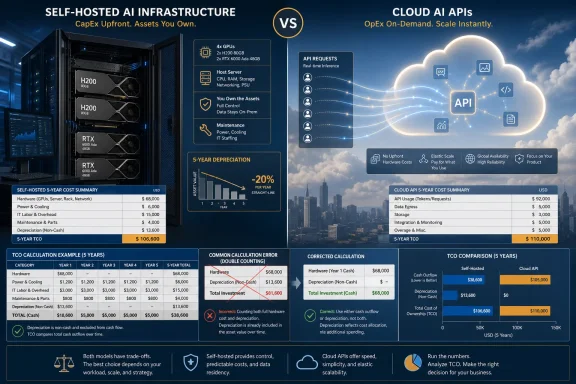 The 12-month TCO table counts the same GPU twice
SitePoint lists both the entire up-front hardware purchase and a year of depreciation as separate costs in its local-inference totals. Those are two different ways to account for the same asset, not two expenses that can be added together in a cash TCO.
For its “light” RTX 5090 workstation, SitePoint adds:
- $3,350 for the complete desktop build.
- $190 in annual electricity.
- $1,800 in annual operations labor.
- $1,117 in depreciation, which is one-third of the $3,350 purchase price.
That produces the article’s stated 12-month total of $6,457. But a cash-based first-year TCO is $5,340: the $3,350 purchase plus electricity and labor. An accrual-style annual operating-cost model could include the $1,117 depreciation charge, but then it cannot also include the full $3,350 capital purchase in the same annual total.
The same issue runs through the medium and heavy scenarios. The $6,900 dual-RTX-5090 configuration receives a separate $1,917 depreciation charge; the $200,000 four-H200 node receives another $66,667. SitePoint’s $308,347 heavy-tier first-year total is therefore inflated by precisely that $66,667 depreciation line. On the article’s assumptions, the cash total is $241,680: $200,000 in equipment, $5,680 electricity, and $36,000 in operations labor.
This is more than an accounting preference because SitePoint uses the inflated total to calculate its cost per million tokens and its break-even points. Hardware depreciation belongs in a budget and in a comparison of annual expenses, but it must replace the capital cost over the depreciation period — it cannot supplement it.
The GPT-4.1 totals do not match the declared token mix
SitePoint says its cloud examples use a 3:1 input-to-output ratio and prices GPT-4.1 at $2 per million input tokens and $8 per million output tokens. OpenAI’s published GPT-4.1 rate card confirms those base rates, along with lower cached-input pricing and a 50% Batch API discount for eligible asynchronous work.
With 75% input tokens and 25% output tokens, the blended GPT-4.1 rate is straightforward:
| Token type | Share of total tokens | Rate per million | Blended cost |
|---|---|---|---|
| Input | 75% | $2.00 | $1.50 |
| Output | 25% | $8.00 | $2.00 |
| Total | 100% | — | $3.50 per million tokens |
At 500,000 total tokens per day, a year contains 182.5 million tokens. That produces an annual GPT-4.1 bill of about $639, not SitePoint’s $1,260. At 5 million tokens per day, it becomes about $6,388, not $12,600. At 50 million tokens per day, it becomes about $63,875, not $126,000.
SitePoint’s published GPT-4.1 effective price is $6.90 per million tokens. Its own stated rates and 3:1 mix produce $3.50 per million. The cloud number is almost exactly double what the disclosed model should generate.
The Anthropic figures have a similar problem. Using the article’s own Claude Sonnet price inputs — $3 per million input tokens and $15 per million output tokens — the same 3:1 distribution produces a blended $6 per million, not the article’s $9.86 per million. Anthropic’s currently published pricing also varies by model, context length, caching, batch processing, and platform, which reinforces why a model needs a named SKU, a fixed region, and a documented mix before it can be used as a procurement forecast.
The “open-weight API” line is less auditable still. SitePoint supplies ranges for Together and Fireworks rather than selecting a specific provider, model revision, region, and rate card, then presents a single exact annual number: $360 at the light tier, $3,600 at medium, and $36,000 at heavy. A range can illustrate market positioning, but it cannot support an exact break-even claim without declaring which endpoint is being modeled.
Correcting the arithmetic changes the 36-month outcome
SitePoint says its four-H200 local deployment costs $391,707 over 36 months and then says that this “beats” OpenAI’s $378,000 total. It does not: $391,707 is higher than $378,000. The article’s prose contradicts its own numbers even before the accounting errors are fixed.
If the model is recast as a three-year cash TCO, the local figure falls because the $66,667 depreciation entry is removed:
- Initial hardware purchase: $200,000.
- Three years of electricity at $5,680 annually: $17,040.
- Three years of operations labor at $36,000 annually: $108,000.
- Three-year local cash TCO: $325,040.
At 50 million tokens per day, that works out to roughly $5.94 per million total tokens over three years.
That is lower than SitePoint’s published $6.90-per-million GPT-4.1 estimate, but that published cloud estimate is itself wrong under the declared 3:1 token distribution. Using the correct $3.50 blended GPT-4.1 rate, the same 54.75 billion tokens would cost about $191,625 over 36 months. Under SitePoint’s own workload assumptions, cloud GPT-4.1 remains approximately $133,000 cheaper than the four-H200 deployment.
The medium-tier conclusion also changes. A $6,900 dual-RTX system with $570 yearly electricity and $9,000 yearly operations labor has a three-year cash TCO of approximately $35,610. At 5 million tokens daily, three years of GPT-4.1 at the stated 3:1 mix is about $19,163. SitePoint’s published model says local can pull ahead over time; its corrected model says it does not.
There are scenarios in which local hardware wins decisively. They generally require very high and sustained utilization, lower marginal labor costs than SitePoint assumes, a model that can genuinely meet application-quality requirements, and an API alternative with a substantially higher realized price than the GPT-4.1 calculation used here. But those conditions need to be demonstrated, not inferred from an arithmetic error.
The Mac Studio configuration is wrong, and the hardware list is dated
SitePoint describes an “Apple Mac Studio M4 Ultra” with 192GB of unified memory. Apple’s March 2025 Mac Studio release paired the M4 Max with the M3 Ultra, not an M4 Ultra. The M3 Ultra Mac Studio starts at 96GB of unified memory and can be configured to 512GB.
That mistake does not invalidate the case for Apple silicon as local-LLM hardware. Unified memory is particularly relevant when a model will not fit in the 32GB VRAM of an RTX 5090, and Apple’s M3 Ultra platform can accommodate model sizes that a single consumer GPU cannot. But a TCO comparison has to price an actual configuration that buyers can order, benchmark, and support.
The article is more solid on the AMD MI325X’s basic specification: AMD lists 256GB of HBM3E memory and 6TB/s of peak memory bandwidth. Yet the price range SitePoint assigns to a single MI325X deployment is not corroborated with an OEM configuration, reseller quote, warranty term, support tier, or regional availability. Datacenter accelerators are frequently sold as part of validated server platforms, not as interchangeable retail components. Treating them like a large consumer GPU purchase conceals a meaningful part of the procurement cost.
Daily tokens do not tell IT what server to buy
The larger methodological omission is capacity planning. “50 million tokens per day” says almost nothing about whether four H200 GPUs are too many, too few, or appropriate. It does not identify the model, quantization format, context length, concurrency, output length, time-to-first-token target, requests per second, service-level objective, redundancy requirement, or demand spikes.
A workload averaging 50 million total tokens per day is roughly 579 tokens per second across 24 hours. Under the article’s 3:1 ratio, that implies about 145 output tokens per second on average. But LLM serving is constrained differently for prompt processing and token generation, and average daily volume does not capture business-hour peaks or tail latency. A customer-facing coding assistant, a nightly document-classification batch, and an internal RAG search tool can consume the same daily token count while demanding radically different infrastructure.
SitePoint correctly points readers toward vLLM for production serving and Ollama for simpler local use. The practical missing step is a benchmark using the same model and the same workload on each candidate platform. Comparing a local Llama, Qwen, or DeepSeek deployment with GPT-4.1 or Claude Sonnet is a cost comparison across different capabilities, tool-use behavior, context handling, safety behavior, and maintenance obligations. It is not a clean substitution calculation.
For Windows developers and IT teams, the actionable conclusion is narrower than SitePoint’s headline: self-hosting should be evaluated as a workload-specific capacity project, while cloud APIs should be evaluated from actual request logs rather than list-price token projections. Measure input/output ratios, cache-hit rates, peak concurrency, retries, latency targets, and the model quality required for the task. Then run either a cash-flow model or an accrual model — never both at once.
The article is right that token price alone is an insufficient basis for architecture. Its own tables show why the accounting model has to be at least as rigorous as the infrastructure decision it is meant to support.
