
Signal65, whose work was commissioned by Qualcomm, reportedly compared an ASUS Zenbook A16 with Snapdragon X2 Elite Extreme against an MSI Prestige 16 using Intel’s Panther Lake flagship and an HP OmniBook X 16 with AMD’s Ryzen AI 9 465. Windows Central says the Qualcomm system led Geekbench 7 by as much as 53% over Intel and 83% over AMD, while Cinebench 2026 multi-core results put it up to 87% ahead. It also reports Snapdragon held the CPU and AI lead in Balanced mode on battery while the other two systems were plugged in and set to Best Performance.
Those are eye-catching results, and they reinforce a broader point already visible in independent reviews: Qualcomm’s second-generation laptop silicon is a much more serious CPU contender than the original Snapdragon X launch. They are not, however, a simple processor league table—and a product-SKU mismatch in the reporting makes the price claim especially shaky.
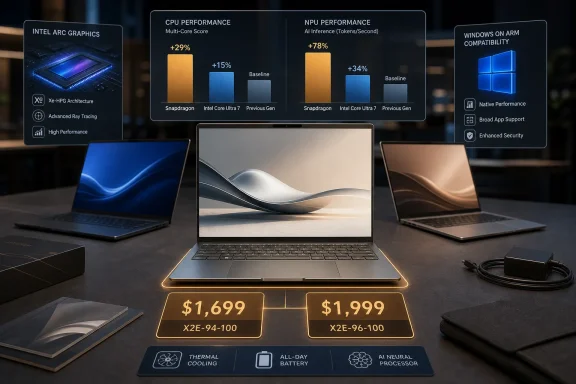 The $1,699 Zenbook A16 is not the advertised top-bin system
Qualcomm’s own Snapdragon X2 product brief lists two Elite Extreme parts with materially different peak clocks. The X2E-96-100 reaches 5.0 GHz for single- and dual-core boost, while the X2E-94-100 reaches 4.7 GHz. Both have 18 CPU cores, the same 80 TOPS Hexagon NPU, the Adreno X2-90 integrated GPU, 53MB of cache, and 228GB/s of LPDDR5X bandwidth. The difference is not cosmetic: the 96 model has the higher boost bin that matters most in lightly threaded and bursty work.
Windows Central identifies the tested Snapdragon part as X2E-96-100, then frames the ASUS system as a $1,699 machine. ASUS’s US product material, however, identifies its $1,699.99 Best Buy Zenbook A16 configuration as the X2E-94-100, paired with 48GB of memory, a 1TB SSD, Windows 11 Home, and a 3K 120Hz touchscreen. Tom’s Hardware independently reviewed that $1,699.99 X2E-94 model and found the same configuration.
The actual X2E-96-100 Zenbook A16 is a different SKU. ASUS sells it with a non-touch display and Windows 11 Pro for $1,999.99. That means the Windows Central report may be correct that Signal65 used a retail X2E-96-100 system, but its accompanying value comparison ties the benchmarked chip to the lower-priced configuration most buyers will encounter. Those are not interchangeable claims.
For IT buyers, this is more than a nitpick over a few hundred megahertz. Procurement decisions often start with an advertised performance-to-price ratio, then get turned into a specific SKU. If the test result comes from the $1,999 top-bin model while the favorable price belongs to the $1,699 lower-bin model, the comparison should say so plainly. The $1,699 Zenbook may still be an attractive deal—48GB of memory in a thin 16-inch OLED laptop is unusually generous at that price—but it is not proof that the highest Snapdragon X2 Elite Extreme performance is available at $1,699.
Signal65 compared complete laptops, not controlled chip platforms
Signal65’s use of retail systems is valuable because it avoids the familiar problem of vendor reference designs producing numbers that never appear in stores. The three systems in this comparison are still three different laptops, though, with different displays, batteries, cooling assemblies, firmware, memory configurations, storage, driver packages, and OEM power policies.
Those choices can substantially affect the benchmarks used here. Cinebench rewards sustained multicore performance, where cooling capacity and long-duration power limits influence the outcome. Geekbench can be sensitive to boost behavior, memory bandwidth, and task scheduling. NPU benchmarks have their own complication: the Snapdragon X2 Elite Extreme’s 80 TOPS NPU has a raw throughput advantage over the 50 TOPS NPUs in the cited Intel and AMD machines. A lead in UL Procyon AI Computer Vision is meaningful, but it is not surprising that an accelerator rated for 60% more theoretical operations per second wins that class of test.
The battery-versus-AC comparison needs similar restraint. Windows Central reports that Signal65 ran Snapdragon on battery in Windows Balanced mode while Intel and AMD were plugged in under Best Performance, with Qualcomm still winning the CPU and AI tests. That result is a useful demonstration of performance availability away from the wall, but it does not alone prove superior efficiency. A proper efficiency conclusion needs the workload result alongside measured platform power, elapsed energy use, battery capacity, screen brightness, and enough repeat runs to account for firmware behavior.
Independent testing gives a reminder of why platform details matter. Tom’s Hardware’s review of the retail Zenbook A16 found the Snapdragon X2 Elite Extreme powerful, but did not find it class-leading in battery life against Intel and Apple systems. The reviewer also measured noticeable heat during sustained Cinebench 2026 work, with the keyboard reaching 104 degrees Fahrenheit and the underside 109 degrees. That does not negate Signal65’s scores; it does show that “fast on battery” and “best endurance” are separate questions.
Intel still has the graphics case, and software remains the purchase gate
Windows Central notes that Intel’s Arc B390 integrated graphics led Snapdragon in Signal65’s graphics tests and that Intel won one Office battery rundown. This is the result that should matter most to buyers who use their thin-and-light as an occasional creative or gaming machine. Qualcomm’s CPU and NPU advances do not automatically make its integrated Adreno GPU the best option for workloads that lean heavily on graphics drivers, graphics APIs, video effects, or game compatibility.
The bigger practical dividing line is still Windows on Arm software support. A benchmark suite can establish that the silicon executes supported native workloads quickly. It cannot establish that every Windows application, peripheral driver, kernel extension, legacy VPN client, anti-cheat component, endpoint-security agent, printer utility, or specialized line-of-business package behaves identically on Arm64 Windows.
For a personal laptop used mainly with modern browsers, Microsoft 365, collaboration clients, media apps, and Arm-native or well-emulated desktop software, Snapdragon X2 performance changes the conversation. The first Snapdragon X generation made Windows on Arm viable for many users; X2 makes it competitive enough that the remaining qualification work is less about accepting a CPU slowdown and more about finding any compatibility blockers.
For managed fleets, the test result should trigger validation rather than a blanket refresh decision. Test the exact X2E-94 or X2E-96 SKU, the required Windows 11 edition, VPN and identity stack, endpoint protection, printer deployment, device-management agents, core productivity software, and any hardware-dependent workflows. A fast Geekbench score cannot remediate a driver that does not exist for Arm64.
Apple is part of the broader story, not this lab comparison
The submitted headline says Snapdragon is beating Apple and AMD in nearly every category, but the new Signal65 comparison described by Windows Central names Intel and AMD systems, not an Apple MacBook. Apple enters through a separate February report based on Hardware Canucks testing of a pre-production Qualcomm-supplied system using the non-Extreme Snapdragon X2 Elite X2E-88-100.
That earlier testing did show Qualcomm’s chip ahead of Apple’s M5 in some multi-core, Blender, and HandBrake tests. It also showed Apple’s M5 ahead in Cinebench single-core performance. Conflating that earlier pre-release comparison with the new commissioned retail-laptop study makes Snapdragon’s Apple lead appear more comprehensively established than the record supports.
There is a related mismatch in the ASUS marketing material. ASUS compares its Zenbook A16 against an M5 MacBook Pro, but it identifies the tested ASUS chip as the X2E-94-100—not the X2E-96-100 used in Qualcomm’s peak performance messaging. That is a legitimate product comparison, but it is vendor testing with different operating systems, memory capacities, storage capacities, power modes, and software stacks. It should inform a purchasing decision only alongside independent application-specific tests.
Qualcomm has won attention; the SKU and workload now matter more than the logo
The defensible conclusion is that Snapdragon X2 Elite Extreme has delivered the CPU and on-device AI performance leap Qualcomm promised, and Signal65’s retail-system work is stronger evidence than the reference-laptop demonstrations from late 2025. Intel’s graphics advantage in this comparison and independent concerns over the Zenbook A16’s sustained thermals and battery life keep the result from being a clean sweep.
Buyers should also separate the two ASUS configurations before treating this as a $1,699 flagship-performance story. The X2E-94-100 Best Buy model is the $1,699 system; the 5.0 GHz X2E-96-100 model is the $1,999 Windows 11 Pro configuration. Qualcomm’s strongest numbers may be real, but the exact laptop, power profile, and Arm64 software workload will determine whether they translate into a better Windows PC.
