

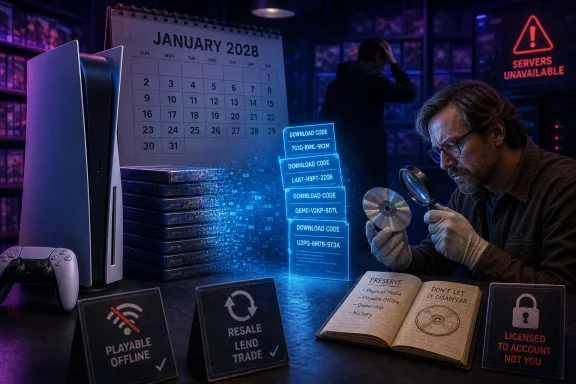
Sony says titles already released on disc, along with games that ship on disc before January 2028, will not be affected by the policy. Subsequent reporting by Game File, echoed by TechSpot and other outlets, added an important qualification: publishers should still be able to order additional runs of eligible pre-2028 disc games after the cutoff. That prevents the announcement from becoming an immediate death sentence for existing PS4 and PS5 libraries.
It does not solve the central problem for future releases. From January 2028, a customer buying a newly released PlayStation game at a retailer will be buying a digital product, even if that transaction happens across a physical counter. Sony’s announcement does not say whether those retail sales will be ordinary download-code cards, whether retailers will retain independent discounting flexibility, or how long redemption and download access will be maintained for future titles.
January 2028 Ends New PlayStation Disc Releases, Not Existing Discs
The distinction is essential because much of the early reaction treated Sony’s announcement as if every PlayStation disc would suddenly become unusable. Sony did not say that. The company’s stated policy concerns manufacturing new physical releases from January 2028 onward; it also said discs released before that date would remain outside the change.
Yet the narrower policy is still a major structural shift. New releases are the point at which a physical market refreshes itself: retailers stock them, used-game supply begins, collectors buy them, and preservation groups can test the shipped code. Stop adding new discs and the market can survive only on back catalogues and reprints of older software.
Sony framed the move as a response to consumer preference for digital media. Its own financial reporting supports the broad direction of that claim: digital downloads account for the large majority of PlayStation full-game purchases. But a majority preference does not answer the ownership question facing the remaining buyers, nor does it establish that the practical benefits of a disc have become irrelevant.
A disc can be resold, lent, borrowed, purchased from a competing store, and retained without an account-level license check in many cases. It is not a perfect preservation mechanism. Modern console games can require patches, online activation, server authentication, or downloads that make the shipped disc incomplete. But an imperfect local copy is materially different from no local copy at all.
Does It Play’s Argument Depends on What Is Actually on the Disc
Istel’s criticism carries more weight than a generic nostalgia pitch because Does It Play tracks a specific question: whether a retail game can be installed and played without relying on a later download. In the figures cited by PC Gamer, the group found that 34% of tested PlayStation 5 releases and 50% of tested Xbox Series X releases did not fully work without downloading additional data.
Those figures are Does It Play’s own testing, not an industry-wide audit, and they should be read that way. The database does not establish that precisely one-third of every PS5 game or half of every Xbox Series game is unavailable offline. Its sample, regional editions, revisions, launch patches, and testing conditions matter. The useful finding is narrower and still significant: a disc label no longer reliably tells a buyer that the full launch game is present and playable.
That makes the preservation fight more technical than the usual “physical versus digital” framing suggests. A retail disc may preserve version 1.0 but omit critical assets. A game may be complete on the disc yet block play behind a server check. Conversely, a digital PC release can be backed up locally and run indefinitely if it has no online DRM or server dependency.
The sensible standard is therefore not “every game must be pressed on Blu-ray.” It is that a buyer should have a workable end-of-life path: a complete installable build, a way to authenticate after commercial support ends, and clear disclosure when any of those conditions are absent. Sony’s July announcement describes its distribution decision but does not offer such a preservation commitment for the digital-only releases that will follow.
Console Lock-In Makes the Price and Access Issue Harder
The preservation group’s broader claim is that physical media restrains a platform holder’s control over price and access. That is partly true, although discs do not eliminate publisher pricing power. A new PlayStation game can still launch at the same manufacturer’s suggested price in every shop. The difference comes later, when stores clear inventory, used copies circulate, and buyers can choose a seller without asking Sony to grant a license.
A digital-only console does not automatically mean a single seller. Sony says future games will be available through PlayStation Store and retailers, but the company has not explained what meaningful retail competition will look like once the game itself is a download. If retailers sell codes that ultimately redeem into PlayStation’s account system, they are competing on promotions and distribution while Sony remains the party controlling entitlement, downloading, compatibility, and the terms of access.
That is why a direct comparison with PC gaming needs care. PC players have largely left boxed retail software behind, but Windows users can choose among multiple stores and delivery models. Steam is dominant, Epic Games Store and Microsoft Store operate as alternatives, and GOG sells many titles without DRM. A player who objects to one storefront has more routes to buy and run software, including independent launchers and, in some cases, direct developer distribution.
Those options do not make the PC market a preservation utopia. Steam’s Offline Mode is useful but is not equivalent to a DRM-free installer. Microsoft Store and Game Pass purchases are tied closely to accounts and service availability. Many PC games depend on publisher launchers, anti-cheat systems, cloud saves, or servers that can disappear. Still, the ability to change storefronts, preserve standalone installers from GOG, or move to another operating system gives PC users leverage that a PlayStation owner lacks.
Istel’s claim that an online-dependent digital license puts the customer at the mercy of a third party is therefore strongest when applied to closed console platforms. There is no competing PlayStation storefront that can sell an alternative license for the same PS5 game. There is no supported way to install a different operating system and keep the console library. Sony’s control of the hardware, account system, store, and future distribution format is unusually complete.
Sony Has Left the Most Important Future Details Unanswered
The immediate temptation is to treat the 2028 cutoff as confirmation that PlayStation 6 will be disc-free. Sony has not announced PlayStation 6, its release date, its media support, or whether any external drive option could exist. Reporting that connects the disc cutoff to a future digital-only console is inference, not confirmation.
Sony has also not committed to supporting today’s PlayStation hardware forever, and it has not said what happens if a purchaser needs to re-download a post-2028 game many years after sale. Those are separate questions from disc manufacturing, but they become more urgent once all new releases require a digital entitlement.
The company’s reprint clarification gives existing physical buyers a better outcome than the original announcement suggested. It preserves the possibility that successful PS4 and PS5 games will remain available on disc after 2028. But it does nothing for a game released on February 1, 2028, which will enter the market without a disc edition to preserve, resell, or test independently.
For PC gamers watching from Windows, the warning is not that digital distribution is inherently unworkable. The better lesson is that store choice, local installers, and offline usability are the safeguards that matter once physical media is gone. Sony’s announced policy removes one of those safeguards for future PlayStation releases. Until it explains durable ownership, offline access, and retailer competition in the digital-only era, Does It Play’s anger is aimed at a real gap in the plan—not merely at the disappearance of plastic cases.