
The result, first reported by PC Gamer and independently described by Tom’s Hardware, is encouraging for the Linux graphics stack: the user says SteamOS recognized the RX 9070 XT as the primary display adapter immediately, with no manual GPU selection. But it is still a one-off community experiment with a very limited test record. The claimed performance figure — more than 100 frames per second in Crimson Desert at High settings — came from only a brief run, with no disclosed resolution, frame-time data, power measurements, driver version, or comparison against the Steam Machine’s built-in graphics.
That distinction should keep the “Steam Machine eGPU” headlines in perspective. This mod establishes that the hardware can be persuaded to use a powerful external Radeon card through its internal PCIe storage link. It does not establish that a Steam Machine has practical plug-and-play external graphics support, that the RX 9070 XT retains desktop-class performance over the connection, or that the setup is stable enough to recommend for ordinary owners.
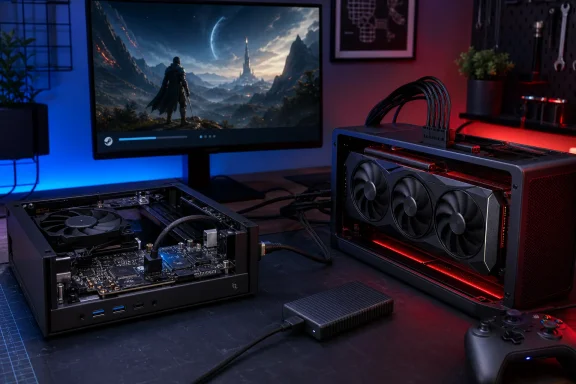 The NVMe slot becomes the GPU connection
The core of the mod is OCuLink, a compact cable standard that exposes PCI Express lanes externally. In this case, the user appears to have taken the Steam Machine’s sole internal NVMe slot — normally occupied by the system SSD — and repurposed it as the connection to an OCuLink eGPU dock.
That is a clever workaround precisely because Valve did not ship the Steam Machine with a user-facing OCuLink, USB4, or Thunderbolt eGPU port. Valve’s support documentation lists two front USB-A 3.2 Gen 1 ports, two rear USB-A 2.0 ports, and a rear USB-C port on a separate bus. None is advertised as an external PCIe graphics interface. The physical NVMe connector is therefore the route with the lowest software overhead and the most direct electrical path to the processor’s PCIe lanes.
It also means the trade-off is fundamental. The internal SSD cannot remain in that slot while the eGPU is connected. Large_Customer_3840 instead booted SteamOS from an NVMe drive inside a USB-C enclosure, turning the Steam Machine’s internal storage socket into a dedicated graphics expansion connector.
For a test bench, that is sensible. For a living-room machine, it creates a chain of dependencies: an opened chassis, an exposed or rerouted cable, an external GPU dock with its own power supply, a desktop graphics card, and USB-attached boot storage. Every one of those components becomes another possible source of boot, sleep-resume, display-detection, cable-quality, and bandwidth problems.
SteamOS recognizing the Radeon card is the real news
The most useful part of the Reddit report is not the Crimson Desert frame-rate claim. It is the fact that SteamOS reportedly detected the RX 9070 XT and made it the primary display device immediately.
AMD lists the Radeon RX 9070 XT as a 64-compute-unit RDNA 4 desktop GPU with 16GB of GDDR6 memory, a 304W total-board-power rating, and two eight-pin auxiliary power connectors. It is a dramatically different class of hardware from the Steam Machine’s semi-custom RDNA 3 GPU, which Valve specifies at 28 compute units, 8GB of GDDR6, and a 110W sustained power target.
The Steam Machine’s standard configuration has 16GB of DDR5 system memory alongside that 8GB graphics pool. The external RX 9070 XT brings its own 16GB of dedicated video memory and substantially more compute hardware. For newer games whose settings are constrained by 8GB of VRAM, that capacity change could matter as much as raw shader performance.
SteamOS and Mesa’s AMD graphics support have made this kind of experiment more plausible than it would have been in the early Steam Machine era. Still, “it displayed an image and launched one game” is a lower bar than comprehensive compatibility. The user reported an initial black-screen issue that was resolved only after connecting the Steam Machine to a television, a sign that display initialization may remain fragile.
Valve’s own troubleshooting guidance recommends connecting the machine directly to a display when diagnosing video problems and warns that adapters, docks, receivers, and switches can complicate display behavior. This eGPU build adds several of those variables at once.
OCuLink’s four PCIe lanes are the bottleneck
An OCuLink eGPU link is much better suited to graphics than a conventional USB data connection, but it does not turn an external card into an internally installed x16 GPU. The AOOSTAR EG01 dock used in the mod is specified for PCIe 4.0 x4 over OCuLink: four PCIe lanes rather than the 16 lanes available to a normal desktop graphics slot.
That limitation is not cosmetic. A Radeon RX 9070 XT has enough rendering throughput and memory bandwidth to expose a narrow host connection in some games, particularly at lower resolutions and high frame rates where more assets, draw calls, and synchronization traffic can cross the PCIe link. Community respondents on the original post flagged potential stutter and suggested frame caps, though those are informed expectations rather than measurements from this specific setup.
The available Crimson Desert result cannot quantify that loss. “Over 100 fps on High” says little without the output resolution, whether upscaling or frame generation was active, the exact scene tested, and frame-time percentiles. A system can report a high average frame rate while delivering uneven pacing — precisely the problem that an external PCIe link can make more noticeable.
There is another unknown: the Steam Machine’s M.2 slot generation and lane arrangement. The dock supports PCIe 4.0 x4, but the actual negotiated speed on Valve’s hardware was not reported. Until someone captures link-state data from SteamOS and runs repeatable benchmarks, readers should not assume a PCIe 4.0 x4 connection, let alone performance comparable with the same card in a desktop PC.
This is an expensive route around a compact PC’s design
The mod is technically impressive, but it does not solve the Steam Machine’s value question for most buyers. Valve’s Steam Machine launched at $1,049 for the 512GB model and $1,349 for the 2TB model in its limited initial drop. Adding a Radeon RX 9070 XT, OCuLink dock, M.2 adapter, USB NVMe enclosure, SSD, cabling, and likely case modification produces a price and footprint closer to — or beyond — a purpose-built small-form-factor gaming PC.
The card alone has a 304W board-power specification, while the Steam Machine’s appeal is its relatively small, self-contained chassis and console-like placement near a television. The external dock must handle GPU power separately, and the GPU changes the acoustic and physical profile of the setup completely. Calling this a “Steam Machine upgrade” is accurate in the narrow electrical sense, but it understates how much of the original appliance-like design has been discarded.
A mini PC designed around OCuLink, or an ITX system with a standard PCIe x16 slot, remains the cleaner option for anyone buying hardware specifically to pair with a desktop-class GPU. Those systems avoid surrendering the only internal NVMe slot and do not require the operating system to live on a USB enclosure.
Valve also explicitly advises owners not to open or modify the Steam Machine, warning that damage caused in the process is not covered by the product warranty. The company says accessible screws use a T8 Torx driver, but that is a service note, not an endorsement of internal modifications. A damaged M.2 socket, connector, or case is the owner’s problem.
What a credible follow-up test needs to show
The mod deserves attention because it has answered one basic compatibility question: an RX 9070 XT can be detected and used through the Steam Machine’s NVMe interface under SteamOS. That is a useful result for tinkerers and a strong sign that Valve’s AMD-focused software base is capable of handling an external RDNA 4 GPU without a bespoke driver installation.
It is not yet a build guide. Before anyone treats it as one, the community needs repeatable data on the negotiated PCIe link, game-by-game averages and one-percent lows, frame-time consistency, sleep and reboot reliability, multi-display behavior, power delivery, thermals, and whether updates to SteamOS or AMD’s Mesa drivers change detection behavior.
For now, the practical consequence is simple: Steam Machine owners have a proof of concept, not a supported expansion path. The next person who replicates it should bring benchmarks — and a backup of the USB boot drive.