
That distinction changes the shopping advice. The Steam Machine is a complete, compact 1080p-oriented PC with a six-core Zen 4 CPU, 16GB of DDR5 memory, 512GB of storage in its base configuration, a custom power system, and SteamOS. A B580 or RX 7600 XT is a component that still needs a CPU, motherboard, memory, storage, case, power supply, cooling, and an operating system or SteamOS installation. The graphics-card comparison is useful for locating Valve’s performance tier; it does not demonstrate that a $249 GPU replaces a $1,049 living-room PC.
BGR’s August 7 guide bases its positioning partly on GamersNexus testing, which is the right source to consult. But GamersNexus’ own results show a more variable outcome than “four cards more powerful” conveys: Valve’s machine lands around the RTX 3060 12GB, RX 6600, RX 5700, Arc A750, and, depending on the game, Intel’s Arc B580. The B580 is not a clean step above the Steam Machine across the board. It is sometimes ahead, sometimes effectively tied, and it has the same basic limitation as Valve’s box: modern games increasingly reward more GPU horsepower than this class offers.
 The Steam Machine’s GPU is stronger than its price tag implies — and weaker than its marketing needs
Valve put a semi-custom 28-compute-unit RDNA 3 GPU with 8GB of dedicated GDDR6 into the Steam Machine, along with a stated 110W graphics power envelope. In GamersNexus’ testing, that hardware delivered 94 frames per second in Resident Evil 4 at 1080p, 59 FPS in Cyberpunk 2077: Phantom Liberty at 1080p Ultra, and 41 FPS in Starfield at 1080p Ultra.
Those are playable numbers, particularly for a machine intended to default to 1080p on a television. Valve told GamersNexus that 1080p is the standard resolution used for Steam Machine Verified testing, and the hardware’s real strength is its quiet, small, turnkey implementation rather than raw throughput. The reviewer measured roughly 20–21 dBA during a Black Myth: Wukong gaming workload, an unusually low noise level for a living-room PC.
But the performance ceiling is also real. The Steam Machine’s resolution settings default to 1920×1080 even when it is attached to a 4K display, and GamersNexus found that this behavior was confusing enough that Valve said it was working on interface changes. Running a game at 4K output through upscaling is possible, but that is different from native 4K performance. Buyers expecting a $1,049 device to behave like a current high-end PC will be disappointed.
The more material problem is consistency. In Black Myth: Wukong, the Steam Machine averaged 43.9 FPS and was roughly tied with the Arc B580. In Oblivion Remastered, it effectively matched AMD’s RX 7600 at the tested settings. In Starfield, however, the RX 7600 XT posted a 36% lead, and Nvidia’s RTX 5060 was 59% faster in the same GPU-bound test. “Steam Machine performance” is therefore not one fixed GPU equivalence; it shifts with the game, Linux/Proton behavior, graphics API, and CPU limits.
The Arc B580 is the only genuinely revealing comparison in BGR’s list
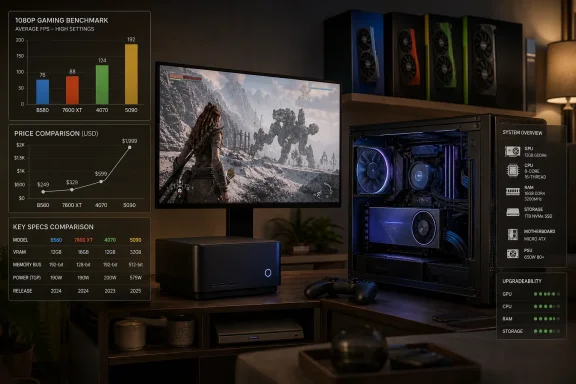
Intel launched the Arc B580 in December 2024 at $249, with 12GB of VRAM. BGR is right to identify it as the low-cost card most likely to make a Steam Machine buyer pause, particularly because it can be installed in a conventional Windows 11 gaming PC and offers more memory than the Steam Machine’s 8GB graphics allocation.
The catch is that the B580’s advantage is not reliably dramatic. BGR cites 79.9 FPS for the B580 versus 59 FPS for the Steam Machine in Cyberpunk 2077: Phantom Liberty at 1080p Ultra. That sounds decisive, but a single benchmark does not settle the comparison. GamersNexus’ direct Steam Machine review says the two were close enough in Black Myth: Wukong to call them roughly tied, while its overall conclusion put the B580 among the most immediately faster current-generation cards rather than in a clearly higher performance category.
There is also a methodology issue that matters more than the rounded FPS figures. GamersNexus benchmarks the Steam Machine on SteamOS using MangoHud, while its Windows GPU suite uses PresentMon. The outlet explicitly warns that these tools monitor different graphics pipelines on fundamentally different operating systems. Its results remain valuable as broad comparative evidence, but treating every result as a laboratory-grade, card-for-card equivalence is a mistake.
For a Windows user who already owns a reasonably modern desktop, the B580 can be a sensible upgrade or a budget build component. Intel’s 12GB frame buffer is attractive at a time when 8GB cards face texture compromises in newer games. But it is not a standalone Steam Machine replacement, and its performance can vary more by game than BGR’s simple hierarchy suggests.
Intel’s official $249 launch price also no longer describes normal street pricing. Recent deal tracking has put B580 models closer to the high-$200 range in the United States, while broader GPU price reporting shows the market has remained stubbornly above launch MSRPs. A recommendation anchored mainly to a 2024 MSRP needs a current-price check before it becomes purchase advice.
Radeon RX 7600 XT: a clearer uplift, but an aging choice
The Radeon RX 7600 XT is the best-supported middle-ground entry in BGR’s list. AMD released the card in January 2024 at $329 with 16GB of GDDR6 memory, and its extra memory capacity gives it a practical advantage for games that punish lower-VRAM settings at 1440p.
GamersNexus’ Steam Machine results support the general point. The standard RX 7600 led Valve’s system by 20% in Resident Evil 4 and Cyberpunk 2077, while the 7600 XT was 36% faster in Starfield and 16% faster in Oblivion Remastered. That does not turn the RX 7600 XT into a 4K card, but it offers a meaningful margin where the Steam Machine is most constrained.
The problem is that BGR’s selection is stale relative to the current market. AMD’s RX 9060 XT now occupies the newer mainstream tier, and contemporary price tracking has placed the 8GB model around $359 and the 16GB version around $449. Those are not bargain prices, but they show why comparing the Steam Machine chiefly with a two-year-old RX 7600 XT is incomplete. The newer cards that materially exceed Valve’s system are available; they just no longer sell at the kind of prices that make “build your own instead” an automatic win.
That is the story BGR gestures toward when it acknowledges expensive memory and storage, but does not follow through on: current GPU pricing has eroded the clean value argument without eliminating the performance argument.
RTX 4070 and RTX 5090 prove only the obvious
The RTX 4070 is indisputably faster than the Steam Machine. Nvidia launched the 12GB Ada-generation card in April 2023 at $599, and it has substantially more raster performance, stronger ray tracing, mature Windows drivers, and access to Nvidia’s upscaling stack. DLSS 4.5 Super Resolution support reaches RTX cards including the RTX 4070, although the multi-frame-generation advantages Nvidia promotes most heavily remain a GeForce RTX 50-series feature.
Still, the RTX 4070 comparison is not especially actionable in August 2026. It is an older, discontinued-generation class of card that illustrates a performance gap but says little about the best new purchase. A buyer shopping today should compare actual prices for current RTX 5060-, RTX 5070-, RX 9060 XT-, and RX 9070-class hardware, rather than treating the original $599 RTX 4070 MSRP as a meaningful price point.
The RTX 5090 entry is even less useful as buying guidance. Nvidia’s $1,999 launch MSRP is real, and BGR correctly warns readers not to expect to find the card at that price. Recent reporting from Tom’s Hardware put the best U.S. price near $4,288, more than twice MSRP. At that price, the comparison has no value proposition at all: the 5090 is vastly faster than Valve’s compact midrange system because it is a flagship GPU priced well above the cost of several Steam Machines.
Its inclusion does underline a valid point: performance comparisons without price and system-level context can be meaningless. No one considering the Steam Machine as a compact console-style PC should be weighing it against a GPU that can cost four times as much before the rest of the computer is built.
Windows remains the simpler route for a DIY replacement
For Windows enthusiasts, the practical split is straightforward. A DIY Windows 11 PC with an Arc B580, RX 7600 XT, RTX 5060, RX 9060 XT, or better card can outpace Valve’s machine and offer broader support for anti-cheat systems, desktop applications, multiple displays, and conventional peripherals. It can also be upgraded later, unlike Valve’s tightly integrated box.
SteamOS is part of what the Steam Machine buyer is paying for. GamersNexus found the interface polished in its controller-first design but noted several growing pains: a 1080p resolution cap by default, rough mouse-and-keyboard behavior in gaming mode, incomplete multi-monitor support outside Desktop Mode, and anti-cheat incompatibilities that block some games altogether. The outlet also reported that Nvidia driver support under SteamOS remains more difficult than AMD or Intel support.
The better conclusion is not that BGR’s four cards are wrong. They are faster, and the RX 7600 XT, RTX 4070, and RTX 5090 are plainly faster. The conclusion is that the Arc B580 is the only one close enough in cost and performance to expose the Steam Machine’s uncomfortable position — and even that card does not beat it by enough in every game to settle the argument.
A buyer who wants the smallest, quietest, prebuilt SteamOS living-room PC still has a reason to buy Valve’s hardware. A buyer who wants maximum frame rate per dollar, Windows compatibility, or a machine that can accept a future GPU upgrade should price a complete desktop around current hardware instead of using a $249 graphics-card MSRP as a substitute for the entire build.
