

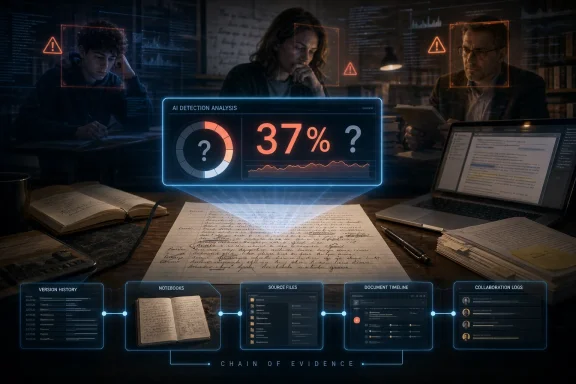
The problem is not that generative AI misuse is imaginary. Students, applicants, marketers, and publishers do use ChatGPT, Gemini, Copilot, and other systems to produce work they present as their own. The problem is that text-only detectors do not recover an author’s process. They classify patterns in the finished prose, then present a probabilistic result in a form that many users interpret as a finding of fact.
That distinction is being lost just as the tools are being placed in more consequential settings.
A detector score is not authorship evidence
Traditional plagiarism systems and AI detectors answer different questions. A Turnitin similarity report can identify matching language against a known corpus of web pages, publications, and submitted papers; an investigator can inspect the matching source, distinguish a quoted passage from unattributed copying, and decide whether the overlap is meaningful.
AI detectors instead infer whether writing resembles text from a model. GPTZero, Turnitin, Pangram, and similar products assess statistical features such as word choice, sentence structure, predictability, and repetition. A score may be useful as a prompt to look closer, but it does not show who wrote a passage, what tools they used while drafting, whether an editor revised it, or whether any AI assistance violated the policy in question.
Even the companies selling the technology concede that limit. Turnitin describes its AI-writing score as a signal for an educator’s investigation rather than a misconduct determination, while GPTZero says no detector can be perfect. OpenAI reached the same conclusion much more publicly: it withdrew its own AI text classifier on July 20, 2023, citing its low accuracy. During the classifier’s short life, OpenAI said it correctly identified only 26 percent of AI-written text in one challenge set and falsely labeled human text as AI-written 9 percent of the time.
Those figures are old, and today’s products have changed. But the underlying limitation remains: a detector receives output, not provenance. It cannot inspect a writer’s notebook, version history, source files, research trail, chat logs, or the circumstances under which a person made choices in a draft. Treating its percentage as proof asks a statistical classifier to perform a forensic function it was never designed to fulfill.
The false-positive dispute is broader than vendor benchmarks
Detector vendors publish impressive-looking accuracy claims, often based on controlled datasets and carefully selected minimum lengths. Turnitin says its model has a false-positive rate below 1 percent in documents where it identifies at least 20 percent likely AI writing, and it says testing of longer submissions found no statistically significant disparity for English-language learners.
Independent research has repeatedly found conditions that are much less forgiving. A Stanford-led study published in Patterns tested seven detectors against TOEFL essays written by non-native English speakers and essays from U.S. eighth graders. The detectors accurately handled many of the U.S. student essays, but misclassified non-native English writing as AI-generated at an average rate of 61.3 percent. At least one detector flagged nearly every TOEFL essay tested.
The mechanism described in that research should make IT professionals wary of simplistic dashboard scores. Systems trained to detect highly predictable language may flag writers who use a narrower vocabulary, formal syntax, repeated phrasing, or a learned academic style. Those can be features of second-language writing, disability accommodations, professional editing, legal or technical prose, or simply a person writing carefully to a rubric.
There is a genuine methodological dispute here, not a settled universal failure rate. Turnitin’s own testing says its current tool performs differently from the products and datasets assessed in the Stanford research. But that disagreement is precisely why a school, publisher, or employer should not use a model score as dispositive evidence. A company benchmark and an outside study can both be technically real while measuring different models, thresholds, languages, document lengths, and adversarial conditions.
The safe conclusion is not that every detector is worthless. It is that no detector percentage can bear the weight of a punishment on its own.
Court records show what happens when suspicion becomes a sanction
The practical danger is no longer hypothetical. In February, a New York court ruled in favor of Adelphi University student Orion Newby after he challenged an AI-plagiarism finding. The published decision records that an instructor relied on a Turnitin result reporting an “AI-generated score” of 100 percent; the court found the university’s plagiarism determination lacked a rational basis.
That outcome does not prove that every high Turnitin score is wrong, nor does it establish a universal legal rule for every college. It does demonstrate the evidentiary gap in a concrete disciplinary case: a number generated by a commercial classifier did not, by itself, establish that a student had committed plagiarism.
Inside Higher Ed, reporting on the case, noted that Newby tested the essay with other detectors that classified it as human-written. That is not a comforting remedy. Running one document through several opaque systems and getting contradictory verdicts does not produce corroboration; it demonstrates that the systems are measuring uncertain statistical signals rather than preserving a chain of evidence.
The Verge also highlights the pending case brought by Yale student Thierry Rignol, who alleges that GPTZero helped trigger an accusation over a final examination and that the process unfairly affected him as a French national and non-native English writer. Rignol’s allegations have not been adjudicated as fact, but the federal docket confirms the dispute is real. Yale’s own public monitoring report says it linked his suspension to its finding that he used AI on a take-home exam, showing how quickly a detector-led controversy can become a formal institutional record.
For schools and employers, the operational lesson is clear. Preserve draft histories and assignment artifacts; discuss the work with the person who submitted it; test their knowledge of the material; compare it with prior, verified work; and document the actual policy violation. Do not begin with an AI score and require the accused person to prove a negative.
Substack turns private suspicion into a reader feature
The distrust problem has now escaped academic integrity systems. On July 21, 2026, Substack introduced a Pangram-powered “Scan for AI text” feature for eligible posts, Notes, comments, and replies. The platform says it estimates how much writing is human-written or AI-assisted, and says neither Substack nor Pangram uses publisher content to train generative AI models.
Substack lets authors disable detection on individual posts, but the public result then says AI detection is unavailable. That design does not provide a neutral privacy choice. In a culture already primed to equate an AI score with dishonesty, an unavailable result can itself become a reputational signal.
Pangram argues that its approach is more sophisticated than older perplexity detectors, which estimate how predictable each next word would be to a language model. Its system describes itself as a classifier trained to distinguish broad patterns in human and model-authored text, and it says it has been independently tested. The company is right that a classifier can be more capable than a crude predictability test.
But greater technical sophistication does not turn an inference into provenance. A tool that labels prose as AI-assisted cannot determine whether a writer used a spell checker, accepted a grammar edit, dictated an outline, consulted an AI system for brainstorming, copied machine-written passages, or did none of those things. Those distinctions are central to school rules, employer policy, publishing contracts, and reader trust.
The feature also changes who gets to make the accusation. A professor at least has a student’s prior work and can conduct a conversation. A random reader scanning a Substack post has none of that context, yet receives an apparently precise percentage that can be screenshotted, reposted, and weaponized. The accused then faces a nearly impossible task: proving an invisible process behind text that may have been revised across multiple devices and applications.
The evidence needs to move upstream
The durable response is not better phrasing designed to evade detectors. That merely trains honest writers to alter their voice around a machine’s preferences while giving intentional cheaters another optimization target. It is also not a blanket ban on AI tools, which collapses meaningful differences between prohibited ghostwriting and permitted assistance such as brainstorming, accessibility support, translation, grammar review, or coding help.
Institutions should define the allowed workflow for each assignment or publication and then assess work through that workflow. The University of Chicago has recommended breaking longer assignments into stages and asking students to reflect on their work. Stanford has suggested more in-person assessments. Johns Hopkins disabled Turnitin’s AI-detection tool over false-positive concerns and instead recommends that a flag lead, at most, to an oral discussion about the student’s knowledge.
For Windows administrators and IT leaders, this has a familiar governance shape. Do not procure a classifier as though it were a logging system. If an organization wants to establish authorship or policy compliance, it needs auditable evidence: document-version history, source-control commits, recorded approvals, device and identity controls where appropriate, clear retention rules, and a human review process with an appeal path.
AI detectors may still have a narrow role in triage, particularly when paired with other evidence. But the public rollout of detector scores is normalizing a far more damaging idea: that a person’s authenticity can be established by whether their writing pleases a statistical model. The technical record does not support that standard, and the reputational damage from getting it wrong arrives long before any appeal does.