
Those are conspicuous numbers because Word is not a third-party cross-platform workload. It is Microsoft’s own flagship productivity application, on Windows 11, running on hardware Microsoft itself is now selling as the premium Surface Laptop experience. But the available reporting establishes a performance symptom, not yet the culprit. PhoneBuff’s robot-driven input may make the timing repeatable; without a published configuration record for Word, Windows, the document, storage, add-ins, and test state, it does not prove that “Windows opens Word twice as slowly.”
That distinction changes the story from a broad indictment of Windows to a reproducible-looking but insufficiently isolated Office test—and that is a problem Microsoft should be able to resolve quickly with proper telemetry and public benchmarking.
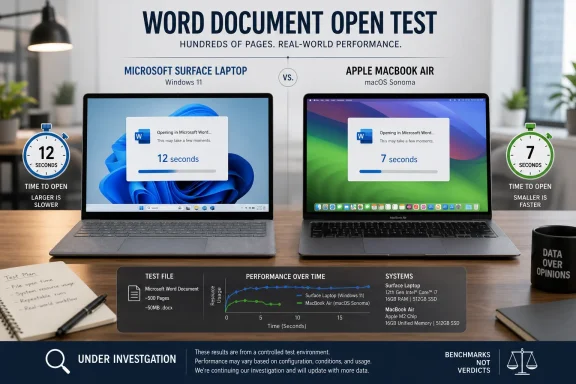 The Word result is real enough to investigate, but not enough to diagnose
Windows Latest says PhoneBuff used the same 500-page Word document in both comparisons. That is a reasonable starting point: document opening is a task people actually notice, particularly in legal, publishing, education, and enterprise environments where reports and contracts can become unwieldy.
Yet opening a document is much more than loading text into a window. Word has to start its process, load its application components, initialize graphics and fonts, query or load extensions, access the file system, parse the document package, load images and embedded objects, apply styles, perform compatibility checks, and render the first visible page. Any one of those stages can be affected by storage latency, endpoint protection, OneDrive Files On-Demand, document location, third-party add-ins, Office update channel, cached data, and whether this was a true cold start or a repeat run.
The missing details are unusually important because the two Windows systems were not merely different laptops. One was an Arm-based Surface Laptop using Qualcomm’s Snapdragon X2 Plus; the other was an x86 Dell XPS 13 based on Intel’s low-power Core 5 320. Their shared 12-second result hints that the result may not be exclusive to Windows-on-Arm translation overhead. But it still does not establish a Windows-wide defect, because PhoneBuff’s reported timing has not been accompanied by the material needed to reproduce it independently.
Microsoft’s own Windows-on-Arm documentation makes clear that native Arm64 applications deliver the best performance and battery life, while x86 and x64 software can run through emulation with an overhead. The Office build therefore matters. Microsoft supplies Word for macOS as a Universal binary that natively supports Apple silicon, but the reporting does not identify the exact Microsoft 365 build on the Surface, whether every component Word loaded was Arm-native, or whether add-ins changed the process architecture.
If PhoneBuff used the latest Microsoft 365 Apps build, no add-ins, identical local copies of the file, recent Windows and macOS releases, and controlled cold-start conditions, the result would be far more serious. As presented, the benchmark is a valuable trigger for investigation—not a clean allocation of blame among Word, Windows 11, the file path, the SSDs, or the laptop configurations.
The comparison exposes a pricing problem for Surface
The Surface comparison has a second issue that is easier to verify than the Word timing: the current official U.S. price does not support the “$300 more” framing quoted by Windows Latest for the Snapdragon X2 Plus Surface Laptop versus the M5 MacBook Air.
Microsoft’s U.S. Store lists the 13.8-inch Surface Laptop, 8th Edition with Snapdragon X2 Plus, 16GB of memory, and a 512GB SSD from $1,599.99. Apple introduced the 13-inch M5 MacBook Air in March at $1,099 with 16GB of unified memory and 512GB of storage. On those baseline public configurations, the Surface premium is $500, not $300.
There may be a sale, education price, retailer-specific SKU, or different Surface model behind the lower number. Windows Latest did not identify one. But the retail price matters more than usual here because the test is being used to make a buying recommendation. A $300 gap is one calculation; a $500 gap materially changes what a Windows buyer should expect in display, ports, serviceability, software compatibility, and device management before accepting any performance deficit.
The MacBook Air is not automatically the better IT purchase. Windows remains the necessary platform for many line-of-business applications, management tooling, drivers, and Windows-only workflows. MacBook buyers also must account for their own platform constraints. But for an individual choosing between a current $1,599 Surface Laptop and a $1,099 M5 MacBook Air, Microsoft cannot lean on a vague “Surface experience” premium while its own Office app appears slower in the one test receiving attention.
Microsoft’s published Surface claims also require careful reading. Its advertised active-web battery testing is a controlled vendor measurement, not a mixed Word-and-Excel productivity workload. It says little about a specific document opening slower than expected, and it does not settle how the Surface behaves with an enterprise image, endpoint security agent, redirected folders, or a full suite of Office plug-ins.
The battery finding is encouraging, but it is a different claim
The better news for Windows is that Windows Latest says the same PhoneBuff runs found lower battery drain on the XPS 13 than on the MacBook Neo during a two-hour productivity segment, and lower drain on the Surface Laptop than the M5 MacBook Air in its comparable sequence. The test reportedly rotated through Word and Excel activity with typing, copy-and-paste work, Spotify playback, and other scripted actions.
That result is plausible, particularly for light productivity use. Windows-on-Arm was designed around the efficiency advantages of Arm systems, while Intel’s latest low-power designs are competing much more directly with Apple on idle power and modest office workloads than older laptop chips did.
It is also directionally supported, though not duplicated, by Tom’s Guide. Its separate continuous web-browsing test found Dell’s 2026 XPS 13 running for 14 hours and 29 minutes, versus 13 hours and 26 minutes for the MacBook Neo. That is not the same workload or methodology as PhoneBuff’s automated productivity sequence, so it cannot validate the percentage-drain figures. It does show that the Dell’s battery result is not inherently implausible.
The important practical point is that battery life and Word document-open latency are different measurements. A system can consume less power during a scripted office session while still taking longer to launch an application or parse a particular document. Treating PhoneBuff’s battery chart as proof that the XPS is the better machine in every productivity task would be as misleading as treating one Word file as proof that every Windows 11 PC runs Office poorly.
Microsoft’s Windows optimization program does not answer the Word question
Windows Latest ties the Word result to Microsoft’s recently stated effort to reduce Windows 11’s memory footprint and improve responsiveness on PCs with 8GB of RAM. Microsoft has publicly emphasized native Windows development and performance work in WinUI, and reporting from Windows Central says the company intends to improve Windows 11’s behavior on 8GB systems before the end of 2026.
That work is worthwhile, especially when the Dell tested by PhoneBuff reportedly had 8GB of memory. But memory footprint is not synonymous with Word’s document-open path. A leaner Start menu, fewer UI allocations, and less pressure from web-based system surfaces may improve the overall feel of an entry-level PC. They will not necessarily fix a delay caused by Word’s document parser, a cloud-file hydration request, a font enumeration bottleneck, an extension, or an SSD configuration.
The WebView2 angle is even less relevant to this specific result than the article suggests. WebView2 embeds the Edge browser engine in applications; Word’s core desktop document loading path is not simply a WebView2 page. Replacing web-backed Windows interfaces with more native code may make Windows 11 feel lighter, but it should not be offered as an explanation for a Word benchmark without evidence that those components were involved.
Microsoft has the instrumentation to identify the delay precisely. A proper response would break the operation into Word process launch, file acquisition, document parsing, image and object load, layout, and first-paint timing. It should then be tested across current Microsoft 365 builds on Arm and x86, with 8GB and 16GB configurations, local and OneDrive-hosted copies, and a clean profile versus a typical enterprise setup.
What Windows buyers should do with this result
For now, buyers should not conclude that a MacBook will open every large Word file twice as fast as a Windows laptop. The test does not show that. Nor should they dismiss it because a single document can be unusual: two separate Windows-versus-Mac comparisons reaching the same 7-second and 12-second pattern is enough to warrant scrutiny.
IT administrators with Word-heavy users can test the claim internally with a representative document set. Use identical locally stored files first, record the Microsoft 365 version and Windows build, run cold and warm starts separately, and repeat with add-ins disabled. Then compare a managed device against a clean build. That will identify whether the delay comes from Office itself or from the environment organizations actually deploy.
Microsoft’s immediate problem is perception, but its larger problem is value. A Surface Laptop that costs hundreds more than an M5 MacBook Air cannot afford to look slower at opening Word, even if the gap later proves to be specific to one test file or setup. The company needs to publish a reproducible explanation—or deliver the Office fix that makes the question disappear.
Update: PhoneBuff comparison reportedly shows wider gaps beyond Word (August 3, 2026)
Neowin reports that PhoneBuff’s Surface Laptop versus M5 MacBook Air testing included additional workloads not covered in the original Word-focused result. Most notably, the Windows-on-Arm Surface reportedly took more than 40 seconds to extract a file archive, compared with under 10 seconds for the MacBook Air.
According to Neowin, the M5 MacBook Air also led in Adobe Premiere Pro, while web browsing was effectively even. The Surface was said to remain competitive in gaming at native resolution with frame generation and upscaling disabled, but Apple pulled further ahead when those features were enabled.
If independently reproducible, the archive-extraction result broadens the concern beyond Word’s document-loading path: it could implicate Windows-on-Arm software compatibility, the specific extraction utility, storage behavior, or the tested system configuration. It still does not prove that every Windows 11 PC—or every x86 Windows laptop—will show the same gap.
