
PC Gamer first reported the reveal following the August 13 VR Games Showcase, and UploadVR independently confirmed that Flat2VR is working with original developer Nightdive Studios. The new Steam listing is already live for wishlisting, which establishes that the PC VR release is a distinct store entry rather than a VR mode quietly added to the 2023 game.
That distinction is more than storefront housekeeping. It means PC players should not assume that owning System Shock today guarantees VR access later.
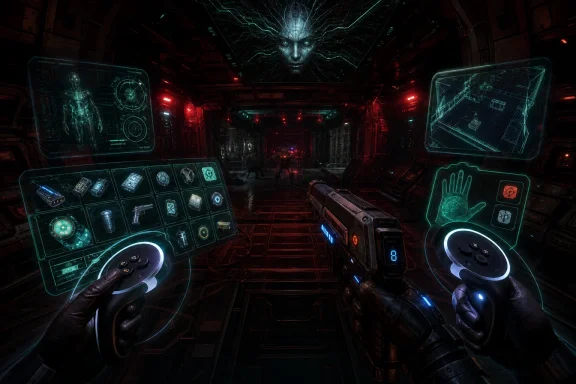 A new Steam product, not a promised patch
The original System Shock remake remains available on Steam as Nightdive’s conventional flatscreen release. Nightdive describes that game as a full remake of the 1994 immersive sim, with a rebuilt interface, updated controls, HD art, revised sound, and the return of SHODAN voice actor Terri Brosius.
System Shock VR, however, has its own Steam app listing. That strongly suggests a standalone release, although neither Flat2VR nor Nightdive has announced a price, bundle, upgrade path, or ownership benefit for people who already bought the remake. Steam users should therefore treat the VR game as a new purchase until the publishers say otherwise.
Flat2VR has taken this approach before. In a January 2025 interview with UploadVR, the studio said it preferred shipping its VR adaptations as separate games rather than DLC, arguing that an add-on SKU could undervalue the VR work. That was the studio’s broader strategy, not a formal pricing announcement for System Shock VR—but it is a useful warning against expecting a free update.
For a game that has regularly been discounted, the answer could affect whether PC players buy the current remake now or wait. Anyone interested specifically in VR should wishlist the new listing, but avoid buying the 2023 release on the assumption that it includes future headset support.
The existing PC VR route is a community mod
Windows PC players can already run the current remake in VR through an unofficial UEVR compatibility plugin maintained on GitHub by modder Ashok0. The mod provides six-degrees-of-freedom head tracking, motion-controller bindings, room-scale movement and VR-specific controls for combat, inventory interaction and the game’s cyberspace sequences.
It is also exactly the kind of configuration burden an official port is supposed to eliminate. The plugin’s own documentation tells users to install UEVR, import a configuration file, optionally add a separate fix package, manage the game’s installed mods, and inject UEVR during the game’s opening splash screens. It warns of UI alignment issues during puzzles and keypads, controller jitter that may require lower graphics settings, potential crashes caused by old mods, and invisible weapons when loading a flatscreen save.
Those caveats do not make the mod unusable; they explain why an official release has value even for PC players who already made it work. A native port should be judged on whether it removes those friction points: reliable motion controls, readable and usable inventory screens, sane seated-play options, stable interaction with terminals and puzzles, and graphics settings that do not demand hours of trial and error.
The reveal trailer did not show enough sustained gameplay to verify any of that. In particular, the announcement has not described how System Shock’s dense multi-function displays, equipment management, map tools, hacking interfaces, or cyberspace will be redesigned for headsets. Those are central parts of the game, not peripheral menus.
The interface is Flat2VR’s real assignment
The combat is the easy part to imagine in VR. System Shock already plays from a first-person perspective and puts guns, melee weapons, security threats and hostile mutants directly in the player’s path. Citadel Station’s claustrophobic corridors, flickering machinery, audio logs and SHODAN’s constant intrusion could translate especially well to a headset.
The difficult part is the original game’s immersive sim machinery. The remake expects players to juggle ammunition, healing items, audio records, implants, quest clues and several onscreen tools while navigating a deliberately labyrinthine station. VR conversions fail when they preserve a flat interface as a floating wall, or when physical gestures turn routine actions into slower chores.
Flat2VR’s role is consequently broader than adding head tracking. Its job is to preserve the tactical pacing and information load of the remake without forcing players to wrestle with a controller cursor every time they need to read an email, rearrange an inventory, solve a circuit puzzle, use an elevator panel or change ammunition.
That is the test that the current trailer cannot answer. Flat2VR has experience with licensed VR adaptations, including work derived from community VR modding projects, but each game brings its own interface constraints. A compelling System Shock VR needs interaction design built around its systems, not an automated conversion of the original HUD.
Quest and PS VR2 support change the scope
The release is planned for Meta Quest, PlayStation VR2 and SteamVR, according to UploadVR and the VR Games Showcase recap. Cross-platform availability gives Flat2VR a larger potential audience than a PC-only VR title, but it also creates a technical question: how much visual and systems parity will remain across standalone Quest hardware, PlayStation 5, and a broad range of Windows PC configurations?
No supported headset list, minimum PC specifications, graphics features, performance targets, or cross-buy policy have been published. The SteamVR label confirms Windows headset support, but it does not yet answer whether the game will be optimized for common configurations such as Quest Link, Air Link, Virtual Desktop, Valve Index, HTC Vive, Pimax hardware, or newer SteamVR devices.
Nor is there confirmation of the VR interaction model. The announcement does not say whether the game will support teleport movement, smooth locomotion, snap turning, smooth turning, seated play, left-handed controls, comfort vignettes, subtitles, or broader accessibility settings. These are routine questions for a flatscreen shooter but practical buying criteria for a VR release.
Flat2VR previously told UploadVR that Quest’s mobile hardware can be a challenge for adaptations and that some games may make more sense on SteamVR and PS VR2 alone. The fact that System Shock VR is also coming to Quest suggests the studio believes it can make the game work across the three platform families. It does not yet establish that every version will share the same visual settings, interaction options, or release date.
Do not confuse this with System Shock 2 VR
The timing can create confusion because Nightdive’s System Shock 2: 25th Anniversary Remaster has its own complicated VR history. In March 2025, Nightdive chief executive Stephen Kick said that an Oculus-funded System Shock 2 VR project had been canceled after Facebook cut multiple projects, while leaving open the possibility that it could return later as a patch or standalone release.
That project is separate from the newly announced System Shock VR. The August 2026 announcement concerns the 2023 remake of the first game, developed in partnership with Flat2VR Studios. It is not evidence that the long-delayed System Shock 2 VR version has been revived, and no new announcement has connected the two.
For Windows players, the immediate result is simple: the remake is getting an official SteamVR adaptation, but it is not available yet and its commercial terms remain unknown. The next meaningful update needs to be gameplay footage showing Citadel Station’s menus and interaction systems in use—followed by the missing essentials: release date, PC requirements, comfort settings, and whether current System Shock owners will have to buy SHODAN’s nightmare all over again.
