
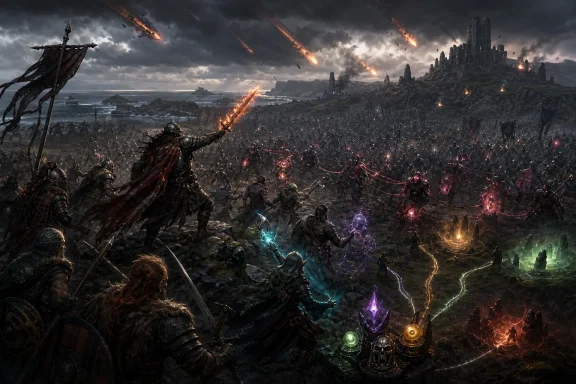
 Overview: A Hack-and-Slash Designed to Make Momentum Matter
The core premise is immediately legible. Players lead a Scottish battalion against an invading force connected to the mysterious Dragon Meteor, hacking through huge enemy groups while reclaiming a beleaguered island. The structure blends third-person action, roguelite buildcraft, squad command, and a grimly cartoonish fantasy aesthetic that puts personality ahead of sterile realism. Tears of Metal’s Steam listing describes it as a solo or four-player co-op campaign built around collecting powers, rallying troops, and confronting invaders seeking the power of the Mother Dragon Stone.
That combination matters because the Dynasty Warriors formula has always had two competing qualities. At its best, it provides the euphoric spectacle of a single hero crashing through an army. At its weakest, it can make the player feel as though they are performing the same efficient combo against an endless conveyor belt of interchangeable opponents.
Tears of Metal’s central innovation is not that it abandons the crowd-clearing fantasy. It is that it gives the fantasy consequences. Battles feed into a campaign where map choices, escalating danger, item selections, army composition, and permanent unlocks all shape the next few minutes of play. The player is not merely mowing down thousands of enemies to complete a checklist. They are assembling a run.
That distinction helps explain why the game has landed so effectively with players who have grown weary of long, bloated action games. A roguelite campaign can be demanding, even punishing, without requiring the emotional commitment of a 60-hour open-world map. It offers a clean proposition: enter the battlefield, make difficult choices, become frighteningly powerful if the build comes together, and carry something useful back to the hub even when the run collapses.
The game entered Early Access on July 22, 2026, with Paper Cult positioning the initial release as a full core experience rather than a bare framework. The developer says the current build includes three acts, three playable heroes, bosses, village upgrades, equipment, emblems, companions, and a complete progression loop, while future updates are planned to expand that foundation. Paper Cult’s Early Access announcement makes clear that player feedback is intended to influence new heroes, gear, balance adjustments, performance work, and quality-of-life improvements.
Why Gaming Burnout Makes a Game Like This Stand Out
Burnout is often confused with simply being tired of games. In reality, it is usually a reaction to friction: too much setup, too many systems that ask for attention before offering fun, too much online discourse, and too many games that demand a player’s time without respecting it.
A modern gaming library can become a museum of obligation. There are service games with seasonal deadlines, cinematic epics that require several hours before their best mechanics appear, multiplayer communities that treat a missed week as a competitive setback, and countless unfinished purchases waiting to be “properly” experienced. Even anticipated releases can start to feel like homework.
In that environment, the strongest argument for an early-access Xbox-on-PC game such as Tears of Metal is not novelty alone. It is immediacy.
The game appears to understand the value of giving players an expressive action toolkit early. The combat is built around special attacks, dodges, movement, crowd control, and the ability to direct allied units toward priority targets. In the Windows Central account that sparked renewed attention around the game, the writer highlights the pleasure of combining direct melee combat with army commands and build-altering effects, such as explosions triggered by dodges or curses that distribute damage across linked enemies. Windows Central’s hands-on report frames that variety as a key reason the game avoids the repetition that can undermine traditional crowd-action titles.
That is a significant design lesson. Players can tolerate repetition when the meaning of repetition changes.
A basic attack string can remain familiar if:
- A new item changes its damage type or follow-up effect.
- A different weapon changes movement timing or defensive options.
- A companion alters the pace of a fight.
- A new enemy demands a different positioning response.
- A map objective shifts the value of speed, caution, or crowd control.
- A permanent upgrade opens a new strategic route on the following run.
The goal is not to ensure that every encounter is totally unique. That would be impossible and, in an action game, potentially undesirable. The goal is to make the player feel that they are interpreting a combat language rather than mindlessly reciting it.
Catharsis Without Empty Calories
There is an important emotional distinction between a game that is simply easy and a game that is cathartic. Easy games remove resistance. Cathartic games give players resistance they can overcome through decisiveness, timing, and an increasingly potent build.
Tears of Metal seems to pursue the latter. The appeal is not merely that enemies arrive in large numbers and can be dispatched spectacularly. It is that the player must earn the right to dominate the battlefield. Bosses become more manageable only after a combination of mechanical learning, better gear, more options, and smarter decisions.
This is where the roguelite structure becomes valuable for players feeling depleted. A loss has a sting, but it does not necessarily represent wasted time. The campaign may end, yet permanent resources can still improve characters, unlock moves, reduce shop costs, or strengthen the army for later attempts. That metaprogression provides a practical answer to a common burnout trigger: the sensation that a difficult game is asking the player to repeat content with no forward movement. Windows Central’s report specifically identifies this accumulation of upgrades and knowledge as part of the game’s satisfying loop.
The risk, of course, is that permanent progression can become a crutch. If early runs are tuned so severely that success depends more on numerical unlocks than personal improvement, the game could drift toward grind rather than mastery. A compelling roguelite needs the player to feel stronger over time, but it also needs the player to become better over time.
So far, the design pitch suggests that Paper Cult recognizes that balance. Enemies grow increasingly dangerous during campaigns, and players need to learn attack patterns and safe openings rather than depending solely on stat gains. That combination—numbers plus knowledge—is the healthiest version of roguelite advancement.
The Musou Formula, Reworked for the Roguelite Era
The clearest creative reference point for Tears of Metal is Koei Tecmo’s Dynasty Warriors lineage. The comparison is useful, but it should not obscure the difference in structure.
Classic Musou games are often sprawling battlefield simulations. They ask the player to manage objectives, seize bases, rescue officers, respond to changing conditions, and defeat named foes while cutting through common soldiers by the hundreds. Their greatest strength is the power fantasy of being an exceptional warrior in the middle of a historical or fantastical war.
Tears of Metal takes the energy of that formula and narrows it into a more replayable campaign format. A run is not simply a mission; it is a sequence of evolving tactical and build-oriented decisions. The player’s immediate goal may be to survive a map, but the larger goal is to create a configuration capable of surviving the maps that follow.
The Army Is More Than Visual Decoration
One of the most interesting aspects of the premise is the presence of a Scottish battalion. Squad mechanics can easily become superficial in crowd-action games: allies are visible, they shout enthusiastically, and they may occasionally trigger a scripted animation, but the player’s decisions remain almost entirely individual.
Paper Cult is aiming for a deeper relationship. The official store materials emphasize rallying forces as part of each campaign, while Xbox’s product page says players can discover artifacts, characters, cosmetics, upgrades, and combos while pushing through battlefields with their forces. The Xbox Cloud Gaming listing also confirms online co-op for two to four players, cross-platform multiplayer support, cloud saves, and Xbox achievements.
If army members can be directed toward priority targets and provide benefits that depend on their survival, then the battlefield acquires an additional layer of responsibility. The player is not just asking, “Can I kill this elite?” They are asking, “Can I kill it before it destroys the part of my formation that matters to the run?”
That is a meaningful way to distinguish the game from a pure character-action title. It keeps the player at the center of the spectacle while making the wider conflict feel less decorative.
Buildcraft Has to Serve Combat, Not Replace It
The item effects described so far suggest a system built around expressive synergies. Dodge-triggered explosions, shared-damage curses, gear upgrades, army perks, emblems, charms, and equipment all point toward a familiar but effective roguelite promise: an ordinary character can become an engine of controlled chaos.
The good news is that the game’s combat foundation appears to be active enough to support that system. It is not a menu-driven auto-battler wearing action-game clothing. A player still needs to dodge, choose targets, manage positioning, recognize attacks, and determine when to commit to offense.
That matters because buildcraft is only satisfying when it amplifies a player’s choices. If the numbers do all the work, powerful items reduce combat to visual noise. If the player has no access to genuinely powerful synergies, loot becomes inconsequential. The sweet spot is when a build makes a player feel inventive and asks them to execute.
Early Access Is the Opportunity—and the Warning Label
It is tempting to treat an enthusiastic early-access launch as a promise of what the full release will be. That is not what Early Access means. It is a chance to play a substantial game while accepting that systems, performance, content, and balance are still subject to change.
Paper Cult is unusually direct about this. The Steam page says the studio expects Tears of Metal to remain in Early Access for roughly four to twelve months, depending on player feedback. Planned additions include more heroes, upgrades, voice acting, languages, balancing work, and further performance and stability improvements. The developer’s Early Access roadmap statement also notes that online multiplayer is supported, while acknowledging the possibility of rare crashes, minor bugs, and unfinished placeholder art or text.
This transparency is a strength. Too many games use Early Access as vague marketing language, leaving players uncertain whether they are buying an exciting work in progress or an abandoned prototype. Here, Paper Cult has at least outlined what exists today and what it intends to improve.
Still, prospective players should treat several points with appropriate caution.
Content Breadth Will Be Tested Over Time
The launch build has three acts and three playable heroes. That is a solid starting package for a small action roguelite, particularly when every run remixes choices and modifiers. But replayability is not the same as unlimited content.
The ultimate test will be whether the maps, objectives, enemy types, bosses, item pools, and character kits retain their fascination after players have identified optimal strategies. A game that feels endlessly varied during its first ten hours may reveal narrow patterns by hour thirty.
Paper Cult says the game currently spans more than 45 handcrafted environments with varying scenarios and objectives. Steam’s product page and Xbox’s Game Preview listing each describe that breadth, but the long-term value will depend on how meaningfully those environments differ in play rather than simply in visual layout.
Balance Is Especially Sensitive in Co-op
Four-player co-op could become one of the game’s most compelling features. Crowd-action games gain a special kind of joyous disorder when several friends turn a battlefield into a screen-filling storm of attacks, effects, and shouted calls for help.
But co-op balance is hard. A build that feels powerful and earned in solo play can become oppressive when multiplied across four players. Conversely, enemies designed to survive a coordinated group can become miserable for solo players. Network stability, enemy readability, reward distribution, and boss health scaling all matter.
Paper Cult’s commitment to balancing and multiplayer stability is encouraging, but those areas should remain a focus of community feedback through Early Access. The studio has said it will use feedback channels, forum discussion, general reception, and opt-in anonymous gameplay data to identify weaknesses. Its Steam Early Access description outlines that approach.
Difficulty Modifiers Need to Add Tension, Not Chores
The game reportedly offers difficulty modifiers unlocked after successful campaigns, increasing both challenge and potential rewards. This is an excellent framework because it allows confident players to stretch the system without forcing everyone into the same skill ceiling.
The danger is that modifiers can become mandatory chores if rewards are disproportionately locked behind them. The best implementation makes higher difficulty appealing to enthusiasts while preserving a satisfying, complete core experience at standard settings. Challenge should be an invitation, not a tax.
The Xbox-on-PC Angle Is More Important Than It Looks
Tears of Metal is currently available in Xbox Game Preview on PC as well as Steam Early Access. That distribution gives the game a meaningful advantage in a fragmented PC market: it can reach both traditional Steam players and those invested in the Xbox ecosystem.
The Xbox listing positions the title as a work in progress and makes clear that it can change before final release. It also lists cloud saves, achievements, online co-op, and Xbox cross-platform features, all of which make the PC version feel more integrated with the wider Xbox platform than a simple store listing would. Xbox’s official page presents the game as playable through Xbox Cloud Gaming while emphasizing its unfinished Game Preview status.
For Windows gamers, the practical specifications are approachable by current standards but not negligible. The Steam listing calls for a 64-bit version of Windows 10, 8GB of RAM, a GTX 1070-class GPU, DirectX 11, and 10GB of storage at minimum. Recommended specifications rise to 16GB of RAM and an RTX 20-series graphics card. Paper Cult’s published system requirements suggest that performance tuning will matter, particularly for players expecting dense effects, high enemy counts, and stable co-op sessions on more modest PCs.
That is another reason Early Access feedback is consequential. In a game built around huge melee clashes, stutters are not merely cosmetic. They can disrupt dodge timing, obscure attacks, complicate online synchronization, and turn a fair loss into a technical frustration.
A Strong Antidote to Repetition—If It Continues Evolving
The early case for Tears of Metal is persuasive because it does not claim to reinvent action games from scratch. Instead, it looks at a genre with an enduring appeal—the joy of charging alone into impossible odds—and gives it a modern structure that values variety, adaptation, and forward progress.
Its strongest assets are clear:
- A focused, readable power fantasy built around clearing massive groups of enemies.
- Roguelite progression that makes failed campaigns feel less disposable.
- Build-altering upgrades that can change how movement, damage, survival, and crowd control work.
- Character variety, with current heroes designed around notably different combat identities.
- Army-command elements that have the potential to add tactical pressure beyond personal damage output.
- Solo and four-player co-op support, allowing the same core campaign to serve different moods and social settings.
- A distinct Scottish dark-fantasy presentation that avoids blending into the endless parade of generic medieval worlds.
The limitations are just as real, if less alarming. It is an unfinished game with a compact initial hero roster, an evolving balance model, and a multiplayer component that will need sustained technical attention. Players should not buy it solely for a hypothetical future version; they should buy it because the current action loop already appeals to them.
That is the practical takeaway from the enthusiasm surrounding the game. Tears of Metal is not valuable because it can cure every player’s gaming burnout. It is valuable because it understands the kind of design that can break a rut: rapid access to satisfying combat, enough resistance to make victories matter, and a progression model that makes another attempt feel like an opportunity rather than an obligation.
For Windows PC players who miss the exuberance of Dynasty Warriors but want more unpredictability, more buildcraft, and a reason to keep returning after defeat, Paper Cult’s early-access slasher is already shaping up as a remarkably well-timed release.
