
The comparison, published by CarBuzz on July 28, draws on J.D. Power studies, NHTSA recall records, owner complaints and iSeeCars longevity data. Its central finding is unsurprising: Tesla has a longer production history, more accumulated field data and fewer unknowns for buyers prioritizing dependable daily transport. But the available data does not support treating either company as a Toyota-like reliability benchmark.
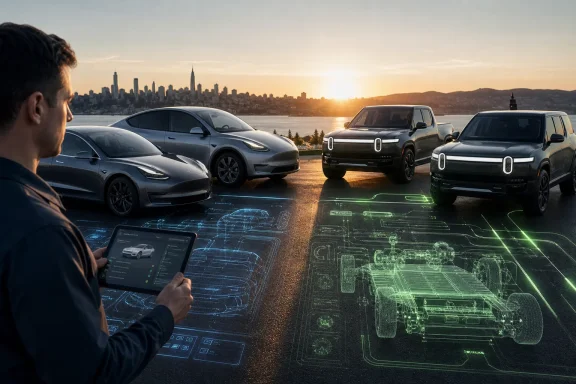 Tesla Has the Stronger Track Record, Not a Clean Bill of Health
J.D. Power’s 2025 Vehicle Dependability Study assigned Tesla an unofficial 209 problems per 100 vehicles, against an industry average of 202. Tesla was not eligible for a formal rank because it does not provide owner data in certain states, but the number still placed it ahead of several established premium manufacturers.
The 2026 study paints a less flattering broader picture for EVs. J.D. Power reported an industry average of 204 problems per 100 vehicles, with battery-electric vehicles at 237. Tesla is not listed in the official 2026 brand chart, so CarBuzz’s reported unofficial Tesla score of 226 should be treated as context rather than an apples-to-apples ranking.
Tesla’s advantage is model maturity. The Model 3 has been through far more manufacturing and software revisions than Rivian’s vehicles, and the Model Y’s Juniper refresh has addressed some of the cabin-refinement complaints associated with older cars. iSeeCars also places Tesla sixth among brands in its 2025 analysis of vehicles predicted to reach 250,000 miles, at 4.6%—roughly the overall average, not a standout result.
That distinction matters. Tesla’s core battery, drive-unit and charging systems have accumulated substantial real-world mileage, but dependability studies still capture recurring issues around infotainment, fit and finish, exterior components and software behavior. A car can remain drivable while still generating enough small defects and irritations to hurt its quality score.
Rivian’s Second-Generation Reset Is the Real Story
Rivian’s early R1T and R1S production was marked by the familiar hazards of a new automaker launching a complex electric platform. NHTSA records include multiple recalls involving early R1 vehicles, including a 2022 campaign over improperly torqued front-suspension hardware. Recalls are safety interventions rather than a complete measure of reliability, but they illustrate the manufacturing risks Rivian faced during its ramp-up.
The company’s second-generation R1 platform, introduced in June 2024, is a substantial engineering change rather than a cosmetic model-year refresh. Rivian says it cut the electrical-control-unit count from 17 to seven, removed more than 1.6 miles of wiring, and redesigned its in-house compute and electrical architecture to improve serviceability and production quality.
That is especially relevant to Windows enthusiasts and IT professionals because both Tesla and Rivian increasingly behave like software-defined vehicles. Features, bugs and system behavior can change through over-the-air updates; that can eliminate a service visit, but it also means a vehicle’s ownership experience depends on release quality, rollback processes and vendor support long after delivery.
J.D. Power currently assigns the 2026 Rivian R1T a 71/100 quality-and-reliability score, described as average. That falls well short of a mature reliability reputation, but it does not erase the significance of the Gen 2 redesign: newer R1 vehicles are the versions to watch, while early 2022-era examples demand closer recall and service-history checks.
The Buying Decision Depends on Tolerance for Operational Risk
Tesla is the safer choice for shoppers who want the established EV platform, a wider service footprint and the most evidence around battery and drivetrain longevity. The Model 3 is the clearest reliability-oriented choice, while later Model Y production is preferable to earlier examples where pricing allows.
Rivian remains the more specialized proposition. The R1T and R1S offer capabilities Tesla does not—particularly off-road utility, packaging and the Gear Tunnel—but buyers should see them as a newer platform with a shorter durability record, not as a proven alternative to mainstream Japanese reliability.
For either brand, the most practical reliability check is not a manufacturer-wide score: verify the exact VIN for open NHTSA recalls, confirm installed software and service history, and distinguish early production from the latest hardware generation. In a market where the vehicle is also a connected computer, the build date may matter nearly as much as the badge.
