
The distinction matters because Tesla’s Q2 results showed a familiar tension. Vehicle deliveries and revenue rose, but profit and free cash flow came under pressure as the company accelerated spending on Robotaxi operations, Cybercab production, AI compute and Optimus manufacturing. Tesla has also begun converting Fremont capacity formerly associated with Model S and Model X production toward Optimus lines.
That is not an identity crisis so much as a high-risk business-model change. The carmaker is trying to move from selling hardware once to customers toward running software, fleets and automation systems that could generate recurring revenue.
 The Vehicle Business Is Becoming the Funding Engine
Tesla still needs its automotive operation. It provides the manufacturing scale, installed fleet, charging network and vehicle data that underpin its autonomous-driving narrative. But the company’s strategic language now puts equal or greater emphasis on Full Self-Driving, Robotaxi, custom AI hardware and Optimus.
Tesla’s own Q2 shareholder materials described its automotive, energy, manufacturing and AI initiatives together, rather than treating the latter as side projects. That framing is deliberate: investors are being asked to judge Tesla on the potential of services and automation long before those businesses match vehicle sales in revenue or profit.
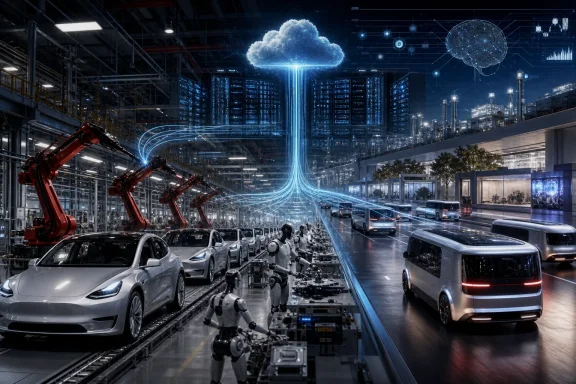
For traditional automakers, a factory’s value is mostly measured by the vehicles it can build. Tesla is testing a different proposition: that a factory, fleet and data center can form a vertically integrated platform for autonomous mobility and industrial robotics.
Robotaxi and Optimus Carry the Premium—and the Risk
The strongest version of Tesla’s case is straightforward. A successful Robotaxi network could turn cars into revenue-producing assets, while Optimus could eventually sell automation into warehouses, factories and logistics operations. Both opportunities are potentially much larger than premium EV sales.
The weak point is execution. Tesla has started Cybercab production and expanded its Robotaxi service, but it remains a limited deployment rather than a proven mass-market transportation business. Optimus production lines are also still being installed, meaning the robot remains a future commercial product rather than a material contributor today.
That creates a valuation problem for IT and enterprise buyers watching Tesla’s claims. The company is making capital-intensive investments in technology categories where reliability, safety cases, support models and regulatory compliance matter as much as impressive demonstrations. A working robot in a Tesla factory is not yet the same thing as a deployable automation platform for a third-party business.
Tesla Is Competing for a Different Kind of Talent
Tesla’s pivot also places it in a more direct contest with companies that recruit AI engineers, robotics specialists, chip designers and cloud-infrastructure architects. Its competitors are no longer only Ford, General Motors, BYD or Volkswagen; they increasingly include autonomous-driving firms, industrial-automation vendors and the largest AI platforms.
For Windows administrators and IT leaders, that shift is worth watching because the eventual Tesla product may look less like a consumer vehicle and more like a managed edge-computing endpoint. Robotaxi fleets, factory robots and AI-driven service networks will depend on telemetry, identity, remote operations, patching, security controls and high-availability infrastructure—the unglamorous operational layer that determines whether ambitious AI projects scale.
Tesla has not stopped being a carmaker. It has made the car business the foundation for a much more speculative effort to become an AI, autonomy and robotics company. Its next test is whether Robotaxi and Optimus can become real businesses before the automotive cash engine is asked to carry too much of the load.
