
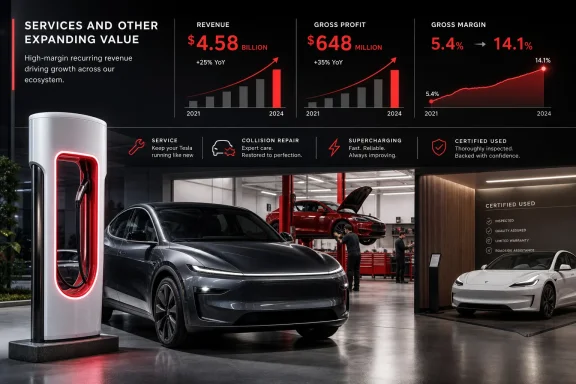
EVWorld’s July 28 report correctly identifies the shift, but Tesla’s newly filed Q2 2026 10-Q provides the sharper picture: revenue in the segment rose 50% year over year, while its implied gross margin reached about 14.1%, up from roughly 5.4% a year earlier. That is a meaningful operational improvement, not merely growth from a larger vehicle fleet.
 The Segment Is Now Carrying Real Margin
Tesla reported $3.93 billion in Services and Other costs against its $4.58 billion in quarterly revenue. The resulting $648 million gross profit was nearly four times the approximately $166 million produced in Q2 2025.
The segment includes used-vehicle sales, non-warranty maintenance, collision work and paid Supercharging sessions. Tesla specifically cited growth in used-vehicle volume and pricing, service and collision revenue, and charging activity as the drivers. At the current quarterly run rate, the unit would produce more than $18 billion in annual revenue, although quarterly results should not be mistaken for a full-year forecast.
That matters because the automotive business remains much larger but faces thinner margins. Tesla’s automotive gross margin slipped to 16.9% in Q2 from 17.2% a year earlier, while automotive regulatory-credit revenue fell 67% to $146 million. Services and Other is therefore becoming a more useful offset: revenue tied to cars already in circulation, rather than solely to the next delivery cycle.
The “Other” Label Still Hides Important Limits
The financial line item is not a standalone software business, and Tesla does not disclose separate revenue or profit figures for Supercharging, insurance, repairs, used cars, connectivity, or subscriptions within it. Claims that insurance or software is already a major profit driver are therefore harder to substantiate than the broader segment trend.
Used-vehicle sales also carry different economics from repair labor or charging. A higher mix of resale activity can lift revenue quickly without making the category as recurring or as high-margin as a conventional software subscription business. Likewise, paid Supercharging is expanding, but Tesla has not disclosed how much of the segment’s $648 million quarterly gross profit came from its charging network.
For Tesla owners, the practical consequence is straightforward: Supercharging, out-of-warranty service, collision repair and the certified used-car channel are no longer peripheral operations that Tesla must merely support. They are increasingly businesses the company has a financial incentive to scale, standardize and keep inside its own ecosystem.
Tesla’s next quarterly filing will show whether Q2 was the start of a sustained margin profile—or a particularly favorable mix of used-car, repair and charging revenue.
