
The change reverses the console-performance plan outlined only days earlier, which topped out at a 40 FPS Balanced mode alongside a 30 FPS Quality mode. In a statement posted on social media, Rebel Wolves said a 60 FPS mode had already been in development but had not been announced because testing was incomplete. Following the response to the initial reveal, the studio brought those tests forward and now says it is ready to commit to the mode for day one.
That makes this a better launch proposition for players with current consoles, but it also puts an important condition on the announcement: 60 FPS is a target, not a guarantee, and it depends on installing the launch patch. Rebel Wolves has not published frame-time data, resolution targets, image-quality comparisons, or a scene-by-scene account of how the Performance Mode holds up under heavy combat, traversal, or dense open-world areas.
 The revised console modes are not the same on every Xbox
The reporting from KitGuru correctly identified the move to add a 60 FPS option, but its platform breakdown was incomplete. Rebel Wolves’ subsequent performance chart, reported independently by Pure Xbox, Gameranx, and XboxAchievements, includes PlayStation 5 Pro alongside the standard PS5 and Xbox Series X.
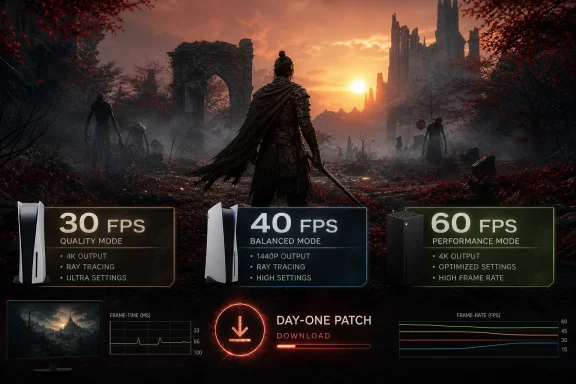
Those three systems are now slated to receive three choices:
- Performance Mode targets 60 FPS.
- Balanced Mode targets 40 FPS.
- Quality Mode targets 30 FPS.
Xbox Series S is the exception. Rebel Wolves has confirmed only one mode for Microsoft’s lower-powered console, and it targets 30 FPS. There is no announced 40 FPS Balanced mode or 60 FPS Performance Mode for Series S.
The distinction matters for buyers deciding between Xbox hardware, particularly because “Xbox Series X|S” is often used as though it describes a uniform console version. Here, it does not. The Series X version has a choice between visual quality, a 40 FPS middle ground, and a lower-latency 60 FPS setting; the Series S version does not.
PlayStation 5 Pro owners will also receive unspecified visual enhancements in addition to the three frame-rate modes. Rebel Wolves has not yet said whether those enhancements mean higher internal resolution, improved ray tracing, denser effects, steadier image quality, or a combination of those features. Until the studio publishes a technical comparison or reviewers test the retail patch, “visual enhancements” is a marketing description rather than a measurable performance claim.
A day-one patch is a real launch requirement
The phrase “available on day one” can sound identical to “included at launch,” but it is not technically the same thing. The 60 FPS mode is being delivered in a patch, meaning console players who install from a disc without connecting their systems to the internet should expect to start with the original mode set rather than the new Performance Mode.
Digital buyers will naturally download the current build through PlayStation Network or Xbox services, but physical-copy buyers and players on limited connections should account for the additional update before starting. Rebel Wolves has not disclosed the patch size or whether the launch patch will also include broader stability, balance, or visual fixes.
There is also a practical reason to hold off on treating the 60 FPS announcement as proof that the game will run at a locked 60. A target describes the development goal, not a contractual minimum. Many modern open-world games use dynamic resolution, variable graphics settings, or frame-rate fluctuations to pursue such a target. Rebel Wolves previously described its 40 FPS setting as using more aggressive dynamic resolution than the 30 FPS quality option, and the same trade-offs are likely to be more pronounced in a 60 FPS configuration.
The studio has not said which settings Performance Mode reduces, whether it uses dynamic resolution, whether ray tracing is disabled, or whether the mode offers a stable frame rate in demanding sequences. Those details will determine whether the new option is a compelling alternative to 40 FPS or simply a lower-fidelity setting with inconsistent performance.
The 40 FPS mode still has a place—if the display supports it
The addition of a 60 FPS mode does not make the 40 FPS Balanced option redundant. A 40 FPS cap can divide evenly into a 120 Hz display refresh cycle—three refreshes per rendered frame—while 30 FPS divides into four. That can make a well-implemented 40 FPS mode substantially more responsive than 30 FPS while preserving more image quality than a 60 FPS mode.
But it only delivers its intended pacing on a television or monitor that supports 120 Hz output. On a conventional 60 Hz display, 40 FPS cannot be evenly presented without variable-refresh-rate support or uneven frame pacing. Rebel Wolves has not spelled out its display requirements for Balanced Mode, so console owners should check their screen’s 120 Hz and VRR capabilities before assuming the 40 FPS setting is the best compromise.
For a player using a 120 Hz VRR television, the three-mode arrangement offers a credible set of choices: Quality for visual fidelity, Balanced for a higher-quality middle setting, and Performance for responsiveness. For those using 60 Hz displays, the newly announced 60 FPS mode is likely to be the more straightforward option—provided its visual compromises and performance consistency are acceptable.
PC system requirements need one major qualification
The console news does not alter the Windows version’s requirements, but it arrives just after Rebel Wolves revised and expanded its PC targets. The official Steam page lists a baseline requirement of a Core i5-11400F or Ryzen 7 2700X, 16 GB of RAM, a GeForce GTX 1060 or Radeon RX 580 with 6 GB of VRAM, Windows 10 or later, DirectX 12, and a 60 GB SSD.
The more detailed chart cited by KitGuru and reported by PC Gamer and VideoCardz gives additional targets: 1080p at 60 FPS on medium settings calls for hardware such as an RTX 2060 Super, GTX 1070 Ti, Radeon RX 5700, or Intel Arc A750; 1440p at 60 FPS on high settings lists an RTX 4060, Radeon RX 7600 XT, or Arc B580; and 4K at 60 FPS on ultra settings lists an RTX 4070 Ti or Radeon RX 9070.
The material caveat is that those final performance targets assume Balanced upscaling. Rebel Wolves’ new numbers are not native-resolution promises. The company has lowered the apparent GPU bar compared with an earlier requirements chart, but it did so while explicitly incorporating NVIDIA DLSS, AMD FSR, or Intel XeSS-style image reconstruction into the test conditions.
That is not unusual for a 2026 Unreal Engine 5 release, and it may be perfectly acceptable in motion. It does mean that someone reading “RTX 4070 Ti for 4K/60 Ultra” should not interpret it as a native 4K benchmark. Image quality, latency, and consistency will depend on the upscaler used, the selected quality preset, and the game’s own implementation.
The official Steam listing also compresses the PC information into only minimum and recommended categories, while the full chart provides resolution and frame-rate targets. Prospective Windows players should rely on the detailed chart for planning a hardware upgrade, but treat every 60 FPS target as an upscaled target until independent retail testing establishes what the game actually delivers.
What to expect on September 3
Rebel Wolves deserves credit for responding quickly to the backlash instead of leaving its 60 FPS option for a later post-launch update. Still, the rapid reversal does not answer the questions players actually need answered before committing: how low Performance Mode drops its resolution, whether its 60 FPS target is maintained, how the 40 FPS mode behaves on non-120 Hz displays, and how the Series S build performs at its lone 30 FPS target.
The first meaningful verdict will come from tests of the patched retail build on September 3, not from the mode labels. Until then, the useful takeaway is straightforward: PS5, PS5 Pro, and Xbox Series X buyers should install the day-one update before judging The Blood of Dawnwalker’s console performance, while Windows players should budget for a 60 GB SSD, 16 GB of memory, DirectX 12, and upscaling as part of the published 60 FPS specifications.