
The announcement came during gamescom Opening Night Live and was detailed by CD Projekt Red in its own press release, with PC Gamer independently confirming the core upgrade and expansion giveaway from the show. CDPR is presenting the release as a broad modernization of its 2015 RPG ahead of the paid Songs of the Past expansion planned for 2027.
For anyone still running the original game on an older Windows 10 PC, a mechanical hard drive, or a DirectX 11-era configuration, this is not merely a visual patch. It is a platform break.
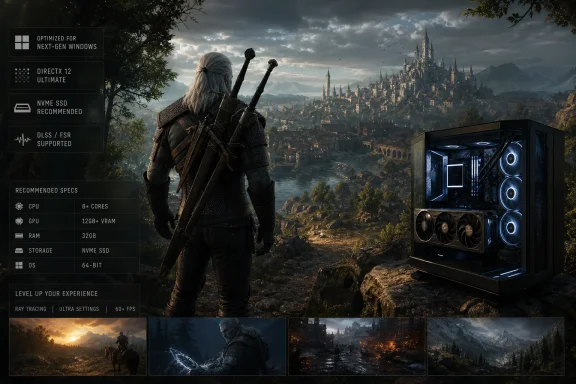 The free upgrade comes with a new hardware baseline
CD Projekt Red’s published PC requirements list 64-bit Windows 11, 12GB of RAM, a 70GB SSD installation, and at least a GeForce GTX 1660 with 6GB of VRAM, Radeon RX 5500 XT with 8GB, or Intel Arc A580. The minimum CPU is an Intel Core i5-8400 or AMD Ryzen 5 2600.
Those are modest requirements by 2026 AAA standards, but they are a dramatic jump from the original Witcher 3 system profile. The 2015 release was built for Windows 7 and DirectX 11 systems; even the 2022 next-generation update retained a DirectX 11 option for players who could not use the DX12 build comfortably. The remaster removes that escape route.
PC Games Hardware reports that the game will now run natively through DirectX 12, with parallelized rendering, and that DirectX 11 and hard-drive installations will no longer be supported. That means players who have kept The Witcher 3 installed on large secondary HDD libraries will need to move it to solid-state storage before September 29.
The practical consequence is easy to miss amid the free-upgrade messaging: a player can own the game and still be unable to run the remastered build on their existing PC. CDPR has positioned the release as a free upgrade for qualifying owners, but the PC qualification is now tied to a more demanding operating system and storage setup than many long-time owners used for the original release.
The company has not published a detailed technical explanation for why Windows 11 is mandatory rather than simply recommended. Its requirements, however, make clear that CDPR is standardizing the future version of The Witcher 3 around the DX12 path and SSD-class asset access.
Path tracing is a high-end option, not the minimum experience
The remaster’s top visual feature is full path tracing on PC. That is a larger rendering shift than the selective ray-traced shadows, reflections, and ambient occlusion included in the 2022 update. Path tracing models far more light interactions in a scene, which can improve indirect lighting, color bleed, reflections, and the way interiors and foliage receive light.
It also costs considerably more GPU performance.
CDPR has confirmed path tracing as a feature, along with DLSS 4.5, AMD FSR 4, Intel XeSS 2.0, ray-traced hair, and other graphical upgrades. But it has not yet published the performance targets, resolution presets, frame-rate expectations, or a separate path-tracing hardware tier. The GTX 1660-class minimum should therefore not be mistaken for a path-tracing recommendation; Nvidia’s GTX 16-series does not have dedicated RT hardware.
The published recommended specification gives a better indication of the conventional rasterized target: a Core i7-8700K or Ryzen 5 3600X, 16GB of memory, and one of a GeForce RTX 2060 Super, Radeon RX 6600 XT, or Intel Arc B580. Even that list does not establish what settings, resolution, or frame rate CDPR considers “recommended.”
That missing information matters more than the feature checklist. Upscaling technologies can help different GPU families reach playable performance, but they do not make path tracing equally practical across them. PC players should wait for CDPR’s settings breakdown and independent benchmarks before treating the remaster as a reason to buy hardware, particularly if their goal is path tracing rather than simply accessing the new build.
Gameplay changes make this more than a graphics refresh
The most meaningful distinction between the 2022 next-generation update and this remaster may be gameplay rather than lighting. CD Projekt Red says it has revised combat, movement, monster behavior, Roach handling, progression, quest tracking, looting, accessibility options, and photo mode.
The company has also confirmed armor transmogrification, allowing players to use one armor set’s appearance while retaining another set’s statistics. That is a straightforward quality-of-life addition, but it addresses a long-standing tension in a game where the preferred late-game equipment appearance does not always match the strongest available gear.
Combat revisions include new finishing animations, revised targeting, and movement intended to close distance more fluidly. These changes may be welcome to players who found the original game’s combat functional rather than exceptional, but they create a compatibility question for the PC modding community. The 2022 update already forced major mod revisions because of its engine, script, and rendering changes. A rebuild touching combat, progression, rendering, and cross-platform mod support is likely to be more disruptive.
CDPR has announced cross-platform mod support, but it has not yet explained which existing PC mods will carry over, how load orders will work, whether console mod access will resemble the systems used by Cyberpunk 2077, or whether the studio will provide a formal migration path for mod authors. Those details will determine whether September 29 is a clean upgrade for heavily modded installations or another reset point.
Before the update arrives, PC players with customized installs should back up save files, mod lists, configuration files, and any locally edited scripts. That is basic preservation rather than a claim that saves will fail, but it is sensible whenever a game receives an engine-level update.
Battle.net and Switch 2 expand the release, but the PC stores remain familiar
The remaster will launch on Steam, GOG, the Epic Games Store, and Battle.net. CD Projekt Red’s new Blizzard Entertainment partnership makes this the first appearance of The Witcher 3 on Battle.net, while the game will also receive a native Nintendo Switch 2 version.
For Windows players, Battle.net is more significant as a distribution change than a technical one. CDPR has not said whether purchases will be portable across PC storefronts, whether the remaster will support cross-save between every store at launch, or how mod support will operate through Battle.net compared with Steam, GOG, and Epic. It has confirmed a Diablo IV Geralt-inspired cosmetic for buyers of Songs of the Past on Blizzard’s storefront, underscoring that the partnership is also a commercial cross-promotion.
The Switch 2 release is separate from the PC upgrade story, but it reveals CDPR’s larger aim. This is not a small anniversary patch designed only to freshen up a back catalog title; the studio is placing the same game in front of a new console audience while making it easier for the existing 65-million-player base to return before new paid content arrives.
Songs of the Past is the commercial destination
CDPR and Fool’s Theory are developing Songs of the Past, a paid 2027 expansion that brings Geralt to Letten, the homeland of Dandelion. The developer says the expansion will add a new region, foes, quests, characters, decisions, abilities, and a chain weapon.
The remaster and expansion giveaway make more business sense viewed together. CDPR is lowering the friction for old owners to reinstall the game, giving base-game owners the two original expansions, updating its technical foundation, and then offering a new Geralt story separately next year.
That does not diminish the value of the free remaster. It does explain why CDPR is willing to make it broadly available: the company is rebuilding an active audience around a game that remains one of its most important franchise assets, while The Witcher 4 targets a 2028 release with Ciri as protagonist.
For Windows users, September 29 is therefore a checkpoint. If the PC meets the Windows 11, DX12, RAM, GPU, and SSD requirements, the upgrade brings a substantial refresh at no additional cost. If it does not, the more immediate task is deciding whether to preserve the current installation or upgrade the machine before the remaster becomes the new standard for Geralt’s final return.
