

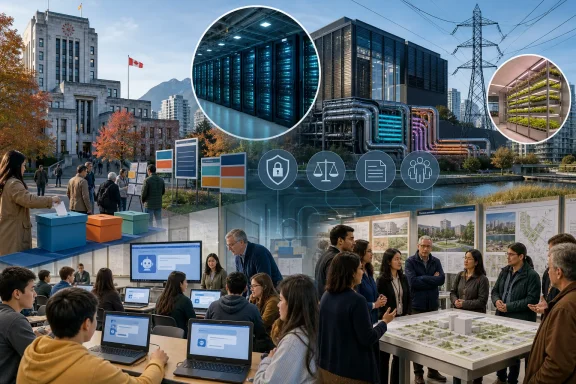
The Tyee’s survey of Vancouver’s seven principal municipal parties provides the first broad snapshot of those positions. But the official records add two important corrections to the campaign framing. First, Vancouver School Board students already have access to Copilot 13+; a promise to “pause the rollout” would now mean withdrawing or restricting an existing service, not preventing a future launch. Second, the Mount Pleasant data-centre public hearing was not legally required under the Vancouver Charter, even though the project does require rezoning. Council chose to send it back for more consultation, leaving the ultimate vote to the council elected in October.
There is also a calendar issue. Elections BC says the formal local-election campaign period begins on September 19, 2026, not August. The pre-campaign period began July 20, nominations open September 1, and the final candidate list will not be known until nominations close September 11. Candidates are campaigning now in the ordinary sense, but voters should be wary of treating preliminary statements as settled platforms.
The Mount Pleasant vote is still live
The immediate City Hall fight concerns 111 East 5th Ave. and 2060 Quebec St., the former Hootsuite-area office property in Mount Pleasant. Telus and the federal government announced in May that Telus would develop two Vancouver AI facilities alongside an expansion in Kamloops as part of a Canadian-controlled, or “sovereign,” AI-computing cluster.
Telus says the Mount Pleasant M3 facility is intended to open by the end of 2026 and scale through 2028, while a second, much larger facility at 150 West Georgia is projected for 2029. The company says the cluster will use an initial 85 megawatts of BC Hydro power, ultimately exceed 150 MW across the three sites by 2032, use liquid cooling, and recover waste heat. Those are company claims and project targets, not city approvals.
The City of Vancouver’s own July 14 referral report establishes what is actually before council. Westbank, acting for the property owner, seeks to rezone the Mount Pleasant land from I-1A industrial to CD-1, adding “bulk data storage” as an allowed use and converting an existing three-storey office building plus two underground parking levels. The proposal also includes a ground-floor café.
That distinction matters operationally. This is not a proposal to erect a new hyperscale tower at 111 East 5th Ave.; it is a conversion of an existing building. But neither is it a routine office renovation. The city report says the building’s existing zoning does not permit data centres, even though staff consider the use consistent with the broader Official Development Plan and Broadway Plan.
Staff recommended approval in principle, subject to conditions, including sending recoverable waste heat into the city’s False Creek Neighbourhood Energy Utility. They also identified an unresolved density problem: the applicant sought 3.0 floor-space ratio, while the city’s technical check estimated the conversion could require as much as 4.2 FSR. If that proves true at development-permit stage, the owner would need another CD-1 text amendment.
The hearing delay is therefore more consequential than the shorthand “punted until after the election” suggests. The city report says a public hearing was discretionary because the project complies with the applicable official-development plans; staff recommended one anyway after receiving about 579 public submissions. Council’s decision to refer the item back to staff did not approve the project, and the report explicitly says preliminary resolutions grant the applicant no legal rights and leave expenditures at the owner’s risk.
Telus’s end-of-2026 opening target now sits beside a municipal approval process that will be inherited by a new council after Oct. 17. That does not kill the facility, but it means the proposed timeline is not within Telus’s control alone.
Moratorium, regulation, or project-by-project approval
COPE has taken the clearest restrictive position. It wants a moratorium on new AI data-centre construction until the city develops environmental and resident-protection rules. TEAM for a Livable Vancouver supports a similar municipal moratorium while planning and regulation are established. Both positions would put the Mount Pleasant decision on hold rather than decide it under the existing planning framework.
OneCity’s position is narrower but potentially more durable. Councillor Lucy Maloney’s July motion sought a regulatory framework and impact assessment for new AI data centres, covering energy, water, pollution, noise, heat and employment. The ABC majority defeated it. OneCity mayoral candidate William Azaroff told The Tyee that his party would assess data-centre development through climate, equity and digital-rights considerations rather than impose an automatic ban.
That is a meaningful distinction. A moratorium is an immediate political stop sign; a regulatory framework creates a standard that can outlast a single project. The practical weakness of OneCity’s approach is timing. Had Maloney’s motion passed in July, staff work might have informed the Mount Pleasant decision. It did not. A new council could revive the idea, but it would be starting after the existing rezoning application has already received staff support in principle.
The Vancouver Greens say they are concerned about land use, noise, energy and water, but have not adopted a formal data-centre position. Vote Vancouver’s Rebecca Bligh has declined a categorical position, saying each proposal should be assessed on its merits and should meet high environmental standards, consider waste-heat recovery where feasible, and fit its surrounding community.
The Vancouver Liberals’ Kareem Allam supports Canadian AI infrastructure as a matter of sovereignty, health care and economic policy, while opposing the use of scarce, expensive Vancouver land for data centres in Mount Pleasant. It is a politically attractive distinction, but it leaves a policy gap: if Vancouver should not host the infrastructure, the party has not explained where the local electricity, connectivity, heat-recovery and zoning advantages of the Telus proposal should be replicated.
ABC did not answer The Tyee’s requests for its current positions on either data centres or student chatbots. Its governing record is clearer than its campaign platform: ABC councillors voted down Maloney’s regulatory proposal, and ABC’s Brian Montague moved the motion that returned the Mount Pleasant item to staff. Neither act is a formal endorsement of the rezoning, but neither establishes new AI-specific safeguards before the matter returns.
Copilot is already available to VSB students
The school-board contest is being debated as though trustees are deciding whether to introduce Copilot. Vancouver School Board records show that decision has already been made administratively.
On May 27, VSB announced Microsoft Copilot 13+ for secondary students. Its subsequent FAQ says the tool is currently available to Grade 8 through 12 students who are 13 or older, with Grade 8 access shifting to the second semester in later years. VSB says the education version operates in its Microsoft school environment, encrypts data, filters harmful content, and does not use prompts or responses to train AI models. The district also says the service was added to its Microsoft licence at no additional cost.
Those safeguards are material, but they do not resolve the policy argument. The BC Teachers’ Federation’s March research note warned that AI in education raises questions about data surveillance, privatization of educational infrastructure, teacher deskilling, bias and the professional autonomy of teachers. The union did not call for a blanket ban, but its analysis is substantially more cautious than the “students already use AI anyway” argument now heard from several candidates.
COPE and TEAM say they would halt or pause Copilot access while consultation, research and policy development occur. That is no longer a pre-launch precaution; it would be a decision to disable access that VSB has already enabled. Candidates should say plainly whether they intend to remove accounts, block classroom use, limit particular grades, require parental consent, or simply stop expanding the service. “Pause” obscures those very different actions.
OneCity has developed the most specific proposed guardrails, although it has not yet released its full policy. Its draft position would delay chatbot use until Grade 10, build privacy and mental-health safeguards, emphasize AI literacy for students and teachers, and encourage teachers to have students work through difficult material without AI assistance. The Grade 10 threshold would require VSB to reverse access for at least some current Grade 8 and 9 students.
The Vancouver Liberals take the opposite educational premise: Allam argues that generative AI belongs in the curriculum with ethics, oversight and guardrails because students will use it regardless. The Greens similarly say students need to learn to use chatbots safely, critically, ethically and responsibly, while acknowledging concerns about privacy, learning, equity, cognitive development and the broader effects of AI. Vote Vancouver says decisions should be made in consultation with students, families and teachers. ABC has not publicly answered the question.
Voters are being asked to choose governance, not a chatbot
The overlooked fact is that neither issue will be settled by a slogan. Trustees do not directly run VSB’s daily operations, but they can set policies that constrain future administrative decisions. Councillors cannot dictate federal AI policy or Telus’s national strategy, but they control zoning, development conditions, noise regulation and the local approval process that determines whether a project proceeds at a particular address.
For Windows administrators and IT professionals, the practical divide should sound familiar. VSB has enabled a vendor-provided tool inside a managed Microsoft environment and says it has controls around account age, content filtering and model training. The political dispute is over whether that is sufficient governance for student use. Vancouver’s data-centre debate raises the same question at city scale: whether promised cooling efficiencies and recovered heat are enough, or whether the city should require independent, comparable public-impact evidence before assigning scarce industrial land and electrical capacity.
By Sept. 11, voters will know who is actually on the ballot. By then, the parties that have offered broad principles will need to answer the implementation questions: what rule they would enact, what existing Copilot access they would revoke or preserve, what data-centre criteria they would require, and whether they would allow the Mount Pleasant rezoning to proceed under the city staff recommendation already on the record.