
Itransition’s August 6 announcement that Vendorland ranked it No. 1 among “Top Microsoft Dynamics 365 Companies” is a marketing credential with a real basis in the directory’s current listings, but it is not an independent Microsoft endorsement or a definitive league table of the Dynamics 365 partner market. The distinction is important for IT leaders choosing an implementation firm for Business Central, Finance, Supply Chain Management, Sales, or Power Platform work, where partner capability is measured in deployment history and workload fit—not a single directory position.
The announcement was distributed through EIN Presswire under Itransition’s name, while Vendorland’s own public methodology describes its output as a two-axis Leaders Board. Vendorland says it evaluates “Focus & Size” within a category and an “Overall Score” for maturity, reputation, and capability; it explicitly says the approach is intended to compare vendors rather than recommend one single best company.
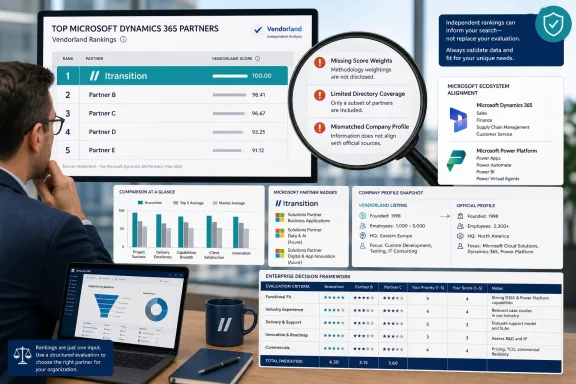
That leaves a gap between the press release’s plain-language “ranked #1” framing and the underlying directory’s stated model. Vendorland may place Itransition prominently within a Microsoft Dynamics 365-related category, but the evidence presently available does not establish a transparent, repeatable No. 1 score against the full universe of Microsoft Dynamics partners.
Vendorland’s methodology says companies first become eligible after creating a profile and supplying enough information about their services, expertise, and portfolio. A listing does not automatically produce a Leaders Board placement, but eligibility itself begins with participation in the marketplace.
That is a meaningful limitation. A directory ranking can compare the firms it has evaluated; it cannot establish that those firms represent every credible Dynamics 365 implementer available to an enterprise buyer. Microsoft’s own partner network includes global consultancies, regional specialists, ISVs, resellers, and industry-focused deployment teams, many of which may not appear in a particular commercial directory or may be assigned to a different category.
Microsoft’s FastTrack Portfolio Partners list from May 2026 illustrates the wider field. The Americas list includes firms such as Avanade, IBM, KPMG, PwC, HSO, Hitachi Solutions, Infosys, Capgemini, Cognizant, RSM, Sikich, Quisitive, and Velosio. Vendorland’s published top 10, as reproduced in the Itransition release, includes Velosio at No. 4 but does not include most of those FastTrack firms.
That does not disprove Itransition’s experience or suggest those omitted companies are necessarily better for every project. It does show the release’s “top companies” label should be read as a Vendorland-specific selection, not a market-wide verdict backed by Microsoft’s deployment-validation program.
Microsoft describes FastTrack Portfolio Partners as organizations with Dynamics 365 Centers of Excellence that work with FastTrack and adopt Microsoft’s Success by Design practices across their Dynamics 365 and Power Platform project portfolios. That is a different test from Vendorland’s directory methodology, and it is one buyers should recognize as such.
The problem is that the published model does not disclose the weights that produced Itransition’s reported first-place position. Vendorland says recent reviews carry additional weight, that its own verified reviews become the primary feedback source after the first such review is published, and that “brand recognition” incorporates digital visibility and reputation. It does not publicly provide Itransition’s component scores, the volume of verified reviews used, the relevant review dates, the size of the company’s Dynamics-specific practice, or a dated leaderboard showing the calculation.
For a buyer, those missing details matter more than a round-number rank. A global software engineering firm with 1,000 to 5,000 employees can score strongly on company scale, visibility, broad client portfolio, and cross-platform capabilities while still not being the best fit for a narrowly scoped Dynamics 365 Business Central migration, a regulated finance deployment, or a rescue project involving heavily customized Finance and Operations workflows.
Vendorland’s sponsorship page adds another point requiring care, though it does not establish wrongdoing. It offers free participation and paid Plus and Pro plans priced at $500 and $1,500 per month, respectively. All three tiers are described as eligible for Leaders Board rankings. Vendorland also states that premium profiles, sponsorships, advertising, and other commercial services do not influence leaderboard positions.
There is no evidence in the materials reviewed that Itransition bought a Vendorland plan, and it would be wrong to infer that it did. But Vendorland’s commercial relationship with listed vendors remains relevant context when treating a directory rank as a procurement signal. Buyers should ask for the underlying evidence rather than assume an ordinal position is equivalent to a lab test, an audited market study, or Microsoft’s own partner validation.
Its public partnership page specifically lists Microsoft Solutions Partner designations in Data & AI and Digital & App Innovation, plus an AI Platform on Microsoft Azure specialization. Those are meaningful credentials, and Itransition’s stated Dynamics 365 portfolio is consistent with a firm that can combine application implementation with Azure, data, and custom engineering work.
However, those two public Solutions Partner designations are not the same as Microsoft’s Solutions Partner for Business Applications designation. Microsoft defines Business Applications as the partner competency tied directly to Dynamics 365 and Power Platform delivery, with partner capability points based on customer additions, intermediate and advanced certifications, usage growth, and deployments. A partner needs at least 70 of 100 points, with points across each required category, to attain the designation.
Itransition’s public partner page does not list a Solutions Partner for Business Applications designation. That does not prove the company lacks the designation; partner statuses can change, and Microsoft’s public directory and Partner Center data are not always easy to map to a corporate marketing page. It does mean the EIN Presswire release’s broad phrasing—“official Microsoft Dynamics Partner since 2008”—should not be treated as confirmation of that specific Business Applications designation.
This is more than badge semantics. A buyer procuring Dynamics 365 Finance, Supply Chain Management, Business Central, Customer Service, or Field Service should ask whether a prospective integrator has current Microsoft-recognized Business Applications status, which workloads it has deployed recently, and whether the project qualifies for FastTrack engagement. Those answers are more useful than a general Microsoft-partner claim.
That looks like a copy or data-association error. Vendorland says most company information undergoes manual verification, while its profile pages also use AI-generated “Top mentions” and customer-sentiment summaries. A mismatched company description on the page of a firm being promoted as the category’s No. 1 provider is a concrete reason to be cautious about treating directory data as procurement-grade evidence without verification.
The profile is also marked as available to “claim,” rather than clearly showing that Itransition has claimed and reviewed it. Vendorland’s methodology says firms can be asked for additional information and supporting documentation, but the current page gives readers no audit trail showing which facts were supplied or approved by Itransition and which were drawn from public sources or AI-assisted analysis.
The practical consequence is straightforward: Vendorland’s ranking may be useful as a discovery lead, but its company page should not be copied directly into an RFP, vendor-risk assessment, or executive recommendation without independent checks.
That leaves a gap between the press release’s plain-language “ranked #1” framing and the underlying directory’s stated model. Vendorland may place Itransition prominently within a Microsoft Dynamics 365-related category, but the evidence presently available does not establish a transparent, repeatable No. 1 score against the full universe of Microsoft Dynamics partners.
 Vendorland’s category is a screened directory, not the whole Dynamics market
Vendorland’s methodology says companies first become eligible after creating a profile and supplying enough information about their services, expertise, and portfolio. A listing does not automatically produce a Leaders Board placement, but eligibility itself begins with participation in the marketplace.That is a meaningful limitation. A directory ranking can compare the firms it has evaluated; it cannot establish that those firms represent every credible Dynamics 365 implementer available to an enterprise buyer. Microsoft’s own partner network includes global consultancies, regional specialists, ISVs, resellers, and industry-focused deployment teams, many of which may not appear in a particular commercial directory or may be assigned to a different category.
Microsoft’s FastTrack Portfolio Partners list from May 2026 illustrates the wider field. The Americas list includes firms such as Avanade, IBM, KPMG, PwC, HSO, Hitachi Solutions, Infosys, Capgemini, Cognizant, RSM, Sikich, Quisitive, and Velosio. Vendorland’s published top 10, as reproduced in the Itransition release, includes Velosio at No. 4 but does not include most of those FastTrack firms.
That does not disprove Itransition’s experience or suggest those omitted companies are necessarily better for every project. It does show the release’s “top companies” label should be read as a Vendorland-specific selection, not a market-wide verdict backed by Microsoft’s deployment-validation program.
Microsoft describes FastTrack Portfolio Partners as organizations with Dynamics 365 Centers of Excellence that work with FastTrack and adopt Microsoft’s Success by Design practices across their Dynamics 365 and Power Platform project portfolios. That is a different test from Vendorland’s directory methodology, and it is one buyers should recognize as such.
The ranking criteria are published, but the actual scoring is not
Vendorland deserves credit for publishing more about its process than many directory sites do. Its methodology identifies the inputs: company profiles, case studies, Vendorland reviews, external review platforms, public company information, analyst research, and AI-assisted analysis of media coverage, online visibility, professional communities, technology platforms, and public discussion.The problem is that the published model does not disclose the weights that produced Itransition’s reported first-place position. Vendorland says recent reviews carry additional weight, that its own verified reviews become the primary feedback source after the first such review is published, and that “brand recognition” incorporates digital visibility and reputation. It does not publicly provide Itransition’s component scores, the volume of verified reviews used, the relevant review dates, the size of the company’s Dynamics-specific practice, or a dated leaderboard showing the calculation.
For a buyer, those missing details matter more than a round-number rank. A global software engineering firm with 1,000 to 5,000 employees can score strongly on company scale, visibility, broad client portfolio, and cross-platform capabilities while still not being the best fit for a narrowly scoped Dynamics 365 Business Central migration, a regulated finance deployment, or a rescue project involving heavily customized Finance and Operations workflows.
Vendorland’s sponsorship page adds another point requiring care, though it does not establish wrongdoing. It offers free participation and paid Plus and Pro plans priced at $500 and $1,500 per month, respectively. All three tiers are described as eligible for Leaders Board rankings. Vendorland also states that premium profiles, sponsorships, advertising, and other commercial services do not influence leaderboard positions.
There is no evidence in the materials reviewed that Itransition bought a Vendorland plan, and it would be wrong to infer that it did. But Vendorland’s commercial relationship with listed vendors remains relevant context when treating a directory rank as a procurement signal. Buyers should ask for the underlying evidence rather than assume an ordinal position is equivalent to a lab test, an audited market study, or Microsoft’s own partner validation.
Itransition’s Microsoft relationship is real, but the stated designation needs precision
Itransition’s core claim to Microsoft experience is supported by its own partnership materials. The company says it has been a Microsoft partner since 2008 and specializes in Dynamics 365-based ERP, CRM, and business application work. Its services pages cite work involving integrations, migration, custom connectors, Power Platform capabilities, and implementations across manufacturing, logistics, retail, automotive, healthcare, insurance, finance, and real estate.Its public partnership page specifically lists Microsoft Solutions Partner designations in Data & AI and Digital & App Innovation, plus an AI Platform on Microsoft Azure specialization. Those are meaningful credentials, and Itransition’s stated Dynamics 365 portfolio is consistent with a firm that can combine application implementation with Azure, data, and custom engineering work.
However, those two public Solutions Partner designations are not the same as Microsoft’s Solutions Partner for Business Applications designation. Microsoft defines Business Applications as the partner competency tied directly to Dynamics 365 and Power Platform delivery, with partner capability points based on customer additions, intermediate and advanced certifications, usage growth, and deployments. A partner needs at least 70 of 100 points, with points across each required category, to attain the designation.
Itransition’s public partner page does not list a Solutions Partner for Business Applications designation. That does not prove the company lacks the designation; partner statuses can change, and Microsoft’s public directory and Partner Center data are not always easy to map to a corporate marketing page. It does mean the EIN Presswire release’s broad phrasing—“official Microsoft Dynamics Partner since 2008”—should not be treated as confirmation of that specific Business Applications designation.
This is more than badge semantics. A buyer procuring Dynamics 365 Finance, Supply Chain Management, Business Central, Customer Service, or Field Service should ask whether a prospective integrator has current Microsoft-recognized Business Applications status, which workloads it has deployed recently, and whether the project qualifies for FastTrack engagement. Those answers are more useful than a general Microsoft-partner claim.
Vendorland’s own Itransition profile exposes a data-quality concern
The most awkward finding sits on Vendorland’s public Itransition profile. Beneath the Itransition heading, the page contains a paragraph describing Bright Inventions, a different software development company, including that firm’s clients and project history. The profile then resumes with Itransition’s own reported size, history, locations, highlights, and client list.That looks like a copy or data-association error. Vendorland says most company information undergoes manual verification, while its profile pages also use AI-generated “Top mentions” and customer-sentiment summaries. A mismatched company description on the page of a firm being promoted as the category’s No. 1 provider is a concrete reason to be cautious about treating directory data as procurement-grade evidence without verification.
The profile is also marked as available to “claim,” rather than clearly showing that Itransition has claimed and reviewed it. Vendorland’s methodology says firms can be asked for additional information and supporting documentation, but the current page gives readers no audit trail showing which facts were supplied or approved by Itransition and which were drawn from public sources or AI-assisted analysis.
The practical consequence is straightforward: Vendorland’s ranking may be useful as a discovery lead, but its company page should not be copied directly into an RFP, vendor-risk assessment, or executive recommendation without independent checks.
What Dynamics 365 buyers should verify before treating the ranking as decisive
A Dynamics 365 deployment can affect financial close, order management, customer records, warehouse operations, field scheduling, and identity-integrated automation. A directory accolade should start due diligence, not end it.- Request recent, comparable references for the exact Dynamics 365 workload and industry, rather than accepting a generalized ERP or CRM project count.
- Confirm the firm’s current Microsoft Solutions Partner designations, relevant specializations, and whether it can support a FastTrack-qualified implementation where the project is eligible.
- Ask for the proposed delivery team’s named certifications, location, language coverage, subcontractor use, and percentage of time allocated to the engagement.
- Require a written integration and data-migration plan covering Dataverse, Azure integrations, legacy ERP links, Power Platform governance, security roles, testing, cutover, and post-go-live support.
- Treat public review scores and directory ranks as supplementary evidence, then validate them against references, customer retention, deployment outcomes, escalation processes, and contractual service commitments.
References
- Primary source: EIN Presswire
Published: 2026-08-06T12:30:00+00:00
Loading…
www.einpresswire.com - Related coverage: itransition.com
Loading…
www.itransition.com - Related coverage: microsoft.com
Loading…
www.microsoft.com - Related coverage: microsoftpartners.microsoft.com
Loading…
microsoftpartners.microsoft.com - Related coverage: itransition.com
Loading…
www.itransition.com - Related coverage: microsoft.com
Loading…
www.microsoft.com - Related coverage: microsoftpartners.microsoft.com
Loading…
microsoftpartners.microsoft.com - Related coverage: fpc.microsoft.com
Loading…
fpc.microsoft.com - Related coverage: fpc.microsoft.com
Loading…
fpc.microsoft.com - Related coverage: techcommunity.microsoft.com
Loading…
techcommunity.microsoft.com - Related coverage: techcommunity.microsoft.com
Loading…
techcommunity.microsoft.com - Related coverage: vendorland.com
Loading…
vendorland.com - Related coverage: vendorland.com
Loading…
vendorland.com - Related coverage: 0e190a550a8c4c8c4b93-fcd009c875a5577fd4fe2f5b7e3bf4eb.ssl.cf2.rackcdn.com
Loading…
0e190a550a8c4c8c4b93-fcd009c875a5577fd4fe2f5b7e3bf4eb.ssl.cf2.rackcdn.com - Related coverage: learn.microsoft.com
Loading…
learn.microsoft.com - Related coverage: learn.microsoft.com
Solutions Partner FAQs - Partner Center | Microsoft Learn
Answers to frequently asked questions about the Solutions Partner program.learn.microsoft.com