
Notebookcheck first highlighted the pair ahead of VZMORE’s IFA 2026 appearance. Its central identification of the products is correct, and VZMORE’s own announcement confirms the processor split and says the four-model family—including two AMD systems—will reach global markets in mid-October. But the reporting also contains a material model-mapping error: it describes the iX9 Ultra as containing AMD’s Ryzen AI 9 HX 470 in one passage, then later correctly identifies the Intel Core Ultra X9 378H and Arc B390. VZMORE’s announcement assigns the Ryzen AI 9 HX 470 to the AX9 Max, an AMD model, not either iX9 system.
That correction changes the comparison. The iX9 Ultra is not a modest Ryzen-equipped step above the iX9 Max; it is an Intel Panther Lake desktop built around Intel’s highest-tier mobile chip configuration. The iX9 Max is an older Meteor Lake design positioned in the same product family, without the component upgrade that gives the Ultra its appeal.
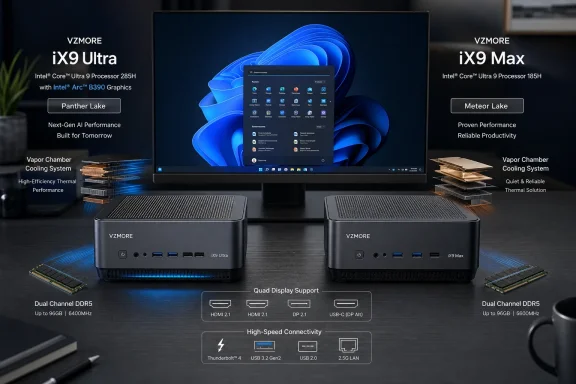 The iX9 Ultra carries the meaningful Intel upgrade
Intel lists the Core Ultra X9 378H as a 16-core Panther Lake processor with Arc B390 graphics, a chip Intel launched in the first quarter of 2026. The X9 378H is the vPro-capable sibling of the Core Ultra X7 368H, with the same headline CPU and graphics configuration but management features that could matter if VZMORE offers a business-oriented configuration.
The Arc B390 is the important distinction for a mini PC that may be asked to do more than office work. Intel places it in the top graphics tier of the Panther Lake family, alongside the X9 and selected X7 parts. It is not a discrete graphics card with its own dedicated memory, so its real-world performance will depend heavily on the memory capacity, memory bandwidth and sustained power settings VZMORE chooses.
Those are precisely the details VZMORE has not yet published for the iX9 Ultra. There is no confirmed RAM ceiling, no stated memory type or speed, no storage layout, no display-output count, and no full port list. There is also no price. Until those specifications appear, readers should avoid treating the Arc B390 label as a complete performance promise, particularly for gaming, video production, local AI inference or multi-display deployments.
The company says its V-Cooling design uses a vapor chamber, bottom air intake, dense fins and vertical airflow. That is a plausible approach for a compact machine, but its claims of 40% more heat-spreading area, 50% higher heat-transfer efficiency and as little as 38 dB under load are VZMORE’s own measurements, not independently validated results. For this class of PC, the meaningful result will be clock speeds, fan noise and chassis temperature after 20 or 30 minutes of sustained work—not a short benchmark run.
The iX9 Max is already a pre-production Windows system
There is at least one useful piece of evidence that the iX9 Max has progressed beyond a rendering or specification sheet. Geekbench records a VZMORE iX9 Max result uploaded on June 4, running Windows 11 Pro with a Core Ultra 9 185H, 32 GB of DDR5 memory and a balanced power plan. The listing reports a Geekbench 6 multi-core score of 13,420 and confirms the processor’s 16-core, 22-thread Meteor Lake design.
That does not establish the final retail configuration or performance. Benchmark database entries can come from early hardware, and the listed four-channel DDR5 arrangement may not describe every SKU VZMORE eventually sells. It does, however, corroborate the basic product identity months before VZMORE’s formal launch window: the iX9 Max is a Meteor Lake mini PC, not an unannounced Panther Lake alternative.
The 185H was a powerful mobile processor in its generation, but it is difficult to justify calling the Max a high-end new-platform Intel mini PC in late 2026. It has Intel Arc integrated graphics and sufficient CPU capability for productivity, coding, home-lab utility duties and ordinary content work. It lacks the newer Arc B390 graphics tier and NPU performance that define the iX9 Ultra.
For a Windows desktop buyer, that makes model selection unusually simple. If pricing is close, the iX9 Ultra is the product that warrants waiting for independent reviews. The iX9 Max will need a clear price advantage, a stronger I/O configuration, substantially quieter operation or a better service arrangement to offset the generational gap.
The rebrand suggestion remains unproven
Notebookcheck notes that the iX9 Max appears visually similar to GEEKOM’s GT13 Max and suggests VZMORE could be selling a rebadged design. The similarities may be worth monitoring, but the available record does not prove a shared manufacturer, shared board design or shared firmware. A common-looking compact enclosure is not enough to establish that relationship.
This is more than a naming exercise. If two systems share a board or firmware lineage, buyers could potentially learn something from the older machine’s thermal behavior, BIOS support, driver issues and port implementation. But until VZMORE publishes a detailed specification sheet—or teardown evidence and firmware identifiers emerge—assuming that the machines are equivalent would be premature.
VZMORE’s own storefront currently presents the company as a retail mini-PC brand with a three-year warranty, 30-day money-back guarantee, U.S. shipping language and lifetime technical support. It does not yet offer a retail iX9 Max or iX9 Ultra product page with the technical detail needed to evaluate either system. The company’s public materials also describe it as German-owned, while Notebookcheck reports that the site’s legal notice names a Hong Kong address. Neither statement by itself establishes where the hardware is designed or manufactured, but the split is a reminder to evaluate the actual warranty and support terms for the region where the PC will be purchased.
The missing specifications matter more than the marketing categories
VZMORE has positioned the iX9 Max for content creation and multi-display work, and the iX9 Ultra for more demanding AI and graphics tasks. Those descriptions are broad enough to conceal the practical differences that determine whether a mini PC works well on a desk or under an administrator’s desk.
Before ordering either Intel system, buyers should wait for confirmation of the following:
- The final memory configuration should state whether RAM is soldered, upgradeable, dual-channel or otherwise bandwidth-constrained, because the Arc B390 uses system memory.
- The storage specification should identify the number and interface generation of M.2 slots, along with whether a second drive remains accessible after installation.
- The port list should specify the exact display standards, USB and Thunderbolt implementation, Ethernet speed, Wi-Fi hardware and whether those interfaces are shared or bandwidth-limited.
- The power limits and performance profiles should be disclosed, because a 15-to-25-watt mobile chip can produce very different sustained results in a mini PC depending on cooling and firmware settings.
- Windows 11 support should include a transparent driver and BIOS update path, especially for the new Panther Lake graphics architecture and NPU.
The last point is important for small vendors. Intel provides the underlying graphics and platform drivers, but a mini-PC maker still controls BIOS releases, memory compatibility, fan curves, sleep behavior, USB stability and any recovery-image support. A three-year warranty is useful only if firmware fixes and replacement logistics hold up after the first wave of sales.
October is a launch target, not a purchasing recommendation
VZMORE has announced a global mid-October 2026 launch target, while final configurations, regional availability and pricing remain undisclosed. That means the company has announced platforms, not complete products. The iX9 Ultra’s Core Ultra X9 378H and Arc B390 combination gives it a credible place in the premium mini-PC market; the iX9 Max’s older 185H makes it a value proposition that has not yet revealed its value.
The practical consequence is to wait for the retail specification sheets and sustained Windows testing. For the iX9 Ultra, the unanswered questions are whether VZMORE supplies enough fast memory, cooling headroom and modern I/O to let the Arc B390 matter. For the iX9 Max, the question is much narrower: whether its final price is low enough to make a 2023-era mobile platform compelling in a 2026 desktop.