

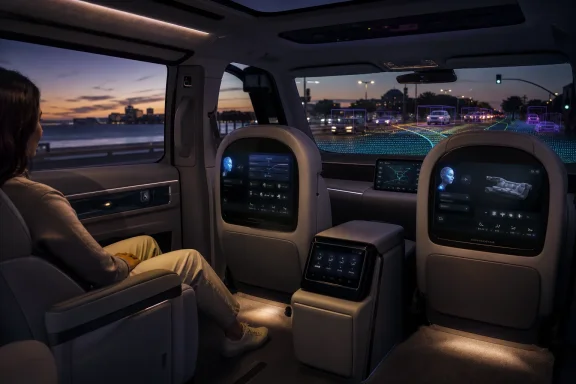
That boundary is the most important detail in the rollout. The Ojai’s Gemini feature is an in-car conversational layer, not an autonomous-driving co-pilot and not a Tesla-style attempt to turn a vehicle AI into the operator of the car. Waymo’s Driver remains a separate sixth-generation automated-driving stack, while Gemini is a passenger-facing interface sitting behind a button on the screen.
Waymo unveiled the update as it prepares to admit more riders to the Ojai, its Zeekr-built electric robotaxi. The company had already begun putting select riders into Ojai vehicles in San Francisco, Los Angeles, and Phoenix earlier this summer, initially as free rides while it collected feedback. The latest announcement is therefore a beta feature reveal during a controlled vehicle rollout, not a declaration that Gemini-equipped Ojais are broadly available to every Waymo customer.
9to5Google, which first detailed the in-car changes outside Waymo’s own announcement, confirmed the feature set: Gemini appears as an overlay summoned from the vehicle display, can answer general questions and control climate settings, and can accept a request to pull over. The publication also reported that the redesigned system is optimized for the Ojai’s larger displays rather than being a simple reskin of Waymo’s existing Jaguar I-Pace screen experience.
Gemini Gets a Passenger Role, Not a Driving Role
Waymo’s wording draws an unusually bright line around Gemini’s authority. The company says Gemini works independently of the Waymo Driver and has no access to real-time driving data. That means a rider can say, “Turn the A/C to 65,” ask about a nearby landmark, or request a stop, but Gemini is not the system deciding whether the vehicle can safely make that stop.
This separation matters for more than marketing. A generative AI assistant can produce fluent but wrong answers; an autonomous-driving system cannot treat those answers as instructions in traffic. By requiring Gemini to remain a passenger tool, Waymo avoids creating the impression that a rider can negotiate driving behavior with a chatbot or talk the vehicle into a maneuver that the automated driver has not independently determined to be safe.
The pullover feature is the narrow exception that proves the rule. Waymo permits Gemini to request a pullover, but the announcement says the assistant otherwise controls no aspect of movement or routing. In practical terms, the voice assistant can pass a rider’s intent into the trip-control flow, while the vehicle’s separate driving software retains authority over whether, where, and how it stops.
That is a more constrained design than many consumers may infer from the Gemini branding. A passenger asking why the car has slowed, rerouted, or paused should not expect Gemini to diagnose the Driver’s real-time reasoning. Waymo says the assistant can provide journey information, yet says it lacks live driving data; the company has not explained what trip-status data Gemini receives, how current it is, or whether it can distinguish a routine delay from an automated-driving intervention.
For IT professionals, the architecture resembles a sensible separation between a user-facing support bot and a production control plane. Gemini may receive a request and expose a limited set of approved cabin functions, but it is not the service with the credentials to operate the safety-critical system.
The Tri-Screen Redesign Is the More Substantial Product Change
Gemini will draw the headlines, but Waymo’s redesigned human-machine interface may have the longer-lasting effect on Ojai passengers. The vehicle has three large displays: a front-center screen and one display behind each front seat. Rather than clone the same map and controls onto each panel, Waymo calls the new design a “choreographed tri-screen experience.”
The distinction is practical. A single passenger seated in the rear-right position can get full access to climate and media controls on that screen, while unused screens show simplified ride status or ambient media. That reduces the awkwardness of a car full of competing touchscreens, where every passenger is technically presented with the same controls but no one can easily tell who is expected to use them.
Waymo’s old in-car screens were primarily confidence-building tools: they showed the route, visualized nearby traffic, presented safety information, and offered support access. The Ojai redesign acknowledges that a purpose-built ride-hail cabin has a different job. With no human driver to ask for temperature changes, music, a stop, or help, the screens become the vehicle’s passenger-service console.
The new Calm Mode is a small but revealing addition. It dims the display and strips the interface back to minimal trip information. That feature does not improve the car’s driving capability, but it responds to a real ride-hail problem: passengers do not always want a bright map, a kinetic animation, or a stream of driving visualizations in their peripheral vision.
Waymo is effectively treating the cabin as a shared computing environment rather than a dashboard. It has to work for a solo rider, a group with competing preferences, passengers who need accessibility support, and people who simply want the screens to disappear into the background. The Ojai’s flat floor, lower entry height, integrated grab handle, braille markings, and screen-reader support reinforce that direction, as Waymo described when it introduced the vehicle in May.
There is a limit to what the redesign can solve. It cannot correct a poor route choice, a rough stop, or hesitation in traffic. A rider posting under the name Ethan McKanna on X praised the Ojai’s automatic door closing and the transition into the full-screen trip interface, while criticizing what they described as indecisive driving and weak speakers. Those are individual impressions, not independently verified performance findings, but they illustrate the split between an improved cabin interface and the still-separate question of how the sixth-generation Waymo Driver feels on the road.
Ojai Is Purpose-Built, but It Still Has a Steering Wheel
The Ojai is a purpose-built robotaxi, manufactured by Zeekr and fitted with Waymo’s automated-driving hardware in Arizona. It is a boxy, electric people-mover designed around sliding doors, a low step-in floor, passenger space, and a high-throughput ride-hail fleet. Waymo says the sixth-generation Driver combines cameras, radar, and lidar and is intended to help the company operate in tougher conditions, including snowier markets.
Despite that mission, the production Ojai retains a steering wheel. TechCrunch reported in January that the earlier Zeekr robotaxi prototype shown during development did not have one, but the Ojai displayed at CES 2026 did. WIRED later confirmed that passenger-ready Ojais are equipped with steering wheels despite being designed for driverless operation.
The presence of a wheel should not be read as an invitation for passengers to drive or as evidence that a safety driver is required. Waymo’s own California filing describes the Ojai as a platform approved for driverless testing and deployment, and its passenger service is built around rides with nobody in the driver’s seat. The wheel instead reflects a different product and regulatory path from rival concepts such as Tesla’s control-free Cybercab.
That distinction also reinforces why Gemini remains cabin-only. The vehicle may retain conventional controls, but the rider’s relationship with the Ojai is still meant to be that of a passenger interacting with service software, not a human driver taking over from an AI system.
The Rollout Details Waymo Has Not Published
Waymo’s announcement is specific about what Gemini can do and unusually direct about what it cannot do. It is far less specific about who receives the update now.
The company says Gemini in Waymo is in beta and that it plans to welcome more public riders “soon.” It has not published a city-by-city rollout schedule for the new interface, named the number of vehicles receiving it, stated whether every existing Ojai is being updated over the air, or identified whether the feature is available to all riders in its early-access markets. It also has not said when the beta label will be removed.
There is a second omission: data handling for Gemini in Waymo. Waymo says the assistant remains inactive unless a rider deliberately engages it, and its rider guidance says in-cabin microphones are only active during a Support call or when riders actively enable them. Those are meaningful safeguards. But Waymo has not published a Gemini-in-Waymo-specific explanation of prompt retention, audio retention, human review, model improvement use, account association, or the relationship between Waymo trip data and Google’s broader Gemini data practices.
That gap deserves attention because a robotaxi query can be more revealing than a phone query. Asking about a nearby medical facility, hotel, landmark, neighborhood, or last-minute itinerary can expose location and intent at the same time. Google’s Gemini privacy materials describe policies for its listed Gemini apps and services, but Waymo has not publicly set out equivalent feature-specific terms for this in-cabin beta.
Waymo’s restrained technical design is the right starting point: Gemini should not get to drive. The next requirement is equally basic for a passenger-facing AI deployed in a vehicle: riders need a clear explanation of what happens to the conversation after the car reaches its destination.