
For agency CIOs, CISOs, acquisition officials, and the contractors that support them, the immediate message is clear: supply-chain risk evidence will increasingly need to exist before an award decision, rather than being assembled after a product, cloud service, or managed-service provider is already embedded in a federal environment. Cheri Benedict, the federal CIO office’s senior cyber supply-chain adviser, told an Intelligence and National Security Alliance webinar that officials want to identify and keep risky vendors and products out of high-priority systems earlier in the process.
The important limitation is equally clear. The federal CIO office has not publicly published the proposed metrics, a collection template, a reporting deadline, the agencies covered, or the consequences for agencies that report weak program maturity. Federal News Network is the only outlet identified in the submitted reporting as carrying Benedict’s timeline, and no official implementation memo or draft reporting instrument appears to have been released alongside it.
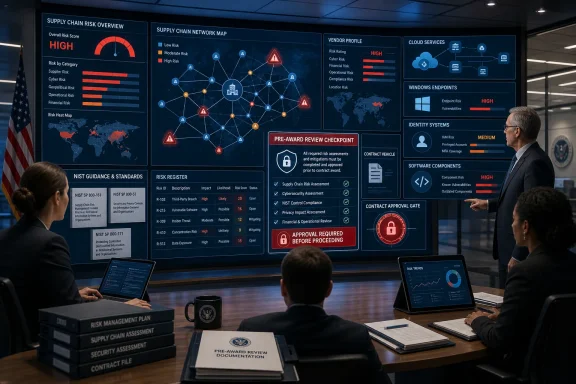 The review targets reporting, not a new NIST baseline
The underlying NIST guidance is not new. Special Publication 800-161 Revision 1, Cybersecurity Supply Chain Risk Management Practices for Systems and Organizations, was originally issued in 2022 and received an errata update in November 2024. NIST describes it as its foundational federal guidance for identifying, assessing, and mitigating risk across a technology product or service’s full lifecycle: design, development, distribution, acquisition, deployment, maintenance, and disposal.
That distinction matters operationally. The White House review described by Federal News Network is not, at least yet, a replacement for NIST SP 800-161. It is a review of the way agencies demonstrate whether they have put that guidance into practice. An agency can point to policies, supplier questionnaires, contract language, software bills of materials, and risk registers; a governmentwide maturity collection would attempt to determine whether those artifacts add up to a functioning program.
NIST’s current materials make the gap visible. The agency released a fillable supply-chain risk assessment scoping questionnaire in December 2025, then released two more implementation-focused resources in mid-2026: SP 800-18 Revision 2 for security, privacy, and supply-chain plans, and SP 1326, a due-diligence assessment quick-start guide. Those are signs that the technical and procedural framework is being made more usable. The White House’s planned reporting revision suggests federal leadership now wants comparable evidence of adoption, not simply another reference document.
For Windows and enterprise administrators, that evidence can extend well beyond a product’s country of origin. SP 800-161 treats the supplier chain as a combination of software, hardware, cloud services, firmware, development practices, component provenance, support arrangements, and the ability to receive reliable vulnerability and incident information. A Microsoft 365 tenant, Azure-hosted workload, Windows endpoint management platform, identity provider, backup product, EDR service, or software deployment tool can each introduce supplier dependencies that need to be understood and documented.
“Left of boom” moves the work into acquisition
Benedict’s “left of boom” formulation is the most useful detail in the Federal News Network report. In government security parlance, it means putting controls ahead of an incident or a costly remediation campaign. In procurement terms, that points toward deeper reviews before a contract award, renewal, or major technology expansion.
Federal acquisition rules already provide a mechanism for this in certain cases. The Federal Acquisition Security Council framework requires executive agencies to share relevant supply-chain risk information when they determine there is a reasonable basis to conclude that a source or covered article presents a substantial supply-chain risk. The rules also allow designated officials to issue orders that prohibit procurement or use of specified products, services, or sources, with the scope depending on whether the order comes from the Department of Homeland Security, Department of Defense, or the Director of National Intelligence.
The current rules are more nuanced than a universal blacklist. Their applicability depends on the agency, acquisition, system type, funding, and the scope of a particular order. Contractors can face representation and disclosure duties, while agencies can seek waivers in defined circumstances. A new maturity-data regime would not automatically change those authorities. It could, however, give the federal CIO’s office and the Federal Acquisition Security Council a better picture of whether agencies are discovering meaningful supplier risks early enough to use them.
That creates a practical consequence for procurement teams: a supplier review that begins after selection may soon look less defensible, particularly for systems categorized as mission-critical or high priority. The problem is not simply whether a vendor is known to be prohibited. It is whether the agency can show it identified critical dependencies, examined alternatives, assessed threats and vulnerabilities, and assigned someone accountable for acting on the results.
The likely pressure point is proof of program maturity
NIST’s guidance does not prescribe one universal maturity score or a single mandatory implementation sequence. It explicitly allows organizations to tailor their supply-chain risk programs to their size, resources, mission, threats, and operational context. Its foundational practices include forming a multidisciplinary program or risk function, gaining executive support, measuring supplier and product criticality, integrating supply-chain requirements into acquisition procedures, and establishing prioritized supplier risk assessments.
A centralized White House collection is likely to test whether agencies can show those functions in a consistent form. That is an inference from the existing NIST framework and Benedict’s comments, not a published list of forthcoming metrics. The details that would decide the burden on agencies remain undisclosed: whether officials will ask for binary attestations, numerical maturity ratings, inventories of critical suppliers, evidence packages, or reporting on individual products and services.
The difference is significant. A lightweight annual survey could expose broad capability gaps but do little to alter day-to-day purchasing. A collection tied to critical systems, acquisition gates, or remediation deadlines could materially affect how long it takes to award a contract and how much documentation vendors must supply. Benedict acknowledged the tension directly, noting that acquisition timelines are already prolonged.
The administration’s March 2026 cybersecurity strategy offers broad policy direction but not the missing operating details. It calls for coordination across government and industry, while Federal News Network reported that Benedict linked the supply-chain review to a policy preference for moving away from adversary vendors and products. The strategy does not itself publish a governmentwide catalogue of vendors that agencies must avoid, nor does it explain how the new data call will distinguish a supplier’s nationality, ownership, operational control, component sourcing, and technical behavior.
What agency technology teams should prepare now
Federal IT organizations do not need to wait for an unannounced reporting template to find the weak spots that a maturity collection is likely to expose. The most useful preparation is to make existing supply-chain controls demonstrable across both procurement and operations.
- Agencies should identify their high-priority systems and map the suppliers behind endpoint management, identity, cloud hosting, backup, security operations, networking, software delivery, and firmware updates.
- Security and acquisition teams should make sure supplier risk reviews occur before award or renewal decisions for critical systems, rather than only after procurement staff have selected a preferred product.
- Program owners should retain evidence that product criticality, threat information, vulnerability history, supplier disclosure practices, support obligations, and viable alternatives were considered in risk decisions.
- Organizations should connect software bill of materials collection, vulnerability-management records, incident-response procedures, and contract requirements to the same supplier-risk register instead of maintaining disconnected compliance files.
- Agencies should assign clear ownership. NIST’s model expects coordination among CIO, CISO, legal, procurement, engineering, mission owners, and supply-chain personnel; a questionnaire cannot compensate for an undefined decision-maker.
This is especially relevant where an agency uses a familiar Windows-centered stack through resellers, integrators, managed service providers, and cloud partners. A direct commercial relationship with a major vendor does not eliminate exposure created by add-ons, dependencies, third-party support, privileged management tools, update channels, subcontractors, or the hardware and services underneath the primary platform. The reporting pressure will be on the agency to show it understands those dependencies in proportion to system criticality.
The missing details will determine whether this changes procurement
Congress has already considered expanding the Federal Acquisition Security Council’s structure and resources. The House-passed Federal Acquisition Security Council Improvement Act of 2024 proposed moving the council into the Executive Office of the President, establishing a program office within the Office of the National Cyber Director, and sharpening the process for reviewing vendors tied to foreign adversaries. But the bill remains pending in the Senate, so it is not the authority behind the White House’s current review.
What is happening now is narrower but potentially more immediate: the federal CIO office is examining whether agency reporting shows a credible, shared view of supply-chain risk. The government already has NIST guidance, FASC authorities, procurement clauses, and exclusion mechanisms. The missing layer is a common way to see whether those tools are being used early enough and consistently enough.
Until the White House publishes its metrics, agencies should avoid treating this as a paperwork refresh. The likely scrutiny will fall on whether a supply-chain program can produce decision-quality records before a critical technology becomes too entrenched to replace.