
Winamp’s current owner is not abandoning music. It is repositioning the brand around direct-to-fan services for artists, with subscriptions, exclusive content, online storefronts, and audience-management tools. Winamp’s own 2026 announcements describe that suite as its future, while its support material directs desktop users to the legacy player.
That is a defensible business strategy. It is also a remarkable end state for an application that became famous precisely because it did one very narrow job exceptionally well: play local files on Windows quickly, flexibly, and without getting in the way.
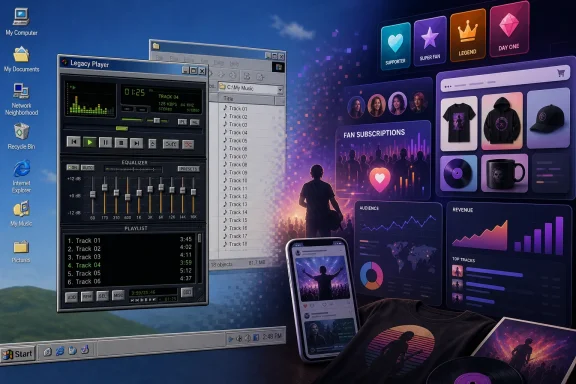 The desktop player became the historical artifact
The original Winamp won the late-1990s Windows desktop through speed, skinning, plugins, format support, and a design that made a music library feel personal. It did not need to become a social network, storefront, creator dashboard, or streaming platform. Its value was that a downloaded MP3, CD rip, or radio stream could be playing almost immediately.
That simplicity remains valuable in 2026. Local collections have hardly disappeared; they have simply moved outside the streaming-first mainstream. Enthusiasts still maintain FLAC libraries, manage media on NAS devices, use audio players on offline PCs, and prefer software whose library is not tied to a subscription account.
Yet the official Winamp download experience makes clear where the company’s attention lies. The desktop application is preserved, but presented as a legacy project rather than the center of an actively evolving Windows product line.
The source-code release exposed the maintenance problem
Winamp tried to recast the Windows player as a community-maintained project in September 2024, saying it would release the legacy player’s code for collaborative development. The move quickly demonstrated how difficult it is to modernize a nearly three-decade-old Windows codebase.
As Ars Technica and Tom’s Hardware reported at the time, the repository used the restrictive Winamp Collaborative License, which prohibited redistribution of modified versions and initially blocked forks. That made the release source available, not open source in the conventional sense.
The situation worsened after developers found code and build components apparently tied to third parties, including Microsoft, Intel, and SHOUTcast. The GitHub repository was deleted less than a month after it appeared. Winamp has continued to describe community development around the legacy player, but the episode left no public, genuinely open development path for the classic app.
For Windows administrators and developers, the lesson is less about nostalgia than software stewardship. An old application can remain useful for years, but aging dependencies, unclear rights, and a closed development model eventually turn routine maintenance into a legal and engineering problem.
A brand is not a replacement for a utility
Winamp’s creator tools may find an audience. Fanzone and artist storefronts address a real problem for independent musicians trying to sell directly to supporters rather than rely entirely on streaming payouts. But they are products that happen to carry the Winamp name, not an evolution of the Windows player’s original appeal.
The practical outcome is straightforward: Winamp remains usable for people who want Winamp, but it is no longer the obvious place to look for a modern local-media player with a clear long-term roadmap. The classic application has become a preserved artifact, while the company behind it has become a music-services platform.
That split is likely to matter more than any future rebrand. Winamp once made software feel faster and more personal; today, its most recognizable product is effectively the legacy layer beneath a different business.
