
That narrower scope does not make the development trivial. It makes it more revealing. China is retiring the Windows version created specifically to meet its own government requirements, including local oversight and customized controls, before its published replacement timetable. For Windows administrators and Microsoft watchers, the signal is not an immediate collapse of Windows usage in China. It is a further retreat from foreign-controlled software at the highest-trust end of the state’s IT estate.
The submitted Indian Narrative analysis calls this an “uninstall doctrine.” The phrase is rhetorical, but the underlying pattern is real: Beijing has spent years moving technology dependencies out of government systems first, where procurement mandates and centralized control can force a migration even when the substitute is less mature.
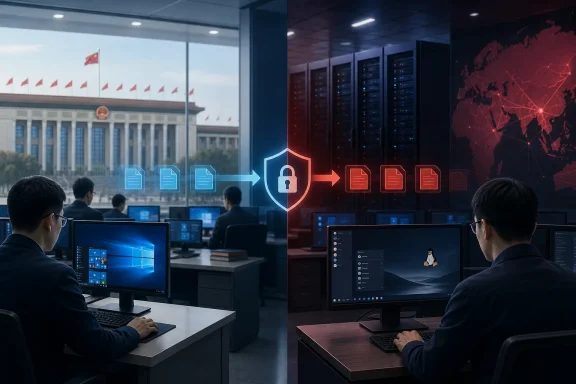 The order targets a special Windows build, not China’s desktops
Bloomberg reported on August 18 that China’s Ministry of State Security instructed some state-linked entities to uninstall the customized Windows 10 release, citing people familiar with the decision. Bloomberg did not publish the affected-agency count, a deadline, a replacement operating system, or a technical finding that prompted the accelerated removal. Those omissions matter, because they leave the operational scope of the directive unverified.
Follow-up coverage from Tom’s Hardware, TechSpot, TechRadar and The Next Web repeated the core reporting, but each traces the instruction back to Bloomberg’s unnamed sources rather than supplying a separate on-the-record confirmation. No Chinese ministry notice publicly setting out the order or its migration requirements has emerged.
Microsoft’s own 2017 announcement confirms the product existed. The company said Windows 10 China Government Edition had been developed by CMIT for Chinese government customers, with Lenovo among the early OEMs. That arrangement was itself unusually revealing: Microsoft did not simply sell an off-the-shelf Enterprise image to Beijing; it participated in a locally structured delivery model designed around Chinese government requirements.
What the current reports do not establish is that China has ordered ordinary Windows 10, Windows 11, Microsoft 365, Azure, or consumer PCs removed. Windows remains the dominant desktop operating system in China by web-traffic measurements, though those figures say nothing precise about government deployment. Treating a targeted retirement of one government edition as a nationwide Windows ban is an overstatement unsupported by the reporting.
February 2027 needs more scrutiny than the reports give it
The reported February 2027 retirement date has been repeated widely, but it does not line up neatly with Microsoft’s public lifecycle documentation for ordinary Windows 10 editions. Mainstream Windows 10 support ended on October 14, 2025, while Windows 10 Enterprise LTSC 2021 is scheduled to reach end of servicing on January 12, 2027.
Microsoft’s public lifecycle pages do not list a separate, clearly identifiable support entry for Windows 10 China Government Edition. That creates an important ambiguity: the February 2027 date may be a CMIT-specific retirement plan, a contractual timetable for government customers, or a simplified reference to the nearby LTSC 2021 deadline. The reporting does not identify the edition version, build number, servicing channel, or update baseline involved.
Administrators should resist assuming that this directive concerns unsupported Windows 10 machines being swapped out as a routine lifecycle exercise. If the reported schedule is correct, the stated concern is data security and technology dependence, not a disclosed Microsoft vulnerability or the ordinary Windows 10 end-of-support calendar.
Microsoft told Bloomberg it was not aware of a security incident affecting the government edition and that the product continued to receive regular security updates. That is not proof that Beijing has no security concern; it is a clear indication that there is no publicly identified CVE, emergency patch failure, or confirmed compromise behind the order.
The absence of technical disclosure is the central limitation of this story. A state-directed removal can be strategically significant without being evidence that the product is insecure. Conflating the two would turn an opaque procurement and sovereignty decision into an unsupported security allegation.
China’s migration problem is bigger than an operating system
The policy logic behind the reported removal is familiar. China has pursued xinchuang—often translated as information-technology application innovation—for years, using government and state-owned enterprises as the first market for domestic processors, operating systems, databases, office suites and security products. Replacing Windows on selected government endpoints is a comparatively manageable layer of that program.
An endpoint operating-system migration still carries costs that headlines often overlook. The machine must run line-of-business applications; authenticate against existing identity systems; handle domestic cryptography and smart-card requirements; print; interact with specialized peripherals; and receive updates through a trusted management path. A replacement that boots successfully is not necessarily a replacement that works across an agency’s workflows.
The likely alternatives are Linux-derived domestic distributions and locally controlled software stacks, but Bloomberg’s reporting did not name the destination platform. That missing detail prevents outside observers from judging whether this is a genuine production migration, a phased removal of a legacy edition, or a procurement directive whose practical implementation will vary by agency.
China has experience with such uneven transitions. Domestic products can be mandated in state-linked environments long before they are competitive with Windows or foreign enterprise software across the broader market. The government can accept compatibility compromises that a retailer, design studio, multinational manufacturer or consumer PC buyer will not.
That is why this development should be read as a decision about control of the supplier relationship, rather than a verdict on Windows usability. Beijing wants to reduce the number of systems whose maintenance, source-code access, licensing, updates or future availability can be affected by a U.S. company or U.S. policy.
Export controls give the decision a different weight
The timing also lands amid a wider U.S.-China technology contest, particularly around advanced computing. The U.S. Bureau of Industry and Security changed its licensing policy in January 2026 to consider exports of Nvidia’s H200, AMD’s MI325X and similar products to China on a case-by-case basis, subject to specified security and compliance conditions. That policy change demonstrated that access can be granted, narrowed or withdrawn through administrative decisions.
For Beijing, Windows represents a different category of dependency from high-end AI accelerators. China can license, customize and deploy Windows through a local joint venture, as it did with CMIT. It cannot make the Windows codebase or Microsoft’s global update infrastructure domestically sovereign merely by localizing its procurement.
Silicon remains the much harder problem. China can field domestic AI accelerators and support them with government procurement, but advanced chip manufacturing depends on a chain of tools and materials that is harder to replace. The operating-system removal should therefore not be mistaken for proof that China has achieved broad technological self-sufficiency. It is a policy choice in a layer where the state has greater leverage and more time to absorb disruption.
The Indian Narrative article is right on one narrow point: a government migration away from a foreign platform is easier to begin than a consumer-wide replacement. State agencies can receive budgets, deadlines, approved hardware lists and mandated applications. The broader market has to be persuaded by product quality, compatibility and cost.
India should not copy the headline, but it should study the dependency
The article’s comparison with India is more useful as a procurement question than as a geopolitical slogan. India has built major domestic digital infrastructure in areas such as UPI and Aadhaar, and Indian software companies including Zoho demonstrate that locally headquartered enterprise platforms can operate at meaningful scale. None of that produces an Indian substitute for Windows, Azure, AWS, advanced GPUs or desktop management tooling.
India’s developing semiconductor projects are also not equivalents to a frontier AI-chip program. A 28-nanometer fabrication plant can be economically important for automotive, industrial and power-management chips, but it does not displace leading-edge logic manufacturing or the compute supply chain used for large AI workloads.
The practical lesson for India, and for any government that talks about digital sovereignty, is less dramatic than “ban foreign software.” Inventory the systems that cannot tolerate a vendor cutoff; identify the applications and identity services that bind them to a single supplier; test alternatives before an emergency creates the mandate; and distinguish ownership of data from ownership of the operational stack.
China’s reported Windows removal offers a more immediate lesson for enterprise IT teams elsewhere, too. Vendor concentration is often invisible until a political dispute, sanctions regime, product retirement or cloud-service change turns it into an operational constraint. A contingency plan does not require abandoning Windows. It requires knowing which business functions would fail if licensing, updates, cloud identity, endpoint management or hardware supply suddenly became uncertain.
China’s government-only Windows 10 edition may disappear from some state-linked machines before February 2027. What remains unanswered is what replaces it, how far the order extends, and whether agencies can complete the migration without rebuilding the surrounding management and application stack. Those details—not the misleading claim that China has “banned Windows”—will show whether this is a symbolic uninstall or a durable break in Microsoft’s role inside the Chinese state.
