
TheZeroNet’s August 20 overview gets the central support-date point right, but its treatment of licensing, upgrades, lockdown features, and post-support patching blurs several important lines. Microsoft’s current lifecycle and deployment documentation shows that Windows 10 IoT Enterprise LTSC 2021 has security support through January 13, 2032, while Windows 10 Enterprise LTSC 2021 stops receiving updates on January 12, 2027.
For a kiosk, industrial controller, diagnostic workstation, or point-of-sale system, that difference is operationally significant. For a standard PC being repurposed as a long-lived desktop, it is not a loophole to keep Windows 10 running indefinitely.
 The Windows 10 deadline did not apply equally to LTSC
Microsoft ended servicing for mainstream Windows 10 version 22H2 on October 14, 2025. That retirement date applied to the General Availability Channel editions most people encountered on business and home PCs, including Windows 10 Pro, Home, and ordinary Windows 10 Enterprise.
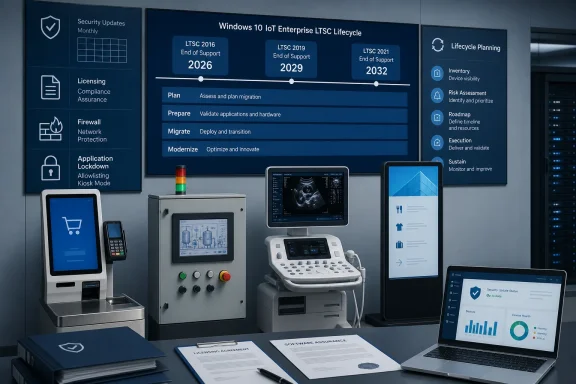
LTSC editions are separately governed. Microsoft’s Windows 10 release record currently lists three Windows 10 Enterprise and IoT Enterprise long-term generations still relevant to field deployments:
| Release | Base version | Final support date |
|---|---|---|
| Windows 10 IoT Enterprise 2016 LTSB | 1607 | October 13, 2026 |
| Windows 10 IoT Enterprise LTSC 2019 | 1809 | January 9, 2029 |
| Windows 10 IoT Enterprise LTSC 2021 | 21H2 | January 13, 2032 |
The immediate problem for administrators is the 2016 generation. It has less than two months of support remaining as of August 20, 2026. A device labeled only “Windows 10 IoT” could be a 2016 LTSB system nearing retirement, a 2019 device with more than two years left, or a 2021 device with more than five years of runway.
Do not use the product family name as the asset-management field. Record the edition, version, build, device model, application version, and last installed cumulative update. A winver check or the Windows version reported by endpoint-management software is a starting point, but a fleet inventory should also identify whether the machine is 1607, 1809, or 21H2.
Microsoft’s July 2026 release information listed build 14393.9339 for the 2016 LTSB line, 17763.9020 for the 2019 LTSC line, and 19044.7548 for the 2021 LTSC line. Those build families are often a more reliable way to distinguish devices than whatever a local inventory agent calls the operating system.
IoT Enterprise LTSC is a Windows Enterprise build with a different contract
Microsoft describes Windows IoT Enterprise as binary-equivalent to Windows Enterprise. That is why administrators can use familiar Windows deployment, management, security, driver, and application tools. It is also why Microsoft’s volume-license deployment process for Windows 10 IoT Enterprise LTSC 2021 begins with Windows 10 Enterprise LTSC 2021 media and converts the installation through the appropriate activation key.
The important difference is not that IoT Enterprise is a radically smaller operating system. It is that the license is intended for a fixed-purpose device: a system that performs a defined job rather than serving as a general employee workstation.
That purpose restriction has practical consequences. A self-checkout terminal that runs a payment application, a medical imaging console tied to certified software, and a digital-signage appliance are the kinds of devices Microsoft identifies for IoT Enterprise. A laptop assigned to a user for Office, browsers, email, and arbitrary applications is not.
Microsoft’s documentation is explicit that IoT Enterprise LTSC cannot be used as a replacement for desktop Windows in general-purpose computing. A long support period does not override the device-use terms.
The distinction also explains the lifecycle disparity. Windows 10 Enterprise LTSC 2021 has no extended-support phase after January 12, 2027. Windows 10 IoT Enterprise LTSC 2021 does: its support runs to January 13, 2032. Microsoft applies the same pattern to Windows 11: Enterprise LTSC 2024 ends on October 9, 2029, while Windows 11 IoT Enterprise LTSC 2024 remains supported until October 10, 2034.
The “OEM only” licensing claim is incomplete
TheZeroNet article says Windows 10 IoT Enterprise LTSC is available exclusively through authorized OEM hardware distributors. That was an incomplete description even for organizations managing their own existing fixed-purpose devices.
Microsoft provides two licensing routes:
- OEM licensing is for manufacturers that preinstall Windows IoT Enterprise on new devices delivered to customers.
- Volume licensing is available for eligible organizations upgrading existing specialized, fixed-function devices.
Microsoft’s current licensing guidance lists the Microsoft Customer Agreement, Microsoft Product and Services Agreement, and Select Plus among the volume-license programs for Windows IoT Enterprise LTSC. The license is not a retail product a home user should expect to purchase from a consumer storefront, but it is also not confined to a device maker’s factory image.
This matters during a refresh. An organization may be able to retain a tested appliance chassis, deploy a fresh IoT Enterprise LTSC image, and license the upgrade through its enterprise agreement — assuming the hardware, application vendor, and Windows IoT use restrictions all qualify. Conversely, an OEM-installed device may have a license tied to the original solution and support arrangement, leaving the customer dependent on the device maker for upgrade media, drivers, and validation.
The price of the operating system is therefore rarely the central question. The cost is the complete change-control exercise: application recertification, peripheral drivers, BIOS and firmware, payment or medical-device compliance, operator workflow testing, image capture, and rollback planning.
Long-term servicing does not mean a frozen security posture
LTSC means Microsoft does not send normal Windows feature updates through Windows Update for those devices. It does not mean the image should be installed once and ignored for a decade.
Microsoft continues to ship monthly quality and security updates for supported LTSC releases. Those updates can change servicing-stack components, browsers, Defender intelligence and platform components, cumulative security fixes, certificates, and drivers delivered through managed channels. A fixed feature set reduces the chance of broad interface and platform changes, but it does not eliminate maintenance work.
The article’s reference to Extended Security Updates is also potentially misleading. Windows 10 IoT Enterprise LTSC 2021’s date of January 13, 2032 is already its published extended-support end date. Administrators should not assume there will be a separate ESU program beyond that point. Microsoft has documented the lifecycle through 2032; it has not promised another paid patching extension after it.
This is especially relevant for devices with limited network exposure. Isolating an older terminal behind firewall rules, application allow-listing, separate credentials, and monitored remote access may reduce risk, but it does not convert an unsupported Windows release into a supported one. For regulated or public-facing devices, the support date must be part of the risk register well before the final patch month.
Lockdown tools help, but they are not automatic protection
Windows IoT Enterprise supports tools that make a fixed-purpose appliance harder to alter accidentally or misuse at the console. Unified Write Filter redirects changes to an overlay that is normally discarded at restart; Shell Launcher can replace Explorer with a dedicated application; and Assigned Access can limit a device to approved applications or a kiosk configuration.
These features are useful when they are designed into the device image and operating procedure. Unified Write Filter, for example, can protect a known-good state from unwanted changes after reboot. It can also interfere with application updates, Windows activation, log retention, and data persistence if maintenance workflows are not deliberately built around it. Microsoft’s own deployment guidance says activation and image capture need to account for the filter’s state.
The claim that a reboot makes “most malware harmless by design” goes too far. A write filter can remove nonpersistent local changes, but it does not stop credential theft, lateral movement, memory-resident activity, network abuse, vulnerable applications, malicious peripheral devices, or an attacker who reaches a management plane. It is a resilience and configuration-control tool, not an antivirus replacement.
Nor are all lockdown capabilities exclusive to IoT Enterprise. Microsoft lists Keyboard Filter support for Enterprise, Enterprise LTSC, Education, and IoT Enterprise editions. The value of IoT Enterprise lies in the combination of fixed-purpose licensing, lifecycle, deployment model, and device-focused configuration options — not in a claim that every kiosk feature exists nowhere else.
Migration planning should start with the device, not the OS
Microsoft says every move from one Windows IoT Enterprise LTSC release to the next requires a new license. TheZeroNet article says an in-place upgrade is unsupported and a clean reinstall is mandatory, but Microsoft’s IoT FAQ says the technical move to a newer LTSC can be either an in-place upgrade or a reinstall. The correct answer depends on the device, vendor support, application certification, and the organization’s change-control requirements.
For many specialized appliances, a clean image remains the safer route because it produces a reproducible baseline. But it should be a deployment decision, not a false assumption about what the platform can technically do.
Windows 11 IoT Enterprise LTSC 2024 is Microsoft’s current long-term release, based on Windows 11 version 24H2 and supported until October 10, 2034. It is the natural starting point for a new fixed-purpose device project. Existing Windows 10 hardware should be assessed individually rather than dismissed on a blanket TPM claim: TPM 2.0 is required for Microsoft’s Edge Secured-core certification, while actual IoT hardware compatibility also depends on the supported processor list, firmware, drivers, and the appliance vendor’s certification position.
For Windows 10 IoT Enterprise fleets, the practical deadline is no longer October 2025. It is the specific lifecycle date tied to the installed LTSC generation — with October 13, 2026 now the urgent cutoff for any remaining 2016 LTSB machines.