
TechSpot first highlighted the hidden feature, internally named IntelligentCarveout, in the August 17 Experimental build. Windows Latest had previously connected similar language to NVIDIA documentation, and independent reporting from AllThings.How and 9to5Windows says the build includes a new SettingsHandlers_UnifiedMemory.dll component and feature ID 61121285. Microsoft did release build 29648.1000, but it did not announce this setting in its public release notes.
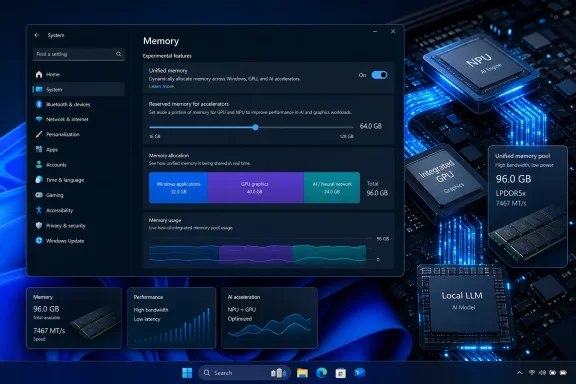
The important finding is in the language attached to the feature. It refers to “Reserved memory for accelerators” and “Memory for graphics and AI acceleration,” with a description saying Windows can reserve additional unified memory for graphics- and AI-intensive software and that reserved memory is unavailable to other applications. That is a different mechanism from the shared-GPU-memory figure Windows users already see in Task Manager.
 A reservation is different from memory the GPU can borrow
On a typical integrated-GPU PC, the CPU and GPU already use the same physical RAM. Windows, firmware, and the display driver decide how much of that memory is treated as preallocated graphics memory and how much can be borrowed dynamically when a game, 3D application, or compute workload asks for it.
Task Manager’s “Shared GPU memory” figure is often misunderstood as RAM permanently handed to the GPU. It is generally a ceiling for system memory the graphics stack may borrow, not a promise that the GPU owns that capacity at all times. A system with 32GB of memory may show a large shared-memory number even though Windows has not actually removed that entire amount from browsers, virtual machines, or foreground applications.
IntelligentCarveout appears to be aimed at a more forceful policy. If the wording observed in build 29648.1000 reflects the shipping behavior, Windows would establish a real protected allocation for accelerators. In plain terms, a user could choose to make a portion of RAM reliably available to the GPU, NPU, or another accelerator, accepting that Excel, Chrome, Hyper-V guests, and the Windows cache cannot reclaim it when they need it.
That is potentially useful on systems where one unified memory pool must serve several demanding jobs at once. It is also the feature’s central trade-off. A 64GB machine with a large accelerator reservation might load a bigger local AI model, but it could become much less forgiving when a user opens several large applications alongside it. The setting would not create memory; it would determine who loses access first when the machine is under pressure.
Microsoft has already acknowledged the larger unified-memory problem
Microsoft’s own RTX Spark announcement from May provides important context that the hidden Windows setting alone does not. The company said it has been changing Windows to support NVIDIA RTX Spark’s unified-memory design, including a “new higher, smarter limit” on the total system memory accessible to the GPU in high-memory systems.
That official statement is narrower than a confirmation of IntelligentCarveout. Microsoft has not publicly said that users will receive a slider or preset control, has not named a target Windows 11 release, and has not identified supported processors, OEM systems, or minimum memory capacities. But it establishes that Windows platform work is already underway to let GPUs access more of the shared pool on devices such as RTX Spark.
NVIDIA markets RTX Spark systems with up to 128GB of unified memory, combining an Arm-based Grace CPU and a Blackwell RTX GPU. NVIDIA says the platform is intended to run local AI work, including model development and inference, while also supporting RTX gaming and creative workloads. On that class of hardware, a Windows policy for deciding how much memory accelerators can count on makes more sense than it does on a conventional 16GB laptop.
The strongest practical interpretation is that Windows is moving from treating unified memory mainly as an automatic resource-management problem toward exposing a policy choice on systems designed around large shared pools. For local AI, capacity can be the hard limit: a model that does not fit into available fast memory cannot simply compensate with more GPU cores. For games, a guaranteed allocation could reduce contention in specific scenarios, though it will not substitute for faster memory or a discrete GPU’s dedicated VRAM.
More capacity does not turn LPDDR5x into GeForce VRAM
TechSpot correctly notes the temptation to compare a 128GB unified-memory RTX Spark system with a GeForce RTX 5090, which has 32GB of GDDR7 VRAM. That comparison needs a firm boundary: more addressable memory can make larger models and larger assets possible, but it does not make the two memory systems equivalent.
A desktop RTX 5090’s dedicated GDDR7 is designed to feed a high-end discrete GPU at far higher bandwidth than the LPDDR5x system memory used in a unified-memory design. A 128GB unified pool may let a graphics processor hold data that would not fit inside 32GB of VRAM; it may still perform much worse when a workload repeatedly streams or accesses that data at bandwidth-sensitive rates.
This is why a user-facing carve-out would be useful rather than magical. It could help avoid a situation where Windows or competing applications crowd a game’s assets or an AI model out of the usable pool. It cannot erase the latency and bandwidth penalties that separate shared system memory from dedicated graphics memory.
The same caution applies to claims that the setting will benefit “gaming and AI” in equal measure. A local language model with a large memory footprint may benefit from predictability and capacity more than a game does. Many games respond more directly to GPU compute power, memory bandwidth, driver behavior, and engine-level streaming than to a larger fixed reservation. The optimal setting could therefore differ sharply between a developer running local inference, a creator editing high-resolution video, and a player launching a modern DirectX 12 title.
The first devices may not be today’s gaming PCs
Reporting by AllThings.How says the hidden control currently surfaces only on supported hardware with an NPU and places it under Settings > System > Advanced, in a “Unified memory” section. Early interface references reportedly include choices such as Recommended, High, Maximum, Custom, and Don’t allow. Microsoft has not confirmed either the hardware gate or those labels, so they should be treated as evidence from an unfinished build rather than a product commitment.
The likely target is a newer set of Windows machines built around a single large, coherent memory pool: NVIDIA RTX Spark PCs, high-memory Arm systems, and AMD designs such as Ryzen AI Max-class machines. It is much less likely to matter on a traditional desktop with a discrete Radeon or GeForce card, where the GPU’s local VRAM remains physically separate from system RAM and cannot be expanded through a Windows reservation control.
That distinction should prevent a predictable round of bad advice. Installing a preview build or forcing a hidden feature flag will not give a GeForce desktop card extra dedicated VRAM. Nor would a reserved-memory setting improve a low-memory integrated-GPU laptop by itself. On a 16GB or 24GB system, aggressively taking memory away from Windows could make the computer feel worse long before it helps an AI or graphics workload.
Admins should view this as an early sign of a new configuration variable, not a deployment-ready Windows feature. A fixed reserve can change memory-pressure behavior, application compatibility, crash patterns, and performance baselines. If Microsoft eventually exposes it on managed hardware, it will need clear reporting through Windows management tooling and unambiguous documentation about defaults, rollback behavior, and how reservations interact with virtualization and endpoint security software.
What Microsoft still has not said
The record supports the existence of hidden code and a Settings component in Windows 11 build 29648.1000. It does not establish that IntelligentCarveout will ship, who will receive it, how the reservation will be enforced across GPU and NPU workloads, or whether an OEM and driver must expose support before Windows shows the control.
Microsoft’s Experimental channel documentation explicitly warns that these early platform builds are not attached to a specific Windows release and that features can change, be removed, or never move beyond Insider testing. That warning matters here because the proposed setting reaches into the core memory-management bargain of the operating system: Windows normally benefits from keeping RAM flexible.
For now, the concrete takeaway is straightforward. Microsoft is testing evidence of a fixed unified-memory reservation policy at the same time it is publicly optimizing Windows for 128GB RTX Spark systems. If the company turns IntelligentCarveout into a supported feature, Windows users on unified-memory hardware may finally get a direct way to choose whether a PC is configured to favor its desktop workload, its game, or its local AI model.