
The useful conclusion is narrower than “NVMe does not matter for gaming.” A fast NVMe SSD remains the sensible default for a new Windows 11 build, particularly because it improves load times, avoids SATA cabling, and is increasingly assumed by game developers. But the test is a sharp warning against paying a large premium for PCIe 5.0 performance solely to raise frame rates: in the games tested, the jump from SATA to NVMe usually did not change playable performance, and moving beyond a basic PCIe NVMe drive brought no measurable benefit.
Tom’s Hardware tested a Samsung 870 EVO SATA SSD against PCIe 3.0, PCIe 4.0, and PCIe 5.0 NVMe drives using a Ryzen 7 9800X3D, GeForce RTX 5090, 16GB of DDR5 memory, Hardware-Accelerated GPU Scheduling enabled, and Nvidia driver 610.62. That is an unusually capable graphics platform paired with a relatively mainstream memory capacity—an important setup choice, since less available RAM should force more asset reads from the system drive.
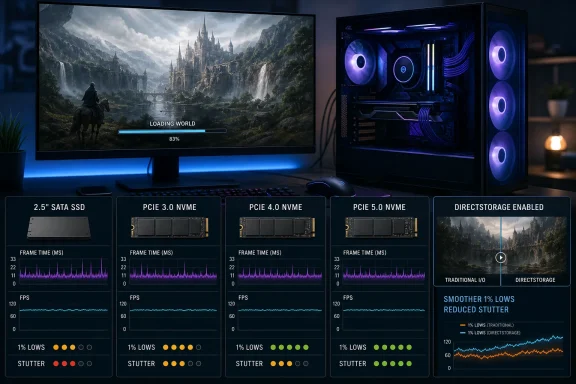 Most game engines still do not consume NVMe-class bandwidth
The headline result holds up under the test data. Across most of the 11 games, Tom’s Hardware found no meaningful frame-rate advantage for PCIe storage over SATA, including in games that sound as if they ought to punish a slower drive.
Alan Wake 2 is the clearest example. The game uses path tracing, mesh shaders, RTX Mega Geometry, and continual streaming of scene assets from storage. At 4K, the test recorded average SSD activity of more than 200 MB/s across the drives, while the PCIe 5.0 SSD briefly reached 5.1 GB/s. Yet the publication reported no meaningful performance difference between the SATA and NVMe drives in normal gameplay.
Starfield produced a similar result. It repeatedly drove each SSD to 100% reported utilization while the player moved through its open world, but its average read bandwidth was only about 15–18 MB/s at 1080p. “100% utilization” in a monitoring tool therefore did not mean the drives were reaching their advertised sequential-read limits. It meant the pattern of reads—small, random, and often at low queue depths—had become the limiting condition.
That distinction is where SSD marketing and actual game behavior diverge. A PCIe 5.0 drive can advertise sequential reads above 10 GB/s, while SATA III peaks around 550 MB/s in favorable conditions. But games generally do not request one enormous, clean sequential transfer. They issue many smaller reads while the CPU, system memory, GPU, decompression path, and game engine decide when the assets can be used.
Tom’s Hardware found that modern games commonly use 32KB or 64KB random reads and relatively low queue depths. Those workloads do not reliably exploit the massive sequential bandwidth advantage printed on an NVMe SSD’s box. A SATA SSD can hit its interface ceiling more often, but if the game’s actual sustained demand remains below that ceiling—or if another part of the PC is waiting first—the additional NVMe bandwidth has nowhere useful to go.
The finding does not rescue hard drives as a viable Windows 11 gaming option. Tom’s Hardware deliberately excluded mechanical disks because many newer games can suffer long loads, streaming hitches, visual issues, or outright poor behavior when installed on an HDD. The relevant comparison is between solid-state drives: a SATA SSD is still dramatically faster at random access than a hard drive, even if it is much slower than an NVMe drive on sequential benchmarks.
DirectStorage is where the SATA ceiling begins to show
The exceptions in the test were Forspoken and Ratchet & Clank: Rift Apart, two PC games that support Microsoft’s DirectStorage technology. In Forspoken, Tom’s Hardware found a substantial improvement in 1% low frame rates after moving from SATA to any PCIe SSD. At 4K, its reported 1% lows were 39% higher on PCIe storage; the gains were 51% at 1440p and 22% at 1080p.
Those figures matter more than a small increase in average frames per second. The 1% low is a way of measuring the slowest portion of rendered frames. A higher result usually translates into fewer noticeable stutters and less severe frame-time disruption, even when the average FPS counter looks similar. For a game streaming assets aggressively during play, that is the performance difference a player is likely to feel.
The storage telemetry explains why. In Forspoken at 1080p, the SATA SSD averaged 240 MB/s and reached 485 MB/s at peak, with average utilization of 52%. The PCIe 4.0 drive averaged 374 MB/s, peaked near 3 GB/s, and showed a much lower average utilization percentage because it had substantially more headroom. The upgrade from SATA to PCIe mattered; the upgrade from PCIe 3.0 to PCIe 5.0 did not produce a clear corresponding gameplay gain.
Microsoft’s DirectX team has long described DirectStorage as a way for games to use the higher bandwidth available from NVMe drives while reducing CPU overhead in the storage pipeline. Microsoft says DirectStorage-enabled games run on both Windows 10 and Windows 11, but that Windows 11 includes additional I/O stack optimizations. The company also says an NVMe SSD is required to see the feature’s significant improvements, particularly when GPU decompression is involved.
But DirectStorage support is not a blank check for faster frame rates. It gives developers tools; it does not force every scene, engine design, compression format, or asset-streaming pattern to behave the same way.
Ratchet & Clank: Rift Apart demonstrates why that qualification is necessary. In standard gameplay, Tom’s Hardware found no measurable difference among the drives. During the game’s portal sequences, the SATA SSD even posted slightly higher average frame rates and 1% lows at 1080p and 1440p. That was not evidence that SATA is faster. The slower drive kept the player in the comparatively simple portal scene longer, inflating the frame-rate metric before the more demanding destination world loaded. At 4K, where the underlying rendering burden is higher, PCIe SSDs produced better 1% lows.
That is an unusually good example of why storage benchmarks need more than a single FPS chart. A drive can appear to “win” a narrowly defined sequence by extending a loading transition. The actual user experience is worse if the player waits longer to arrive in the game world.
The missing comparison is a normal PCIe 3.0 SSD versus expensive flagship storage
The most actionable part of the test is not SATA versus NVMe; it is the lack of a meaningful hierarchy within NVMe. Tom’s Hardware tested PCIe 3.0, 4.0, and 5.0 models, and reported no meaningful gameplay advantage from newer generations across its suite. Once a game had enough storage bandwidth to avoid becoming the bottleneck, additional theoretical throughput did not translate into higher FPS.
For Windows 11 users planning an upgrade, that makes a solid PCIe 3.0 or PCIe 4.0 NVMe SSD the practical sweet spot if pricing and capacity are favorable. A PCIe 5.0 drive may still make sense for sustained file transfers, professional media work, large local datasets, virtual machines, or a workstation that regularly moves hundreds of gigabytes. Gaming alone did not justify it in this test.
Existing SATA SSD owners should be more selective. Replacing a healthy SATA game drive solely because a benchmark tool reports lower sequential throughput is hard to justify if the games played are similar to Alan Wake 2, Starfield, Cyberpunk 2077, DOOM: The Dark Ages, or other titles in the test that showed comparable performance. A SATA SSD also remains an entirely reasonable secondary library drive for older games and titles without unusually demanding streaming behavior.
The case for moving to NVMe is stronger when the SATA drive is also constrained by low capacity, poor endurance, an aging controller, or a need for faster installs and loading. Windows itself will feel more responsive when storage latency and application launch behavior improve, but that is separate from claiming a broad in-game FPS uplift.
One benchmark suite cannot settle every Windows 11 storage question
The test was thorough enough to challenge the assumption that every demanding game needs a top-end SSD, but it should not be read as a universal storage recommendation. It covered 11 titles on one high-end system, using 16GB of RAM, specific game scenes, maximum quality settings, and one SATA SSD alongside three NVMe models. Different patch levels, graphics settings, memory capacities, modded games, or poorly behaved storage drivers can produce different outcomes.
The 16GB configuration is especially significant. Tom’s Hardware said it chose that capacity partly to force greater SSD reliance than a 64GB system would require, though it reported little difference in observed storage activity when comparing 16GB and 64GB. That makes the broad lack of PCIe advantage harder to dismiss, but it does not establish that every memory-constrained PC will behave identically.
There is also a practical distinction between a game that supports DirectStorage and one that makes it central to its asset pipeline. Neowin’s summary correctly identifies the two DirectStorage titles as the standout cases, but the evidence does not show that the feature alone guarantees a major NVMe uplift. Forspoken is the stronger proof of the benefit; Ratchet & Clank: Rift Apart shows the result can be scene-specific and complicated by how the game masks loading.
For most Windows 11 gaming PCs, the buying rule is now straightforward: use an SSD, prefer NVMe when building or upgrading, prioritize capacity and a reputable drive over PCIe 5.0 headline speed, and reserve a premium storage purchase for workloads that can actually saturate it. The small group of games built around fast asset streaming is growing, but this benchmark shows it has not yet made a SATA SSD obsolete.