

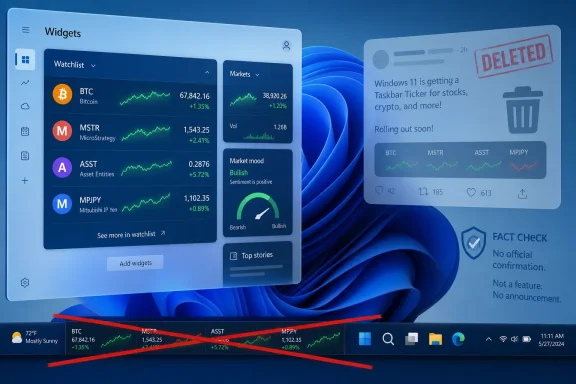
That leaves the event as a reported personal wish list, not a confirmed Windows roadmap item. Microsoft has announced no dedicated always-visible taskbar ticker for those instruments, and no other outlet appears to have independently reported a request to Microsoft, OpenAI, or another Windows developer connected to Livingston’s deleted post.
The distinction matters because Windows 11 already has a finance-capable Widgets experience, but it is a different product from the toolbar widget described by the report. Users can configure a Stocks widget and receive finance-related taskbar announcements, yet the widget content lives in the Widgets board, opened from the taskbar or with Windows+W. It is not a persistent horizontal tape of prices occupying taskbar space.
The reported request does not identify a product owner
Traders Union says Livingston wanted live desktop tickers and later mentioned walking around his neighborhood for two hours while connected to Codex on his PC. But the article does not say that he addressed Microsoft, the Windows Insider team, OpenAI’s Codex team, an independent Windows developer, or his own audience. It also does not establish whether “toolbar” meant the Windows taskbar, a browser toolbar, a custom application panel, or an overlay.
Those omissions are consequential. A request directed at Microsoft could be read as feedback about Windows Widgets or the taskbar; a request made to an AI coding tool could instead be a prompt to generate a local desktop utility. The source supplies no evidence that anyone accepted the request, began development, or has a release timetable.
The report’s headline also overstates what can be verified. A user asking for a widget is not the same as a widget being requested through an official feedback channel, much less a feature entering Windows 11. Windows enthusiasts should treat it accordingly: there is no new Windows 11 ticker feature to install, enable, or test on the basis of this report.
The deleted-post problem is more than a sourcing technicality. Without a preserved original, it is impossible to confirm the requested layout, whether prices were meant to update in real time or periodically, whether the quote list was complete, or whether Livingston was describing an existing setup rather than proposing a new one. Traders Union says it “saved everything,” but the published article itself provides none of that saved material beyond its brief paraphrase.
“Strive” is a company name, not a complete ticker request
There is a second ambiguity in the reported instrument list. MSTR is the Nasdaq symbol for Strategy, the company formerly known as MicroStrategy. Strive’s Class A common stock trades on Nasdaq under ASST, according to Strive’s investor materials and SEC filings. MPJPY is an over-the-counter American depositary receipt for Japan’s Metaplanet, not the primary Tokyo-listed ordinary share.
Calling the requested display “Bitcoin, MSTR, Strive and MPJPY” therefore combines four different kinds of market references:
- Bitcoin is a continuously traded crypto asset whose displayed price depends on the exchange, currency pair, index methodology, and update interval.
- MSTR is a Nasdaq-listed U.S. equity whose regular-session quote follows U.S. market hours.
- ASST is the Nasdaq symbol required to quote Strive common stock precisely; “Strive” alone is a company name and may not resolve consistently in a market-data feed.
- MPJPY is an OTC ADR, meaning its availability, quote freshness, and displayed liquidity can differ from Metaplanet’s primary Japanese listing.
That is the unglamorous engineering issue absent from the report. A desktop ticker for this combination needs to define what “live” means. Bitcoin can change around the clock. Nasdaq quotes have regular and extended sessions. An OTC ADR can be less actively traded, while the Tokyo-listed underlying security follows a different exchange calendar and operates in yen. A price strip that simply paints four changing numbers without identifying the venue, currency, market status, and delay could create more confusion than it removes.
For a retail watchlist, a delayed indication may be sufficient. For a trader expecting executable market data, it is not. Microsoft’s own Windows documentation describes Widgets as glanceable, dynamically refreshed information and explicitly says they are not intended to replace full applications. That is a sensible boundary for Windows’ built-in Stocks widget, particularly where users may read a quote as a trading signal.
Windows 11 already has the ingredients, but not the requested form factor
Microsoft’s support documentation says Windows 11 Widgets can show stock updates, allow users to update a watchlist, and send announcements from finance widgets to the taskbar. Those announcements are temporary: the taskbar normally returns to weather after the message disappears. The user can also turn finance announcements and notification badges off.
That means a user who wants a simple stock watchlist may already be able to get much of the practical value through the existing Widgets board, provided the desired symbols are supported by its underlying market-data service. It does not mean Windows 11 can currently pin a custom four-symbol quote tape directly beside Start, Search, or the system tray.
Microsoft has also documented a development route for third-party Windows widgets. A packaged Win32 application or a progressive web app can register as a widget provider and supply dynamic widget content using Adaptive Cards. The important limitation is placement: third-party providers integrate with the Windows Widgets host, not as arbitrary, permanently resident taskbar controls.
A developer building the thing Traders Union describes therefore faces a product choice:
- Build a Windows Widget, accepting that it lives in the Widgets board and follows Microsoft’s host model.
- Build a conventional desktop application with a compact always-on-top window or panel.
- Build a taskbar-adjacent utility using supported notification and tray mechanisms, accepting that it will not become a native taskbar element.
- Use a browser or progressive web app dashboard, which can offer richer charts and data controls but does not solve the persistent desktop-ticker request by itself.
The first route is the most Windows-native, but the second is closer to the reported request. Windows 11’s taskbar is deliberately constrained, and Microsoft has not opened it as a general-purpose container where each app can insert an unbounded stream of live financial symbols. That protects taskbar consistency and limits background clutter, but it also explains why the built-in Widgets system is a panel rather than a revival of the old Live Tile model across the taskbar.
Codex is a plausible way to build it, not evidence that it exists
Livingston’s reported mention of Codex may explain why the request surfaced alongside Windows 11. An AI coding agent could help create a personal market panel: ingest an approved data API, normalize quote fields, cache results, display a watchlist, and add alerts. But the Traders Union item does not say Codex produced code, created a widget, or remotely interacted with his Windows desktop.
That gap is especially important for IT administrators and security-conscious users. A live-price widget needs a data provider, and a data provider normally means credentials, rate limits, data-licensing terms, and some decision about where an API key resides. A quick locally generated utility should not hard-code a market-data key into a script, expose it in a public repository, or claim “real-time” pricing when its plan supplies delayed data.
There is also a reliability question. A desktop quote display that runs persistently must handle market closures, feed failures, stale timestamps, regional symbols, exchange holidays, and the difference between last trade, bid, ask, and indicative price. The request makes sense as a personal dashboard; it is not a trivial UI tweak.
For now, the verifiable story is narrower than the headline suggests. Traders Union reported that Adam Livingston wanted a Windows 11 live-ticker toolbar, but the source record does not establish the original post, its recipient, a product plan, or a working implementation. Windows 11 already provides finance widgets and taskbar alerts, while a true persistent Bitcoin–MSTR–ASST–MPJPY tape would require either a third-party app or a change Microsoft has not announced.