
The answer being recirculated on Windows 95’s 31st anniversary comes from Raymond Chen’s The Old New Thing, Microsoft’s long-running engineering history blog. Chen wrote that the Windows 95 CD included Edie Brickell’s “Good Times,” Weezer’s “Buddy Holly,” a Rob Roy trailer, Bill Plympton cartoons, Pinball, and the hovercraft capture-the-flag game Hover! because “it was fun.” He also said the extras helped show off Windows 95’s multimedia abilities.
That is an unusually candid explanation from a company that was selling an operating system into a market still split between floppy-drive business machines and CD-equipped home PCs. But it was not a new Microsoft statement made for the anniversary. Chen’s original post is dated January 3, 2006; Windows Central revisited the licensing history in February 2026, and WindowsLatest revived the older quote on August 25, one day after the actual anniversary of Windows 95’s August 24, 1995 launch.
The distinction does not make the story less interesting. It makes the real lesson clearer: Microsoft used the installation disc as a showcase for the kind of PC it wanted consumers to buy next.
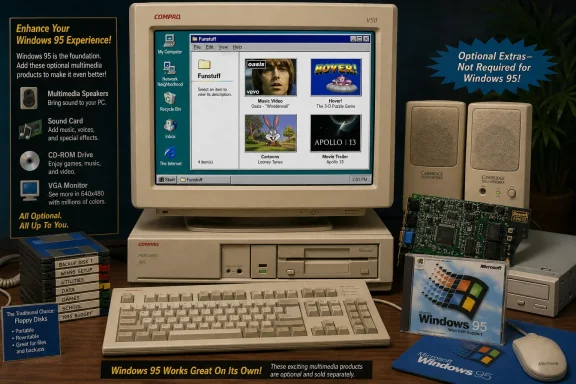 The extras were a CD-ROM advantage, not a Windows 95 requirement
Microsoft’s archived Windows 95 documentation lists CD-ROM drives, sound cards, and other multimedia equipment as optional hardware. The operating system could be installed from either a CD-ROM or a stack of high-density floppy disks, and Microsoft’s minimum requirements centered on a 386DX processor, 4MB of RAM, VGA graphics, and hard-drive space—not speakers, audio hardware, or optical media.
That corrects a common retrospective claim that Windows 95 made sound support, speakers, and CD-ROM drives mandatory for all PCs carrying the OS. It did not. A buyer could run Windows 95 without a sound card, and Microsoft’s setup documentation explicitly treated several multimedia components as conditional. CD Player installed automatically only when a CD-ROM drive was detected; sound-related components similarly depended on detecting sound hardware.
What Microsoft did do was reserve a richer experience for users who bought the CD version or had a CD-equipped machine. Its own Knowledge Base described the Funstuff folder—containing Hover!, pictures, and videos—as material available only on the CD-ROM. Those components were not part of a normal typical, portable, or compact installation; users had to choose them during Custom Setup.
That design tells a more useful story than the idea that Microsoft simply stuffed a disc with cultural ephemera. The extras rewarded users who had made the jump to the hardware Microsoft and PC makers were promoting: a machine with enough storage, optical media, sound output, and graphics capability to make a video clip feel impressive rather than gratuitous.
“Buddy Holly” required more than a marketing deal
Chen’s February 2026 follow-up explains why Weezer’s “Buddy Holly” was not a casual add-on. Microsoft first had to negotiate rights to the song with Geffen Records, apparently without the band members’ involvement. Chen wrote that the group initially objected to finding out after negotiations were already under way, before later describing the distribution as a major opportunity in the pre-YouTube era.
The rights problem then widened beyond the song itself. The Spike Jonze video used a recreated Happy Days setting and integrated footage associated with the television series. Chen said Microsoft’s lawyer had to obtain permission from the actors whose appearances were implicated by the video. In other words, Windows 95’s most remembered bonus was not simply a file copied to a master disc; it was a licensing project involving music rights, visual rights, and individual likeness permissions.
Windows Central’s reporting on Chen’s account adds the strategic point that his original “because it was fun” answer leaves understated: multimedia material also served as a ready-made demonstration of what a modern Windows PC could do. A music video was more effective than a benchmark chart at showing a home buyer why a CD-ROM drive, speakers, and better graphics mattered.
This was a period when the delivery mechanism itself carried the message. A 1995 consumer could not assume that an Internet connection was available, let alone fast enough to download video. Shipping a recognizable music video on a Windows disc meant the product arrived with content that could prove the machine’s audio and video capabilities immediately.
The start button got the headlines; the disc sold the experience
Windows 95 remains associated with the Start button, taskbar, long file names, desktop shortcuts, and Plug and Play hardware support. Microsoft’s own historical account also records the launch’s midnight retail openings and seven million copies sold in the first five weeks. The Rolling Stones’ “Start Me Up” campaign and Jay Leno’s appearance at the launch turned a software release into a mainstream event.
But the CD extras addressed a different problem: Windows 95 had to persuade ordinary buyers that a PC was becoming an entertainment machine as well as a work machine. The Funstuff directory supplied something users could click, hear, watch, or play soon after setup. It reduced the gap between buying hardware marketed as “multimedia” and encountering multimedia on it.
That approach had limits. The clips and games were not part of the operating system’s stability, networking, compatibility, or administration story. They did not fix driver conflicts, make a 4MB PC feel fast, or remove the need for DOS-era troubleshooting. And because they were CD-only options, they were unavailable to many of the users most constrained by older hardware.
Still, the bundle was an effective piece of product design. It treated the installation media as an experience rather than a delivery vehicle, at a time when a single CD offered enormous unused capacity compared with the operating system files themselves. Microsoft could make its new platform feel richer without waiting for third-party software publishers or Internet services to do the work.
The anniversary story is strongest as a record correction
Chen’s original explanation deserves to be remembered precisely because it is so unvarnished. Microsoft had practical reasons to put multimedia demonstrations on the Windows 95 CD, and Chen later made that point directly. Yet the company also made room for material that existed because someone thought it would delight users.
The anniversary coverage should not turn that into a claim that Windows 95 universally required a CD-ROM drive, speakers, or multimedia-capable hardware. Microsoft’s period documentation shows otherwise: the base operating system was designed to run on far more modest machines, while the CD edition supplied an optional ladder into the richer PC experience the company hoped would become standard.
Thirty-one years after Windows 95 launched on August 24, 1995, the Funstuff folder remains memorable because it captured that transition in a form users could actually open. It was software marketing, hardware evangelism, and—by Microsoft’s own account—fun, all sitting beside the setup files.