
TechnoSports’ July 29 report correctly notes the absence of an official Windows 12 announcement, but its developer framing is already dated. Microsoft’s current developer documentation lists Windows App SDK 2.2 as the latest stable release, with Windows App SDK 2.0 servicing releases continuing separately. That is a sharper signal than Windows 12 speculation: Microsoft is decoupling significant app-platform capabilities from the operating system’s major-release cycle.
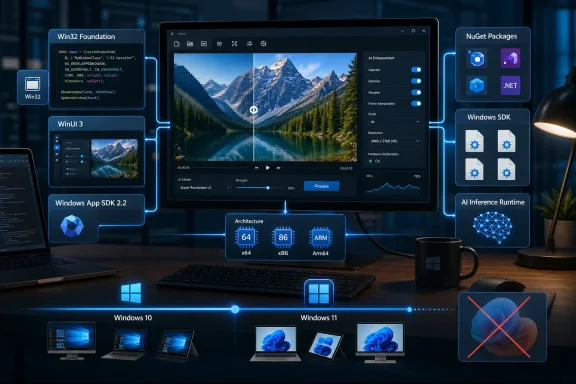 The Windows App SDK Is the API Story That Exists
Microsoft Learn describes the Windows App SDK as independent of both the Windows SDK and the installed Windows release. Applications can take dependencies through NuGet, while the traditional Windows SDK supplies Win32, WinRT and COM declarations, and the OS ultimately determines what is available at runtime.
That split matters for productivity. A team can adopt newer WinUI 3, lifecycle, notification, windowing and machine-learning capabilities without tying every release to a full Windows migration. The Windows App SDK 2.2 release adds VideoScaler for real-time AI video upscaling and ApplicationData.GetForUnpackaged(), giving unpackaged desktop software a direct WinRT route to application-data storage.
For developers maintaining conventional desktop applications, this is the practical modernization path: preserve a Win32 executable and existing deployment model where needed, then selectively bring in Windows App SDK APIs. It is less dramatic than a generational OS reset, but far more usable for organizations with years of native code and line-of-business dependencies.
Compatibility Still Defines Enterprise Adoption
The Windows App SDK 2.2 baseline supports Windows 10 version 1809, build 17763, according to Microsoft Learn. That broad reach is important because it lets developers ship newer app experiences while serving estates that have not moved uniformly to the latest Windows 11 feature release.
It does not remove compatibility work. An application compiled with a newer Windows SDK can see newer APIs at build time, but it must use runtime checks before calling APIs unavailable on an older Windows build. Administrators should also treat the App SDK runtime as an application dependency to be deployed and serviced, especially for unpackaged apps and externally located packages.
The immediate architectural priorities are straightforward:
- Keep Win32 interoperability intact rather than assuming a wholesale WinUI 3 rewrite.
- Use feature detection and graceful fallbacks for OS-bound Windows APIs.
- Separate OS requirements from NuGet-delivered Windows App SDK requirements in deployment documentation.
- Test x64, x86 and Arm64 runtime installation paths before broad rollout.
AI APIs Will Raise Hardware Questions, Not Create a Windows 12 Mandate
Microsoft’s July developer update highlights AI-focused additions, including video upscaling and Windows ML reliability work. These capabilities will increase interest in GPUs, NPUs and efficient local inference, but they do not establish a confirmed new hardware floor for an unannounced Windows release.
For software architects, the risk is not missing a mythical Windows 12 SDK. It is designing an AI feature that silently assumes accelerator hardware, consumes too much memory, or lacks a CPU fallback. The right design is capability-based: detect hardware and available APIs, tier quality or latency accordingly, and make the non-accelerated path acceptable rather than broken.
Microsoft has also continued to invest in developer workflow rather than just runtime APIs. Its June 2026 developer announcements included Windows Developer Configurations, native Coreutils for Windows, experimental Intelligent Terminal work, and planned WSL Containers tooling. Those projects point to an effort to reduce workstation setup and cross-platform friction now—not after a future Windows rebrand.
Plan for the Platform Microsoft Has Shipped
Windows 11 remains the client platform to target, while Windows App SDK 2.2 is the nearer-term decision point for native Windows teams. The payoff is incremental but real: newer APIs can arrive through a managed package cadence, while enterprises retain the compatibility discipline required by Win32 and mixed-version fleets.
Until Microsoft publishes an actual Windows 12 product announcement, SDK, supported-version matrix and API documentation, any claimed Windows 12 productivity advantage is speculation. The next actionable milestone is Microsoft’s next Windows App SDK and Windows SDK release—not a name that has yet to appear in official developer documentation.
