
Neowin’s anniversary report correctly identifies the visible change: NT 4.0 made Windows’ consumer and corporate lines look far more alike. Microsoft’s July 1996 launch material promised a Windows 95 interface atop NT’s reliability, security, networking, centralized policies, and remote-management tooling. The practical outcome was bigger than a shell refresh. It established the user experience that would carry through Windows 2000 and, after Microsoft retired the consumer Windows 9x line, into Windows XP and every mainstream Windows desktop release since.
The anniversary fell on Monday, August 24, 2026 — yesterday, not today, August 25. That may sound pedantic for a 30-year-old operating system, but the split between manufacturing and retail illustrates the way Microsoft shipped enterprise software: build completion, channel availability, and broad deployment were separate events.
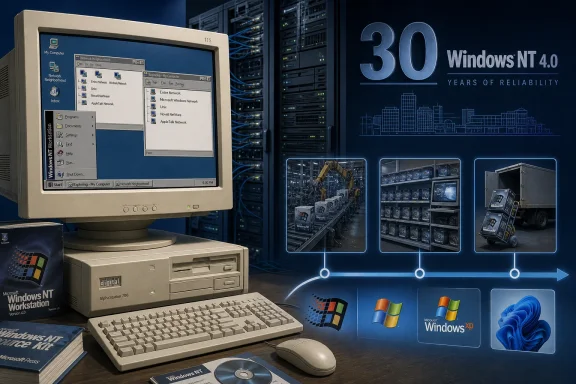 July 31, August 24, and September: three NT 4.0 milestones
Microsoft announced on July 31, 1996 that Windows NT Workstation 4.0 and Windows NT Server 4.0 had entered manufacturing. Its own release material did not give a same-day public launch date; it said general availability was expected within the following month. Contemporary reporting from the Los Angeles Times also described the July 31 event as completion and delivery to manufacturing sites rather than a retail release.
The August 24 date attached to the anniversary is specifically tied to the retail arrival of NT 4.0 Workstation. TechSpot’s anniversary coverage independently identifies August 24, 1996 as the date it arrived in stores. Microsoft’s archived news index then records Windows NT 4.0 as broadly available through the channel on September 3, a useful reminder that availability was staggered rather than a single worldwide switch being flipped.
That distinction also corrects a common shorthand. Saying “Windows NT 4.0 released on August 24” is reasonable when referring to the product’s public retail debut, but it is incomplete when discussing the build Microsoft shipped. The RTM build was 1381, and the product was already in the hands of manufacturing partners more than three weeks earlier.
For system administrators, this is familiar territory even now. “Released,” “available,” and “deployed” describe different stages, especially when an operating system must reach OEMs, retail channels, volume-license customers, hardware vendors, and internal IT teams with images and driver packages ready.
The Windows 95 interface was a port, not a cosmetic skin
Windows NT 3.51 and Windows 95 existed simultaneously for about a year, yet they looked like products from different eras. NT 3.51 retained the Program Manager and File Manager conventions of Windows 3.x, while Windows 95 introduced the Start button, taskbar, desktop shortcuts, My Computer, Network Neighborhood, and the Explorer-based shell. NT 4.0 moved the latter interface to the NT family.
Microsoft’s original Workstation announcement explicitly highlighted the Start button, Taskbar, Shortcuts, Network Neighborhood, My Computer, and Windows NT Explorer. It also paired the familiar desktop with user profiles, system policies, Setup Manager scripts, and remote diagnostics. That combination explains why the release mattered to corporate computing: Microsoft could make a managed NT workstation less alien to employees trained on Windows 95 without abandoning NT’s administrative model.
Raymond Chen, the longtime Microsoft engineer and historian, later described why this was substantive engineering rather than a simple copy operation. The Windows 95 and NT window-manager code had diverged enough that NT’s team used Windows 95 as a reference while reimplementing behavior and APIs in the NT codebase. Explorer and related user-mode components could be carried over more directly, but then had to be adapted for NT’s Unicode foundation.
That history undercuts the simplistic idea that NT 4.0 merely placed a Windows 95 theme over NT 3.51. The visual convergence was real, but it required work across the shell, window manager, APIs, and text-handling assumptions. The result was a shared user model sitting on two still-separate operating-system families.
NT 4.0 made the server desktop easier to recognize — and easier to misread
The new shell helped administrators, particularly in smaller organizations where one person often managed servers and desktops. Microsoft pitched Windows NT Server 4.0 around management wizards, graphical DNS administration, file and print performance, Internet Information Server 2.0, Index Server, remote administration, and PPTP for virtual private networking.
Some of the marketing claims should be read as period claims, not settled benchmarks. Microsoft said NT Server 4.0 could deliver more than twice the file-server throughput of NT Server 3.51 in Netbench 4.0 testing and claimed better scalability on larger multiprocessor systems. Those figures were vendor-supplied and tied to its test conditions. The enduring fact is the direction of the release: NT 4.0 was designed to turn Windows NT into a more approachable platform for file services, web and intranet workloads, remote access, and centrally managed corporate PCs.
Bundling IIS 2.0 was particularly telling. In 1996, the intranet was a major enterprise priority, and Microsoft wanted Windows NT Server to be the operating system beneath internal websites as well as traditional file shares and domain services. That was an important step in the company’s move from desktop software supplier to server-platform vendor.
Yet the friendlier desktop could obscure the real divide between Windows 95 and NT. Windows 95 was still rooted in the consumer-oriented Windows 9x architecture; NT 4.0 was an NT system built for protected memory, preemptive multitasking, security boundaries, and symmetric multiprocessing. The user could see a shared Start menu. An administrator still had to account for different drivers, different application compatibility, different hardware expectations, and different deployment requirements.
A graphics decision traded performance for failure isolation
NT 4.0’s most consequential technical change was not on the desktop at all. Microsoft moved the USER and GDI graphics components into kernel mode, a decision intended to improve graphics performance. Microsoft’s current Windows documentation still notes that GDI has run in kernel mode since Windows NT 4.
That choice gave NT 4.0 a performance boost at a time when Windows was competing for workstation credibility, but it concentrated risk in the graphics and driver path. Modern Microsoft driver guidance explains the rationale for user-mode graphics components plainly: defects in code running outside the kernel are less likely to force an entire system reboot. NT 4.0 operated under the earlier model, where a faulty display or printer graphics driver could take down the machine rather than merely crash the affected process.
The trade-off was defensible in its 1996 hardware environment, but it is also an early lesson in a problem Windows engineering spent years reducing. Display drivers grew more complicated as accelerated graphics advanced, and later Windows driver architectures separated more work from the kernel to improve resilience and security. In that sense, NT 4.0 is part of the technical lineage of both modern Windows’ performance ambitions and its repeated attempts to contain driver failures.
The operating system also had limitations that make any nostalgia-driven deployment a bad idea. It lacked the plug-and-play maturity users associated with Windows 95, had constrained driver availability compared with the consumer line, and never received native USB support. More importantly, Windows NT 4.0 Workstation Service Pack 6a left extended support on June 30, 2004. Microsoft’s own security guidance at the time told remaining customers to migrate because future vulnerabilities would no longer be addressed.
The real legacy arrived when the two Windows families finally converged
NT 4.0 did not unify Windows. It standardized the experience while Microsoft continued selling a DOS-derived consumer platform alongside NT for years. Windows 98 and Windows Me followed Windows 95; Windows 2000 followed NT 4.0; and only Windows XP, released in October 2001, brought the mainstream consumer desktop onto the NT codebase.
Still, NT 4.0 made that eventual transition easier to imagine. Users learned the Start menu and Explorer model on Windows 95; business users and administrators received broadly the same desktop on NT 4.0; software developers could target a more consistent Win32 experience. The operating systems underneath remained materially different, but the gap users saw had narrowed sharply.
Thirty years later, the practical message is not that Windows NT 4.0 is usable infrastructure. It is unsupported legacy software whose presence on a network should trigger an isolation and replacement plan. Its importance is historical and architectural: on August 24, 1996, Microsoft began making the NT platform look like the Windows PC most people recognized — a design decision whose outline remains visible in Windows 11.