
Plummer has shown the project publicly, saying Microsoft supplied the Windows XP Task Manager source code and allowed him to demonstrate it on his YouTube channel. But this is not a macOS port of that code: the new application is being written separately in Swift.
The practical appeal is clear for Windows users who administer Macs or simply prefer Task Manager’s compact, graph-heavy view of a machine. Plummer’s prototype is reportedly sampling system information at 60Hz, though he is considering 30Hz or 15Hz to improve stability.
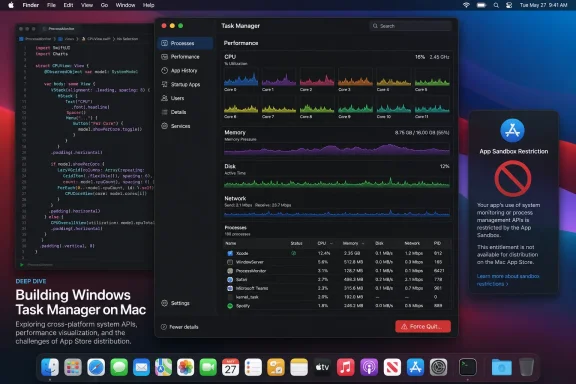 The Mac App Store is the immediate obstacle
The bigger problem is distribution, not the dashboard. Plummer had considered a free beta release through the Mac App Store, but Apple requires sandboxing for Mac App Store submissions, and its App Sandbox rules prohibit an app from terminating other running applications.
That restriction conflicts with a core expectation of a Task Manager-style utility: selecting a hung process and ending it. An app distributed outside the App Store could potentially retain that capability, subject to normal macOS permissions and signing requirements.
Apple’s built-in Activity Monitor already provides process inspection, CPU and memory information, GPU-related metrics on supported systems, and the ability to quit or force-quit processes. The opportunity for Plummer’s project is therefore less about filling a total feature void and more about delivering a familiar Windows-style workflow, richer at-a-glance visualization, and potentially clearer startup and service management.
For now, this is an experimental personal project rather than a shipping Mac utility. Plummer has also floated the possibility of releasing the code if he loses interest, but the decisive question is whether he chooses an outside-the-App-Store release path—or pares back the tool enough to fit Apple’s sandbox model.
Update: Dave Plummer announces immediate release of Task Manager OG for macOS (August 2, 2026)
Dave Plummer has now announced the immediate availability of “Task Manager OG” for macOS, superseding the project’s earlier experimental status. In a July 31 post cited by Neowin, Plummer described the app as free and said Windows support is planned to follow.
The release appears to establish a public distribution path despite the Mac App Store sandboxing issue previously facing the project. Plummer has not indicated in the announcement whether the Mac build is distributed through Apple’s store or independently, nor whether it includes the ability to terminate processes.
Plummer also said he may offer a paid Pro version in the future, while keeping the current application free. For Mac users accustomed to Windows Task Manager, the practical change is that the Windows-inspired monitor is no longer just a prototype to watch—it is reportedly available to try now.
