
Windows Latest revived the episode on August 26, tying it to the 25th anniversary of Windows XP reaching PC manufacturers on August 24, 2001. But the former Microsoft engineer at the center of the account, Dave Plummer, described the key’s origin publicly in October 2025; Tom’s Hardware, Numerama, Tecnoblog, and other outlets reported it then. The anniversary is timely. The underlying disclosure is not new.
More importantly, the version now circulating needs one correction. There is no public evidence that Microsoft “lost” the key in the sense of accidentally publishing it or building an intentional back door into XP. Plummer’s account supports the narrower and more consequential conclusion: a real corporate credential and the media built to accept it escaped into the warez scene before the operating system’s retail launch.
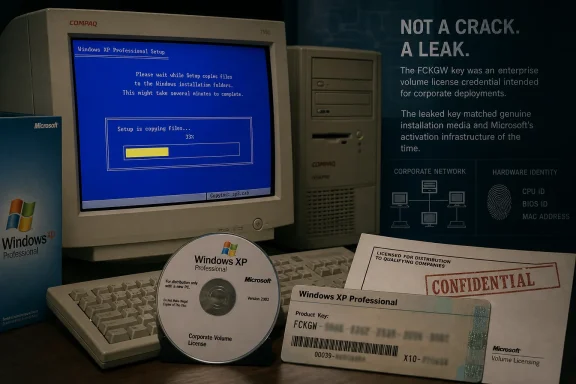 A volume credential, not an activation exploit
Windows XP was Microsoft’s high-profile introduction of Windows Product Activation for consumer Windows installations. Microsoft said at XP’s October 25, 2001 retail launch that activation was meant to deter “casual copying,” the everyday practice of installing one purchased copy across multiple PCs.
For ordinary retail and OEM copies, the process connected a product key to a hardware-derived installation identity. The design was meant to make copying the same disc and key less useful: a fresh installation on different hardware would ordinarily need to complete activation again.
Large organizations presented a different operational problem. A company deploying Windows XP to hundreds or thousands of managed machines could not reasonably telephone Microsoft or perform individual online activations at every desktop. Microsoft therefore sold XP Professional volume-license media and keys under programs such as Open License, Select License, and Enterprise Agreement. Those installations were designed to avoid the consumer activation workflow.
Microsoft’s own later support guidance is unusually direct about the result. Its knowledge-base article on changing a Windows XP volume-license key says XP volume media and product keys must match in channel, edition, and language. It also acknowledges that a “leaked” volume key used across multiple machines could be blocked from installing XP Service Pack 1 and later updates.
That is the useful technical point lost when the key is described as a “crack.” The installation did not bypass activation after the fact. It entered a product channel where activation was not expected in the first place. A stolen or leaked VLK was still unauthorized for anyone outside the organization licensed to use it, but it was accepted by the operating system because the media treated it as a corporate deployment.
The ISO mattered as much as the key
A volume key alone was not a universal password for any Windows XP disc. Microsoft’s documentation says explicitly that XP setup media and product keys had to match: retail keys worked with retail media, OEM keys with OEM media, and volume keys with volume-license media. An attempted mismatch produced an invalid-key error.
That technical boundary explains the durability of the pirate release. It was not simply a memorable string pasted into forums. The key circulated alongside a corporate XP Professional image that could recognize it. The package turned a licensing credential into an easy-to-redistribute installation path.
Plummer has said the key was leaked with a final XP build by the warez group devils0wn weeks before the October 2001 retail release. Reporting by Tom’s Hardware and Numerama attributes that timing and attribution to Plummer’s account. The exact chain of custody—who first exposed the corporate key, and from which licensed organization or distribution channel it came—has not been independently documented in public records.
That missing provenance matters. Calling it a “Microsoft leak” is broadly understandable, because Microsoft’s volume-licensing system issued the credential and did not prevent its rapid misuse. But it does not establish whether a Microsoft employee, a licensee, a partner, or another recipient was responsible for the disclosure. The public evidence supports a compromised corporate credential; it does not identify the source of the compromise.
Product Activation was effective only inside its intended channel
The embarrassing part for Microsoft was not that Windows Product Activation had been cryptographically broken. It was that the protection applied unevenly by design.
Windows XP’s consumer activation system could bind installations to a hardware profile, while volume-license customers received a workflow designed for mass deployment without those individual checks. That division was commercially sensible. It also created a high-value target: anyone who got both the proper volume media and a valid VLK gained an installation experience close to what a legitimate enterprise administrator would see.
Microsoft’s later remediation confirms the scale of the problem. The company’s XP volume-key guidance warns that systems installed with publicly exposed keys might be unable to install SP1 or later service packs, or receive updates through Windows Update. The remedy was not a patch that rewrote activation architecture. It was a key replacement process for customers using volume media.
In other words, Microsoft could blacklist known-abused credentials, but it could not reverse the core property that made volume licensing workable: one credential could support many installations. Once a key and matching image were copied broadly, blocking it risked disrupting any legitimate customer still using that credential. The company had to balance anti-piracy enforcement against the managed deployments that volume licensing existed to support.
The episode also shows why product keys should never be confused with proof of ownership. A key can be syntactically valid, accepted by installation media, and even activate software under a particular workflow while still being unauthorized for the user entering it. Licensing rights came from the organization’s agreement with Microsoft, not from possession of 25 characters.
The anniversary story should not become XP revival advice
Windows XP’s release timetable is clear in Microsoft’s contemporary record: XP was released to computer manufacturers on August 24, 2001, and reached general retail availability on October 25, 2001. The August anniversary commemorates release to manufacturing, not the date consumers could buy a boxed copy.
For administrators and retro-computing users, the more relevant date is April 8, 2014, when Microsoft ended extended support for Windows XP. Some embedded and specialized variants received limited updates after that, but the mainstream desktop operating system is long outside the supported Windows servicing model.
The old key’s story therefore has historical value, not operational value. Microsoft’s XP volume-key article says leaked keys were blocked from SP1 and later update paths, while current Microsoft support discussions acknowledge that XP activation infrastructure has been retired. Even a legitimately licensed XP installation should be treated as a compatibility artifact, isolated from untrusted networks and not used for modern browsing, email, identity-sensitive work, or business data.
Plummer’s recollection is valuable precisely because it strips away the mythology. The famous XP key did not demonstrate a secret universal exploit hidden in Windows. It demonstrated that a licensing exception created for enterprise deployment became a single point of failure once the credential and media escaped. Microsoft eventually blacklisted the exposed key, but by then the image of a hand-labeled CD had already become part of PC history.