

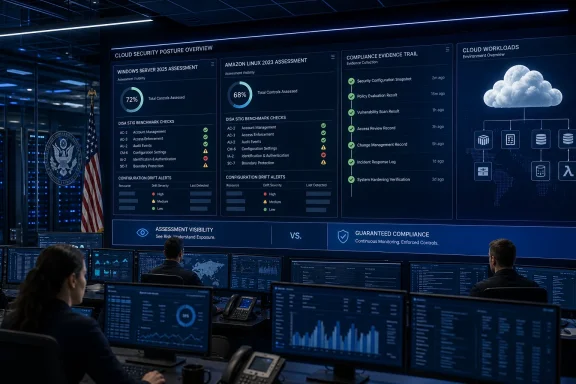
But the announcement should be read precisely. This is an assessment and visibility capability, not proof that a Windows Server 2025 instance is compliant, authorized to operate, or safely remediated. Wiz has not publicly detailed the benchmark revisions it evaluates, scan frequency, remediation workflow, pricing, or whether the feature is available only in Wiz for Government. Those omitted operational details determine whether the feature reduces audit effort in practice or merely adds another compliance dashboard.
Windows Server 2025 finally has a current STIG target
The timing is sensible. DISA published the initial Microsoft Windows Server 2025 STIG on February 27, 2025, and the DoD Cyber Exchange now lists the platform among its active STIG products. The guide has continued to move: the Windows Server 2025 material reflected in the latest available public STIG records is dated May 28, 2026.
That distinction matters for administrators who have already deployed the new LTSC release. Windows Server 2025 has been generally available since November 2024, but a deployment can only be assessed meaningfully against the operating-system-specific controls once the corresponding STIG exists and the assessment tool tracks the active revision. Calling a server “STIGged” without recording the benchmark version, applicable profile, documented exceptions, and control results is not a defensible compliance position.
Windows Server STIG work is also broader than the base OS. A workload may require separate treatment for Active Directory Domain Services, DNS, IIS, SQL Server, Microsoft Defender Firewall, applications, and the surrounding cloud configuration. A posture tool that evaluates Windows Server 2025 OS controls can make one part of that process substantially easier; it does not absorb the responsibilities created by every enabled role.
Microsoft has its own parallel direction for Windows Server 2025. Its OSConfig tooling supports role-aware security baselines and drift control, with Microsoft explicitly positioning the work as helping organizations move toward CIS Benchmark and DISA STIG recommendations. That makes Wiz’s addition useful as a centralized assessment plane, particularly for hybrid or multi-cloud teams, but it is not the only route to maintaining a hardened Windows Server configuration.
The practical question for Windows administrators is whether Wiz’s checks can identify the same drift that their Group Policy, desired-state configuration, Azure Policy, PowerShell DSC, endpoint tooling, and vulnerability-management controls either introduce or miss. A new report is valuable only if it maps cleanly to the change process that will resolve the finding.
Amazon Linux 2023 support follows AWS’s own STIG release
Amazon Linux 2023 is the other significant half of this launch, although it is less novel than the marketing framing suggests. AWS and DISA announced an Amazon Linux 2023 STIG in September 2025, and AWS provides Systems Manager resources intended to apply and maintain the hardening configuration across EC2 fleets. AWS later documented updates to the Amazon Linux 2023 STIG in its 2026 first-quarter release materials.
In other words, the important new element is not that Amazon Linux 2023 can now be hardened to a DISA baseline. It is that Wiz is reportedly bringing that benchmark into its own cloud-native assessment workflow alongside Windows Server 2025.
That distinction changes the buying case. AWS Systems Manager can help apply a hardened configuration. Wiz can potentially identify where deployed instances deviate from the control set and place that configuration posture alongside exposed identities, network paths, vulnerabilities, sensitive data, and workload context. Those are complementary functions, not interchangeable products.
For federal operators, the combination may be more useful than either layer alone. A failed hardening check on an internet-facing Windows Server 2025 system with a privileged workload identity deserves a different priority than the identical check on an isolated development instance. A cloud security platform’s main contribution is supposed to be that contextual triage, rather than a long unranked catalog of deviations.
“Continuous” compliance still requires control ownership
Futurum describes the capability as shifting teams from periodic manual reviews to continuous hardening validation. That is directionally right: cloud environments change too frequently for spreadsheet-driven assessment to offer a reliable picture of current configuration state. VM image refreshes, autoscaling, domain-policy updates, emergency patches, new security groups, agent changes, and infrastructure-as-code deployments can each reopen a previously cleared finding.
Yet continuous assessment does not eliminate the manual compliance work federal teams care about most. It changes where that work begins.
A STIG contains many controls that need human interpretation. Some require documentation of approved services, installed roles, system purpose, network architecture, operational need, exception authority, or compensating controls. An automated platform may reliably flag that an expected setting is absent, but it cannot decide whether a mission-specific exception is valid, whether the system owner accepted the risk, or whether a control is applicable to a particular server role.
The same applies to remediation. Automatically changing every failing control can break an application, a legacy integration, a management workflow, or a domain service. Mature environments need an approved control-to-remediation workflow: detect the variance, verify applicability, determine ownership, test the fix, deploy it through the configuration-management path, collect evidence, and document exceptions. Wiz has not said that this new feature remediates Windows Server 2025 or Amazon Linux 2023 findings, and the supplied reporting does not establish that it does.
The better description, then, is continuous evidence of technical configuration posture. That can materially shorten the time spent finding failures and proving what changed. It cannot replace a system security plan, a risk decision, a security-control assessor, or an authorizing official.
Wiz has the federal platform status to make the feature relevant
Wiz’s federal credibility is more substantial than a compliance feature announcement alone. The FedRAMP Marketplace lists Wiz for U.S. Government as FedRAMP Certified at the High impact level, with an agency authorization dated September 25, 2025. Wiz announced that FedRAMP High milestone the following day.
That matters because government buyers cannot simply assume a commercial security platform is permitted to process the information it needs to assess. A product that ingests cloud metadata, asset inventory, configuration data, identity relationships, vulnerability findings, and potentially sensitive security context has to fit within the agency’s authorized architecture. Wiz for Government’s High authorization makes the product a more plausible candidate for high-impact federal workloads than a commercial-only service.
It does not, however, establish Department of Defense authorization at a specific Impact Level, nor does it mean every commercial Wiz capability is automatically present in the government offering. Wiz itself said in late 2025 that it was working toward ongoing full feature parity between Wiz for Government and the commercial product. The current announcement does not state whether automated STIG assessments ship in both environments on day one, whether coverage differs, or whether federal tenants receive the same policy logic and reporting experience.
Federal teams should seek a direct answer before making this a control dependency. They need to know the exact Wiz environment where the capability runs, the required cloud permissions, what customer data is retained, the supported clouds and instance types, whether disconnected or restricted environments are covered, and how reports record the precise STIG revision used for each result.
The audit bottleneck may move rather than disappear
The operational upside is real if Wiz can keep pace with DISA’s release cadence. Hardening standards evolve, and an assessment engine that lags behind a revised STIG creates false confidence. Windows Server 2025 and Amazon Linux 2023 are both moving targets: their security guidance, operating-system updates, cloud deployment methods, and supported roles continue to change after general availability.
The decisive test will be version transparency. A useful federal compliance product should let an administrator answer, without vendor support: Which STIG version was assessed? When was the workload last evaluated? Which checks are automated? Which controls are out of scope? What evidence supports a pass or failure? Which exceptions were approved, by whom, and when do they expire?
Those details are missing from the current announcement. So are publicly identified federal customers, contract awards, and a statement of feature pricing. The Futurum Group frames the launch as a potential platform-expansion move in government cloud security, but no independent reporting located for this announcement confirms deployment scale or agency adoption.
For Windows Server 2025 operators, the near-term consequence is narrower and more useful: Wiz may offer a new way to surface OS hardening drift alongside cloud risk data, just as the Windows Server 2025 STIG matures. It will earn a place in a federal compliance program only if its findings are traceable to the current DISA benchmark, actionable through existing change controls, and available in the authorized government environment where those servers actually run.