
For game developers, VFX environment artists, technical artists, and procedural-world builders, that combination matters. World Machine has always been associated with large landscapes, erosion-heavy mountain ranges, masks, and production-ready terrain exports. Dragontail Peak retains that identity, but it also introduces a more modern foundation built around true 3D terrain, a redesigned interface, stronger graph workflows, and a substantially updated viewport.
The most important shift is not merely that World Machine now supports Apple Silicon Macs and Linux workstations. It is that the application is beginning to move from a heightfield-centric terrain tool into a broader terrain-authoring platform capable of creating cliffs, undercuts, and other shapes that traditional landscape data struggles to describe.
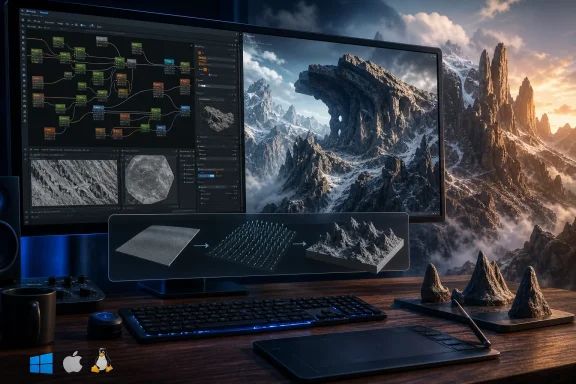 Overview: A Major New Direction for World Machine
World Machine has been in use for more than two decades, making it one of the established names in procedural terrain generation. Its basic workflow remains immediately recognizable: artists construct a node graph from generators, selectors, filters, simulation devices, and output nodes, then build a terrain result suitable for use in a game engine, a DCC application, or a visual-effects pipeline.
At its core, the appeal is still procedural control. A creator can begin with a painted layout, imported terrain data, or a basic noise pattern, then use erosion, thermal weathering, strata, snow, masks, and other tools to turn simple forms into a more convincing landscape.
That workflow has long made World Machine useful for projects requiring:
- Mountain ranges and valleys
- Erosion-driven terrain detail
- Desert, alpine, volcanic, and coastal landscapes
- Terrain masks for vegetation and material placement
- Heightmaps for real-time engines
- Mesh terrain for DCC and VFX workflows
- PBR-oriented textures and splat maps
- Large tiled environments
Dragontail Peak does not abandon the familiar graph-based approach. Instead, it broadens it. The series began with Build 4059, which introduced the foundational true-3D terrain functionality, and Build 4065 extends the release by making the software available on macOS and Linux while delivering a significant UI overhaul.
That is a consequential transition. For much of its history, World Machine existed in the Windows ecosystem alone, even as Blender, Houdini, Unreal Engine, Unity, and many production tools became increasingly cross-platform.
macOS and Linux Support Finally Arrive
The cross-platform release is the headline practical improvement in Build 4065. World Machine now supports Windows 10 or later, macOS, and Linux, with native support for both Intel-based Macs and Apple Silicon hardware.
For Windows users, the update does not fundamentally change the platform story. World Machine remains a native desktop terrain-generation application and continues to fit naturally into Windows-based game-development and visualization pipelines. However, the expansion still benefits Windows teams because it reduces friction in mixed-platform studios.
Why Mac support changes the conversation
macOS users have historically had limited native choices for specialized terrain generation. Many artists relied on a Windows PC, Boot Camp-era workflows, virtualization, remote systems, or an alternative terrain tool with different procedural capabilities.
Native macOS support changes that equation. Environment artists who use a Mac workstation for Blender, Cinema 4D, Houdini, Maya, or Unreal Engine-related work can now keep World Machine within the same desktop workflow rather than treating terrain generation as a separate Windows-only task.
The Apple Silicon angle is especially important. Modern Mac workstations are no longer a niche choice for many 3D artists, especially freelancers, small studios, educators, and creators who value performance per watt and portable workstation hardware. A native release avoids the compromises associated with running an older Windows-only application through a virtual machine or compatibility layer.
There are still technical realities to consider. World Machine’s macOS port uses an OpenGL Core profile, an approach that enables the application to run on the platform but also reflects the particular graphics constraints of macOS. Artists should therefore treat the first cross-platform builds as a serious production development rather than assume every workflow will behave identically across operating systems from day one.
Linux support is equally meaningful
Linux support may be less visible to casual artists, but it has substantial relevance in studios and technical pipelines. Linux remains common in VFX, rendering, simulation, pipeline engineering, and infrastructure-heavy production environments.
A native Linux build can simplify workflows where terrain data needs to move between asset creation, automated build systems, render farms, and proprietary tools. It also creates a more direct path for technical artists who prefer Linux workstations or rely on Ubuntu-based development environments.
The cross-platform rollout appears to emphasize x64 Linux, while the macOS version targets Apple Silicon as part of the native support plan. That distinction matters when teams are planning deployment across a mixed hardware fleet. Linux users should also expect some maturity gaps in packaging, distribution, driver behavior, and platform-specific troubleshooting while the new release line settles.
Still, the broader result is clear: World Machine is no longer tied exclusively to Windows.
True 3D Terrain: Moving Beyond the Heightfield
The defining technical change in Dragontail Peak is the addition of Vector Displacement Map, or VDM, terrain. This is the feature that gives the release its strategic importance beyond its operating-system support.
Traditional terrain tools often rely on heightfields. A heightfield stores elevation across a two-dimensional grid: each point has a single height value. It is efficient, well understood, easy to use in engines, and ideal for broad landscapes such as hills, river valleys, plateaus, dunes, and conventional mountains.
But the structure has a fundamental limitation: one horizontal coordinate can only map to one vertical elevation.
That means a conventional heightfield cannot naturally represent a true overhang. It cannot fold a cliff face back over itself, create a recessed rock shelf, or construct a proper cave ceiling. It can suggest those forms using textures, meshes, decals, or carefully arranged adjacent assets, but it cannot encode them directly in the core terrain surface.
What VDM terrain makes possible
A Vector Displacement Map changes the terrain representation. Rather than moving a surface only up and down, VDM data can displace it in three dimensions. This allows the surface to bend, project, and form more sculptural terrain shapes.
In World Machine, that opens up new forms including:
- Overhangs
- Undercuts
- Proper cliff faces
- More dramatic rock formations
- Recessed surface detail
- Cave-like structures
- Complex high-resolution geological features
This is a major improvement for artists who create environments where sheer rock formations must look convincing at close range. Conventional heightfield terrain often produces a recognizable visual artifact on steep slopes: the geometry stretches or compresses as it tries to translate near-vertical detail into a format that was never designed to support it.
VDM terrain gives artists more freedom to create geological forms that look less like an elevated image and more like a shaped three-dimensional surface.
The cave limitation still matters
The term true 3D terrain should be understood with some technical care. VDM-based surfaces enable far more complex terrain than a heightfield, but they do not automatically solve every volumetric-environment problem.
In particular, VDM terrain can create cave-like recesses and overhanging structures, but it does not inherently provide arbitrary holes through a terrain volume. An artist may create the interior impression of a cave, yet a fully functional cave mouth or tunnel entrance can still require mesh-based modeling, booleans, volumetric tools, or additional environmental assets.
That is not a weakness unique to World Machine. It is a consequence of what a displacement-based surface can represent. But it is an important distinction for teams expecting a complete replacement for voxel or signed-distance-field terrain systems.
The most sensible reading of Dragontail Peak is that it makes World Machine substantially better at generating cliff-rich and sculptural terrain, not that it transforms the software into a full volumetric world editor.
Bringing Existing Node Graphs Into the New Workflow
A new terrain datatype is only useful if it can participate in familiar production processes. Dragontail Peak’s strongest design choice may be its effort to bring VDM support into many of the tools World Machine artists already know.
Many core devices now work with VDM terrain, reducing the need to discard established node graphs simply because a project needs more advanced cliff geometry. Supported workflows include foundational input and shaping tools, along with familiar systems such as:
- File Input
- Strata
- Tiling
- Blur
- Selectors
- Erosion
- Thermal Weathering
- Snow
The ability to retain a known procedural graph while substituting a VDM-based terrain source is important. Mature World Machine projects can contain hundreds of connected nodes, custom devices, macros, masks, controls, and exports. Rebuilding all of that around a new data model would be a major adoption barrier.
Instead, Dragontail Peak is positioned as an evolutionary upgrade. Existing graphs can remain valuable while artists selectively introduce VDM terrain into areas where heightfields are insufficient.
New devices for VDM authoring and repair
World Machine also includes new devices intended specifically for VDM creation and processing. These tools allow artists to generate and combine primitive forms, apply noise and displacement, repair common VDM artifacts, and optimize terrain before output.
That is a necessary addition because VDM terrain introduces different practical issues than heightfields. A heightfield has predictable sampling behavior and a relatively simple relationship between resolution and terrain detail. VDM-based workflows are more flexible, but they can introduce more difficult seams, distortions, and mesh-quality challenges.
The inclusion of repair and optimization devices shows that the release is not treating VDM support as a cosmetic feature. It acknowledges the production problem: advanced terrain geometry is only useful if it can be exported reliably and integrated into real projects.
Experimental features require measured adoption
Some VDM-related devices and workflows remain marked as experimental. That should not deter artists from evaluating them, but it does mean teams should plan carefully before standardizing a major production around the new functionality.
The key risks include:
- Changes to simulation behavior in future builds
- Inconsistent results between heightfield and VDM outputs
- Seams between a heightfield base and a separate cliff mesh
- Missing support in certain devices
- Extra optimization requirements for real-time targets
- Pipeline changes for engines built around conventional heightmaps
For a personal art project, experimentation is likely part of the appeal. For a studio, the prudent approach is to create targeted test scenes: steep cliffs, rock arches, snow accumulation, eroded valleys, and export handoffs to the intended engine or DCC package.
That testing will reveal whether VDM terrain improves the final asset enough to justify the added complexity.
Erosion, Snow, and the Challenge of Natural Detail
World Machine’s reputation has always been closely connected to natural-process simulation. Raw noise can produce a mountain shape, but erosion, sediment movement, thermal weathering, and snow deposition are what help the terrain communicate age, climate, scale, and material behavior.
Dragontail Peak’s VDM support matters because it brings many of these systems closer to complex terrain rather than reserving them for broad heightfield surfaces.
Erosion on more convincing cliffs
Erosion is often the difference between terrain that looks algorithmic and terrain that looks geological. In a traditional heightfield workflow, hydraulic erosion can cut channels, form drainage patterns, carve gullies, and create sediment deposits effectively. But near vertical surfaces remain difficult because the terrain format itself does not provide a fully believable cliff face.
By extending VDM support to core simulation tools, World Machine can now pursue more natural relationships between a cliff surface and its weathering. The potential is significant: jagged rock faces, talus-like transitions, accumulated debris, snow-catching ledges, and more nuanced changes in material distribution.
The practical result will depend heavily on the individual device behavior and the quality of the final mesh conversion. Yet the direction is strong. It brings World Machine closer to the terrain language used by environment artists who need both large-scale procedural landscapes and high-impact hero formations.
Water tools remain an incomplete piece
Not every major terrain system has made the VDM transition. Surface-water devices, including workflows for rivers, oceans, and related water generation, were not fully supported in the initial VDM release path.
That is understandable. Water simulation and drainage assumptions are strongly tied to terrain topology, height direction, and flow continuity. Adding support for overhangs and more complex displacement geometry makes these systems substantially harder to solve in a way that remains intuitive and performant.
For now, artists should expect a hybrid approach. VDM terrain may handle cliff and rock complexity, while heightfield-oriented workflows continue to manage conventional rivers, coastlines, and large-scale water behavior. World Machine has indicated that additional VDM support for water-related tools is planned, but this is an area where the software’s future iterations will matter greatly.
A Rebuilt 3D Viewport Improves Iteration
Terrain generation is an iterative process. Artists adjust a noise scale, modify erosion duration, reshape a mask, refine a snow layer, and then need to understand what changed without losing the larger visual context.
Dragontail Peak updates the 3D viewport with a more contemporary feature set, including HDR environment lighting, HDR panorama support, and environment fog.
HDR lighting and panorama-based context
The ability to use an HDR panorama as both a background skybox and environment-lighting source improves more than presentation. It gives artists a more useful context for evaluating terrain form.
Rock faces, shallow erosion channels, snow ridges, and low-angle cliff shelves can look dramatically different depending on the lighting direction. Neutral or flat preview lighting often hides the very details that a terrain artist is trying to refine.
Using HDR environment lighting helps expose surface variation, while a skybox can make the preview feel closer to an actual scene rather than an isolated editor view. This is not a final-rendering replacement, but it can make the decision-making loop more informative.
Fog is a practical visualization tool
Height fog may sound like a purely atmospheric feature, but it has real usefulness in terrain work. Massive landscapes need to be assessed at distance, and fog provides cues about scale, elevation, layering, and the readability of a terrain silhouette.
For artists building expansive mountain ranges or game maps, the ability to preview atmospheric depth can make it easier to see whether a scene has a convincing progression from foreground detail to distant forms.
A:B comparison supports better decisions
The updated viewport also supports side-by-side A:B comparisons. This is a deceptively valuable workflow feature.
Procedural artists often need to compare alternate settings without trusting memory. A small change in erosion, noise frequency, or strata behavior can create a different overall result, even if each change looks subtle in isolation. A direct visual comparison makes it easier to choose between versions and reduces the temptation to rebuild repeatedly just to confirm whether a prior setting was better.
The Interface Redesign Is More Than Cosmetic
Build 4065 also overhauls World Machine’s user interface. For a tool built around dense node graphs and parameter-heavy devices, interface design directly affects productivity.
A terrain project can quickly become visually complex. Wires cross the canvas, macro groups nest inside broader systems, output branches multiply, and a graph that began as a simple mountain generator becomes a substantial procedural asset.
The redesign is therefore not merely an aesthetic refresh. It is an attempt to improve the readability and navigability of a workflow that can become unwieldy at scale.
Better graph editing for large worlds
Several workflow upgrades are especially useful for complex node graphs:
- Wire Slice, which cuts through several connections with a single gesture
- Velocity-sensitive grid snapping, allowing precise placement during slow movement and faster navigation during broad rearrangement
- Better graph organization and visual polish
- Faster editor behavior with projects containing many nodes
- Improved device discovery and customization
- A favorites-oriented workflow for commonly used tools
Wire Slice is a small feature with an outsized effect. Disconnecting or reorganizing a graph can be tedious when nodes have many dependencies. A single-stroke method for breaking multiple wires makes exploratory work less destructive and less time-consuming.
Velocity-sensitive snapping also reflects an understanding of how procedural artists work. When composing a section of graph, precision is useful. When moving across a large canvas or rearranging a group, strict snapping becomes an obstacle. Adjusting the behavior based on movement speed is a thoughtful solution.
Macros become first-class components
Macros and custom devices are now treated more prominently, with access from the primary device workflow and support for versioning.
That matters because macros are central to how advanced World Machine users scale their work. A carefully designed macro can encapsulate a complex erosion treatment, rock-generation system, mask builder, biome logic set, or export workflow into a reusable component.
Versioning offers an important pipeline benefit. If a studio or artist improves a macro, existing projects can potentially be updated in a more controlled fashion rather than forcing manual reconstruction. This improves maintainability, especially where custom devices are shared across multiple scenes or team members.
There is still a trade-off. Versioned reusable components can create dependency-management problems if updates alter expected results. Teams should establish clear naming, testing, and approval practices for macro libraries, particularly when scenes are already in late production.
Export Flexibility Remains a Core Strength
World Machine’s relevance depends on its ability to fit into other tools. It is not typically the final destination for an asset; it is a terrain-generation stage in a wider pipeline.
Dragontail Peak continues to support a broad export model. Terrain can be delivered as 3D meshes, as VDM data, as traditional terrain information, and as textures and masks appropriate for downstream tools.
Key formats and output paths include:
- glTF mesh export
- OBJ mesh export
- EXR outputs, including high-precision data workflows
- PNG texture output
- TIFF texture output
- Heightmaps
- Splat maps
- Terrain masks
- PBR-oriented textures
- VDM exports
- Hybrid heightfield-plus-cliff-mesh workflows
This flexibility is critical because different targets have different expectations. Unreal Engine and Unity terrain workflows often favor heightmaps and material masks. A DCC workflow may favor meshes and high-resolution texture maps. A VFX scene may require more customized geometry, displacement, and shading data.
The hybrid output path is particularly promising. It allows a broad heightfield terrain base to remain compatible with established engine workflows while adding a separate mesh component for cliffs and overhangs. That approach is likely to be one of the most practical ways for game teams to benefit from VDM terrain without redesigning their entire world-building process.
The caveat is seam quality. Joining a heightfield terrain with a separate 3D cliff mesh is technically difficult, and the early Dragontail Peak roadmap acknowledges that this connection can require further improvement. Artists should inspect these junctions closely, especially under strong lighting and from gameplay camera distances.
Pricing, Editions, and Who the Upgrade Serves
World Machine’s licensing structure continues to position it as accessible for individual artists while reserving some larger-scale capabilities for professional users.
The Indie license is priced at $119 and allows terrain builds using up to four CPU threads. The Professional license is priced at $299, removes the CPU-thread limit, and includes tiled terrain export for larger-world workflows.
A free non-commercial edition is also available, though its terrain output is restricted to 1,025 × 1,025 pixels.
That structure makes the free version useful for learning the node workflow, testing devices, experimenting with procedural terrain, and deciding whether the software fits a project. The resolution cap, however, makes it unsuitable for many production targets where higher-resolution terrain, texture detail, or large-world exports are required.
Best fit for each edition
The free edition makes the most sense for:
- Students and hobbyists
- Non-commercial landscape experiments
- Learning the World Machine graph system
- Testing exports and terrain styles
- Evaluating Dragontail Peak on a new operating system
The Indie edition is likely the sweet spot for:
- Freelance environment artists
- Small game teams
- Concept artists
- Blender and Unreal Engine users
- Independent VFX work
- Artists who need commercial rights but do not require maximum CPU throughput
The Professional edition is better suited to:
- Large tiled worlds
- High-resolution terrain production
- Studios with demanding build requirements
- Technical artists managing complex exports
- Teams where build speed directly affects iteration costs
Why Dragontail Peak Matters for Windows Users
It may seem odd for a Windows-focused audience to care deeply about a macOS and Linux release. But the update matters to Windows users for several reasons.
First, cross-platform support makes World Machine more viable in mixed studios. A Windows-based technical artist can build a tool or macro library that is easier to share with Mac- and Linux-based colleagues. That reduces the chance that terrain work becomes isolated on a single platform or workstation.
Second, the work required for cross-platform support often improves the underlying software architecture. The move toward a more modern framework, a refined viewport, a revised interface, and better workflow organization benefits Windows users directly.
Third, the VDM work is platform-independent. Whether an artist uses Windows 11, macOS, or Linux, the true value of Dragontail Peak is its expanded terrain vocabulary. Overhangs, sculptural cliffs, and more robust mesh-oriented outputs improve the creative ceiling across the board.
The release also reinforces a useful reality for Windows professionals: Windows remains a strong home for specialized creative software, but cross-platform availability is increasingly important to the health of an ecosystem. Tools that support more operating systems can attract more users, receive more varied testing, and fit more production pipelines.
The Bottom Line
World Machine Dragontail Peak is not a routine feature update. It is a deliberate modernization of a long-running terrain-generation tool, with Build 4065 delivering the practical milestone of native macOS and Linux availability and the wider release series delivering a more ambitious model for terrain creation.
The addition of Vector Displacement Map terrain is the most exciting technical development. It addresses a long-standing constraint of heightfield workflows and gives World Machine a credible path toward richer cliffs, undercuts, and sculptural geological features. At the same time, the software wisely retains the familiar node-based systems, erosion workflows, masks, exports, and traditional terrain capabilities that made it valuable in the first place.
There are real caveats. VDM workflows remain an evolving area, some devices still need broader support, water-related systems have not fully caught up, and hybrid terrain-plus-cliff exports may require careful seam management. Studios should test the new release against their specific engine, DCC, and asset-pipeline requirements before making it a universal standard.
Even so, Dragontail Peak is a substantial step forward. For Windows terrain artists, it brings stronger tools and a broader production ecosystem. For Mac and Linux users, it finally makes World Machine a native option. And for anyone building believable digital landscapes, it offers a more capable answer to a long-standing creative limitation: terrain no longer has to stop where the heightfield ends.
