
Microsoft’s latest developer tooling makes the company’s long reversal on Linux impossible to miss: Windows now offers native Linux containers through WSL Containers and a Microsoft-maintained package of Unix-style utilities that runs without a Linux distribution.
As XDA Developers detailed, the new
That is a meaningful change for Windows developers who previously chose between Docker Desktop, a container engine installed inside a WSL distribution, or another third-party stack.
Microsoft’s new Coreutils for Windows package, also released in preview, installs with
There is an important PowerShell caveat. Names such as
CMD has its own compatibility traps, since several Unix command names collide with longstanding DOS commands. That makes this package most useful for portable scripts and users who understand which shell is resolving a given command—not as a blind drop-in replacement for every legacy batch file.
That distinction matters for real workloads. A Windows-native
Microsoft’s direction is therefore less about replacing Windows with Linux than making Windows a more capable host for Linux-oriented development. The company’s 2018 entry into the Open Invention Network, including access to more than 60,000 Microsoft patents for the Linux System definition, marked the legal and strategic break from its earlier posture. The product work has since made that reversal tangible on ordinary Windows PCs.
For Windows IT teams, the immediate question is not whether Linux has “won” Windows. It is whether developer workstation standards, endpoint controls, container-image policies, and support procedures are ready for Linux workloads that increasingly arrive as first-party Windows features.
As XDA Developers detailed, the new
wslc.exe command-line tool lets developers build, run and manage Linux containers directly from Windows. Microsoft’s WSL documentation confirms that WSL Containers is in public preview and includes both the CLI and an API for Windows applications to create and interact with Linux containers.That is a meaningful change for Windows developers who previously chose between Docker Desktop, a container engine installed inside a WSL distribution, or another third-party stack.
wslc is not a replacement for every Docker or Podman workflow yet, but it moves a basic Linux-container path into the WSL platform itself.
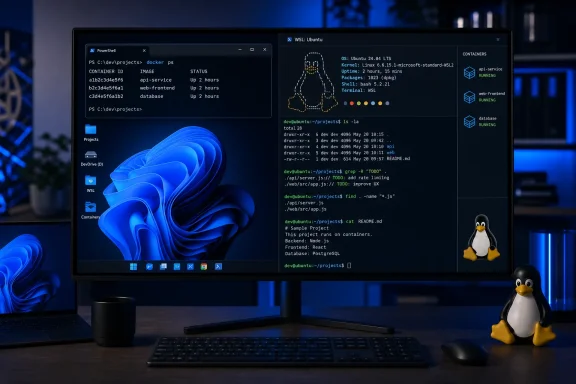
The practical shift is in the command line
Microsoft’s new Coreutils for Windows package, also released in preview, installs with winget install Microsoft.Coreutils. It packages Rust-based ports of familiar Unix commands including grep, find, cp, cat, and ls, designed to run directly on Windows rather than inside WSL.There is an important PowerShell caveat. Names such as
ls and cat are already PowerShell aliases, so an interactive PowerShell session may still resolve them to Get-ChildItem and Get-Content rather than Microsoft’s newly installed executables. Admins and developers who want Unix behavior need to call the executable explicitly or adjust aliases or functions in their PowerShell profile.CMD has its own compatibility traps, since several Unix command names collide with longstanding DOS commands. That makes this package most useful for portable scripts and users who understand which shell is resolving a given command—not as a blind drop-in replacement for every legacy batch file.
WSL remains the bigger compatibility layer
Coreutils does not put Linux inside Windows. WSL 2 does. Microsoft’s documentation describes WSL 2 as using a Linux kernel built by Microsoft, which provides substantially broader Linux system-call compatibility than the original translation-based WSL architecture.That distinction matters for real workloads. A Windows-native
grep can improve shell consistency, but WSL 2 is what enables Linux development environments, systemd-based services, GUI Linux applications through WSLg, and now the platform behind WSL Containers.Microsoft’s direction is therefore less about replacing Windows with Linux than making Windows a more capable host for Linux-oriented development. The company’s 2018 entry into the Open Invention Network, including access to more than 60,000 Microsoft patents for the Linux System definition, marked the legal and strategic break from its earlier posture. The product work has since made that reversal tangible on ordinary Windows PCs.
For Windows IT teams, the immediate question is not whether Linux has “won” Windows. It is whether developer workstation standards, endpoint controls, container-image policies, and support procedures are ready for Linux workloads that increasingly arrive as first-party Windows features.
References
- Primary source: XDA
Published: 2026-07-29T16:30:10+00:00
Microsoft called Linux a cancer, and now it ships a real Linux kernel inside Windows
Microsoft loves Linux now, it seems.
www.xda-developers.com
- Related coverage: learn.microsoft.com
WSL container | Microsoft Learn
An overview of what the WSL container feature is, and how to use it to run Linux container workflows on Windowslearn.microsoft.com - Related coverage: github.com
Is there any way to use WSL2 back-end with Windows Containers? · Issue #571 · microsoft/Windows-Containers · GitHub
Docker is deprecating use of Hyper-V backend, in favor of performance benefits of WSL2. If there is any way whatsoever to make this work with WSL2 backend, the instructions need to provide that option. https://learn.microsoft.com/en-us/v...
github.com
- Related coverage: techcommunity.microsoft.com
Announcing Azure Linux 4.0: Purpose-Built for Azure, Now in Public Preview | Microsoft Community Hub
Today at Microsoft Build, we're announcing the public preview of Azure Linux 4.0 - Microsoft's first party Linux distribution, purpose-built for Azure. Azure...
techcommunity.microsoft.com
- Related coverage: azure.microsoft.com
- Related coverage: linux.com
Microsoft's Ballmer: Linux is a cancer - Linux.com
Author: JT Smith The Chicago Sun-Times has an interview with Microsoft CEO Steve Ballmer. Here’s what he has to say about Linux: “It’s good competition. It will force us to be innovative. It will force us to justify the prices and value that we deliver. And that’s only...
www.linux.com