

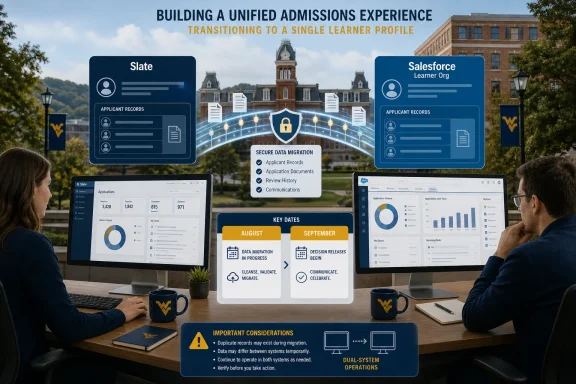
WVU’s August 5 E-News announcement confirms that 2027 applicants should be handled in Slate, while applicants from previous entry terms remain in Salesforce Learner Org until migration completes. Staff have been told to search Slate first and then Learner Org if a record is absent—a practical instruction, but also an acknowledgement that the University will temporarily have two possible systems of record for admissions work.
The rollout arrives far earlier than the schedule WVU publicly described in February. At that time, the University said its Modernization Program Sponsors and Steering Committee expected to begin using Slate in Fall 2028. The new announcement does not explain whether that earlier date referred to a broader institutional rollout, whether the implementation timetable was formally revised, or why a 2027 recruitment deployment was feasible roughly two years sooner than the previously stated expectation. That missing explanation is more than a calendar curiosity: it changes how staff should read the launch. This is not a long-run planned replacement being prepared in the background; it is now a live production system handling a recruitment cycle already underway.
Slate is live, but Salesforce has not yet been retired
WVU selected Slate in February as the replacement for its Salesforce-based enrollment tool suite, arguing that a platform built specifically for higher education would consolidate communications, event management, fraud detection, application processing and analytics. The University also said the move would reduce custom development and ongoing maintenance, allowing IT to focus resources on Workday and other modernization priorities.
Those are vendor-selection objectives, not proof of realized savings. WVU has not published a contract value, implementation cost, migration budget, number of integrations being retired, or a date for the final shutdown of Salesforce Learner Org. It also has not said which Salesforce functions, if any, will remain in use outside admissions. WVU’s CRM site currently still presents separate logins for Salesforce Marketing Cloud, an administrative Salesforce org, Learner Org and Slate, suggesting this is an Enrollment Management replacement rather than an immediate university-wide Salesforce exit.
That distinction matters for administrators evaluating the change. Replacing Learner Org does not necessarily eliminate Salesforce licensing, identity integrations, support responsibilities or data dependencies across the University. WVU’s February statement spoke broadly about simplifying its technology environment; the August launch shows the first active production cutover, not yet the completion of that simplification.
Slate itself is designed around this admissions workflow. Technolutions documents application management, reader workflows, communications, event management and decision release as core functions. Its decision-release workflow can use reviewer evaluations and configured rules to release decisions individually or in batches, with applicants notified to retrieve their letter through a secure status portal. That aligns directly with WVU’s schedule: head reviewer training runs through August and September, undergraduate decisions begin September 1, and graduate decisions begin October 1.
The August overlap is the operational risk point
The critical work now is not opening a Slate login. It is maintaining accurate records while two systems coexist.
WVU says migration from Salesforce Learner Org to Slate begins in mid-August and will finish before August ends. In that interval, a counselor, reviewer or service-center employee may need to confirm whether a student belongs to the 2027 population in Slate or to a previous entry term still held in Learner Org. The University’s search-first guidance is sensible, but it places responsibility on staff to recognize a missing record as a migration-state question rather than a definitive absence.
The exposure is familiar to anyone who has worked a CRM cutover: duplicate work, inconsistent notes, mismatched application statuses, and communications launched from the wrong platform are all possible when records and processes straddle two live systems. WVU has not publicly described its reconciliation process, its rules for updates made during migration, or whether changes made in Learner Org after a record has been copied to Slate will synchronize automatically. Those details determine whether the transition is merely inconvenient or whether it creates a genuine data-integrity problem.
The timing gives the University a narrow runway. If migration finishes by August 31 as planned, undergraduate decision releases start the next day. Technolutions’ own decision-release guidance emphasizes configuration, testing, decision codes, letters, portals and release rules before a decision is made available to applicants. WVU’s announcement indicates the core recruitment intake is live, but ongoing reviewer training and planned optimization through December show that the operating model is still being refined around the first live decision cycle.
This is normal for a major admissions-platform deployment, but it should temper the “launch complete” framing. A successful intake launch does not by itself validate the more consequential stages: application review, decision release, applicant response, deposit processing and enrollment handoff.
Four programs remain on the old application path
The new application process does not apply uniformly across WVU. Four programs that began accepting 2027 applications earlier in the year will continue using the Salesforce Learner Org application until further notice:
- Fast Track Nursing will remain on its existing undergraduate application process.
- Pathologist’s Assistant, Medical Laboratory Science and Endodontics will remain on their existing graduate application processes.
WVU has not provided a timetable for moving those programs into Slate, nor has it said whether their differing requirements, earlier application windows, integrations or specialized review workflows prevented a simultaneous cutover. The practical result is that “apply through Slate” is not a universal rule for prospective WVU students in 2027.
That exception matters beyond applicant communications. Recruitment staff and support personnel now need to know not only the entry term, but also the program, before choosing the correct system. Any public-facing pages, email templates, inquiry responses and call-center scripts that treat Slate as the only application destination risk sending applicants in those four programs to the wrong workflow.
WVU should publish a consolidated applicant-facing matrix before decision activity ramps up: program, entry term, correct application system, support contact and expected date of transition. The internal E-News notice is clear for employees, but an admissions system change fails most visibly when applicants encounter conflicting instructions.
The schedule makes September the first real test
WVU’s public milestone sequence is unusually specific: head reviewer training through September, undergraduate decisions beginning September 1, graduate decisions beginning October 1, and continued development and process improvements from October through December. That is a phased implementation plan, even if the University is describing the August event as a launch.
The immediate benchmark is whether the first undergraduate decisions release cleanly from Slate on September 1, with accurate applicant portals, notification messages and supporting records. The next benchmark is whether the August migration actually permits staff access to Learner Org to end on schedule. WVU has promised further updates on that access cutoff but has not committed to a date.
For now, staff should treat Slate as the authoritative location for the 2027 cycle, preserve the search discipline WVU has prescribed, and avoid assuming that Salesforce has been decommissioned simply because Slate is live. The migration is the milestone that determines whether the launch becomes a clean handoff or a longer dual-system support burden.