
The important catch is that this is not a one-way, permanent conversion of a used disc into an unrestricted digital purchase. Xbox Wire’s announcement says little about resale, lending, title-by-title eligibility, regional limits, or how entitlement checks work. Windows Central, citing its own sources, reports that the digital entitlement remains tied to the specific physical disc: if that disc is sold or given to another person and they activate it, the entitlement moves to their Microsoft account and is removed from the prior owner’s account.
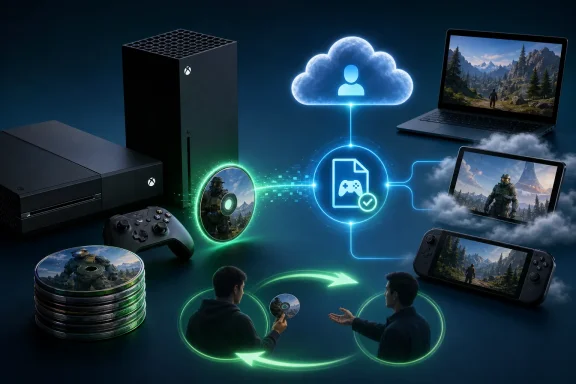
That condition turns Microsoft’s new system into something more interesting than the simplistic “free digital copy” framing suggests. It is a technical attempt to preserve the practical behavior of physical ownership—where a single copy can change hands—while allowing its current holder to use digital-only features on Xbox consoles, Windows PCs, cloud services, and handheld hardware where the game supports them.
 A digital entitlement that follows the disc
Microsoft’s official description is straightforward. Insert a supported Xbox One or Xbox Series X disc into an Xbox One or Xbox Series X console, launch the game, and the account can claim its digital entitlement. The company says the owner can then use digital benefits, including Xbox Play Anywhere and Xbox Cloud Gaming, where supported.
Those three words matter. The announcement does not mean every eligible disc automatically becomes a Windows PC game, a cloud-streaming title, or a title playable on every Xbox device. Xbox Play Anywhere is a publisher- and title-specific program; a game must already have a Play Anywhere digital entitlement for ownership to extend between Xbox console and Windows PC. Cloud Gaming likewise depends on whether Microsoft supports that game and account configuration for cloud play.
For owners of eligible Play Anywhere releases, the value could be substantial. A disc purchased for an Xbox One or Series X could provide an account-based license usable on a Windows gaming PC or compatible Xbox handheld without keeping the optical disc in a drive. That is especially relevant for players moving from disc-equipped hardware to Xbox Series S-style digital consoles, or to Windows-based portable devices that have no practical way to use a console Blu-ray disc.
But Microsoft has announced a program, not a blanket compatibility guarantee. The company has not yet published the promised list of thousands of supported games, nor has it identified the games excluded from the launch catalog. “Most” Xbox One and Series X discs is a useful broad commitment, but it leaves owners of specific collections unable to determine whether their copies qualify until the Insider test begins.
Xbox 360 and original Xbox discs are not part of the announced scope
The distinction between Xbox generations is one of the most significant limitations. Microsoft’s Xbox Wire post names Xbox One and Xbox Series X disc-based games. It does not promise support for original Xbox or Xbox 360 discs, including games that are already backward compatible on newer consoles.
Windows Central reports that original Xbox and Xbox 360 games will not participate because their discs were not made with the identifiers the new system uses. Microsoft itself has not yet published the underlying technical requirements, so that explanation should be treated as Windows Central’s reporting rather than a confirmed engineering specification. Still, the official language is narrow enough that collectors should not assume their older libraries will gain a portable, account-level license.
That limits the preservation argument Microsoft is making. The company says the feature supports a future in which players can be more confident their games remain available as devices and distribution methods change. For Xbox One and Series X titles, the program could preserve access on newer hardware by attaching a digital entitlement to a disc that can still be resold. For legacy Xbox and Xbox 360 collections, no comparable disc-to-digital path has been announced.
The distinction also matters for the growing number of digital-only Xbox devices. A player who owns an Xbox 360 disc cannot assume that backward compatibility alone will let the game move to a disc-free console or a Windows device. Existing backward compatibility generally remains a disc-verification arrangement: the console can download a compatible version, but the physical media still serves as proof that the player owns it.
Resale is the feature’s unresolved practical test
If Windows Central’s description proves accurate in the Insider build, Microsoft has found a compromise that differs sharply from ordinary digital storefront licensing. The purchaser would not receive a license permanently detached from the media. Instead, the disc would act as the transferable anchor for an account entitlement.
That means a player could claim a game digitally, put the disc away, and play without repeatedly inserting it—until the disc is activated by another account. Selling the disc would then mean selling the accompanying digital access. Lending it could carry the same risk if the borrower’s console or account claims the entitlement.
This is a far more consequential rule than the source material supplied with this story indicates. A player who reads “the physical disc will continue to work” might reasonably believe they can claim a digital version, sell the disc, and retain the digital copy. That would create unlimited duplicate licenses from a single disc as it moved through the used market. A transferable entitlement prevents that outcome, but it also means owners should treat the disc as essential even after they no longer need it for routine play.
Microsoft has not yet spelled out several details that will decide whether this works cleanly in households and in the used-game market:
- It has not publicly said whether simply launching a disc on a second account transfers the entitlement automatically or presents a warning and confirmation step.
- It has not described what happens when a disc is lent temporarily rather than sold.
- It has not explained the behavior for consoles kept offline after an entitlement is claimed.
- It has not published a policy for damaged, replacement, region-specific, promotional, or multi-disc editions.
- It has not said whether publishers can opt titles out after the initial compatibility list is published.
These are not edge cases. They are the normal ways physical games are shared, traded, collected, and preserved. Xbox Insiders should test them carefully rather than assuming that “digital entitlement” has the same meaning as a conventional Xbox Store purchase.
The program extends convenience, not independence from Xbox services
Microsoft is presenting disc-to-digital as a preservation measure, and there is a legitimate preservation benefit in allowing a supported disc to establish access across Microsoft’s account ecosystem. The player no longer depends solely on a working optical drive, a particular console model, or a local installation tied to one machine.
However, the system is also another expression of account-based licensing. Claiming an entitlement requires a Microsoft account and an Xbox console with a disc drive. Play Anywhere access, cloud access, license transfers, and the program’s promised flexibility depend on services Microsoft operates and policies Microsoft can change.
That tension was visible during the Xbox service disruption in late July. Tom’s Hardware reported that a licensing-service outage affected sign-ins, libraries, game launches, and, for part of the incident, disc-based games on Xbox 360, Xbox One, and Xbox Series X|S. Microsoft restored the service after roughly 16 hours and promised a post-incident review, but the outage illustrated a basic fact: modern console discs do not guarantee that a game remains playable when platform entitlement systems fail.
Disc-to-digital does not solve that availability problem. It may improve portability for a supported game and reduce dependence on a particular drive-equipped console, but it does not turn the license into an offline archival copy. For players concerned chiefly with preservation, maintaining the disc, a compatible console, local installations, and any available offline access remains prudent.
August 31 will show whether the promise survives contact with collections
The initial Xbox Insider rollout is a test, not a general release date. Microsoft has not announced when the feature will reach all Xbox One and Xbox Series X owners, how quickly additional titles will be added, or whether eligibility will vary by market. Its wording also does not confirm support for Xbox Series S, which has no disc drive; Series S owners would logically need access to a supported disc through an Xbox One or Series X console before using any entitlement elsewhere.
For Windows and PC-focused Xbox players, the practical payoff is clear but conditional: check whether a favorite disc game is supported by the program, then check separately whether its digital version supports Xbox Play Anywhere. Only that combination turns a shelf copy into an account entitlement that can reach a Windows PC without repurchasing the game.
Microsoft deserves credit for testing a model that tries to retain resale and lending behavior instead of simply declaring physical media obsolete. But the feature’s real terms are more demanding than a free upgrade. Until Xbox publishes its compatibility list and license-transfer rules, owners should keep every eligible disc they care about—and treat the August 31 Insider test as the first chance to learn precisely what they are receiving.