
Microsoft has not announced an Xbox Elite Series 3, set a release date, confirmed a price, or acknowledged the device in the pictures. But this is no longer a leak built solely on a stranger’s marketplace story. The newly surfaced hardware closely matches images published in May by Brazilian outlet Tecnoblog, reportedly drawn from certification material at Brazil’s Anatel telecommunications regulator. Those earlier images had already pointed to an Elite successor with Wi-Fi connectivity, a Local/Cloud pairing mode, new lower controls, and a replaceable battery.
The apparent prototype does not prove every rumored capability is coming to retail. It does, however, make the most important conclusion harder to avoid: Microsoft is testing a premium Xbox controller designed around both conventional console and PC play and direct cloud gaming.
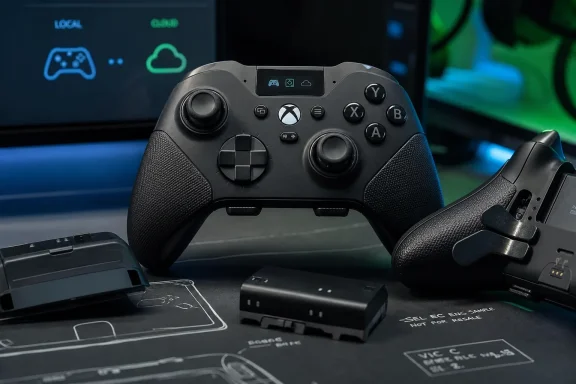 The display is new evidence, but its job remains unknown
The prototype’s small display is the headline feature because it was not an obvious part of the controller’s familiar Elite silhouette. Images preserved from the deleted Reddit post appear to show status text associated with Local and Cloud operation, suggesting the panel may be intended to communicate connection state rather than serve as an in-game secondary screen.
That distinction is important. A tiny monochrome-style status panel could let users see whether the controller is pairing with an Xbox console, a PC, Bluetooth host, or a cloud-streaming session without checking a television or phone. It could also display battery data, profile selection, firmware status, or an error message when the device cannot connect. The reported owner said the unit would not pair with an Xbox console or PC, which is consistent with an unfinished, restricted, or disabled engineering sample—but it means none of the display’s behavior has been demonstrated.
TechRadar, Windows Central, and PC Gamer independently reported on the Reddit images and their removal. Their reporting also agrees on the central limitation: the hardware is unannounced and cannot yet be treated as a final retail design. A screen found on a prototype may be a diagnostic tool, a test feature, or a production-bound component. The photos alone cannot settle which.
Still, a physical display costs space, power, and money. Its presence on what appears to be a late-looking controller shell indicates that Microsoft at least considered giving the Elite line its own on-device interface instead of relying entirely on the Xbox Accessories app.
The May regulatory leak gives the photos more weight
The August images matter because they align with details that appeared months earlier through a separate route. In May, Tecnoblog reported that Anatel documentation showed two unannounced Xbox controllers: a compact cloud-focused controller and a more traditional premium pad that appeared to be the Elite Series 3.
Windows Central, The Verge’s reporting as cited by other outlets, and Android Authority described the alleged Elite controller as supporting Wi-Fi alongside Bluetooth, with a control for moving between local and cloud modes. The May material also showed the two unusual controls near the bottom edge and a user-removable rechargeable battery.
The newly leaked prototype appears to retain those traits. That overlap does not establish the product’s retail name, launch window, specifications, or software features. It does undermine the idea that the Reddit images are merely a new, unrelated mock-up: the physical design is consistent with certification images reported months earlier.
There is a caveat that the original story does not adequately address. Regulatory documentation can demonstrate that a radio-equipped device was submitted for approval, but it does not guarantee commercial release in its pictured form. Companies certify variants that later change, ship in selected regions, or never reach stores. Microsoft’s silence therefore remains meaningful, especially on timing.
The claim that the controller could launch later in 2026 is still only rumor-level reporting. No Microsoft announcement, retailer listing, or public launch event has confirmed that schedule.
Cloud mode could be the real generational change
The Elite Series 2 launched in November 2019 at $179.99, offering adjustable-tension thumbsticks, swappable sticks and D-pads, rear paddles, trigger locks, and a built-in rechargeable battery. Microsoft still sells it as its premium Xbox controller, and its fundamental PC connection model remains conventional: Xbox Wireless, Bluetooth, or USB-C.
The apparent Elite Series 3 moves beyond that model if the leaked Local/Cloud controls and Wi-Fi hardware make it to market. Rather than sending input to a PC, phone, console, or television app first, a direct-to-cloud controller could connect through home Wi-Fi to the cloud-gaming service. The goal is to remove one link from the input path.
For cloud gaming, that can be useful. A conventional Bluetooth controller sends the button press to the local device, which forwards it across the internet to the game server. Direct cloud connectivity could send the input straight from the controller to the service, reducing local Bluetooth overhead and avoiding host-device power or pairing problems. Google pursued a comparable architecture with the Stadia controller, although Microsoft has not publicly described how its own implementation would work.
For Windows players, the practical implication is narrower than the marketing language may suggest. A direct cloud mode would benefit Xbox Cloud Gaming sessions; it would not make locally installed PC games respond faster than a wired USB connection, nor would it eliminate the quality limits imposed by a home network, Wi-Fi congestion, or the distance to a cloud datacenter.
Microsoft would also need to answer several operational questions before this becomes a straightforward buying recommendation:
- The company has not said whether direct cloud mode would work across all Xbox Cloud Gaming-supported devices and regions.
- The company has not described setup, account authentication, Wi-Fi switching, guest access, or how the controller would behave on captive-portal networks.
- The company has not confirmed whether a PC could configure the alleged screen, wheels, cloud mode, or any new inputs through the Xbox Accessories app.
- The company has not stated whether the controller would support existing Xbox Wireless Adapter workflows on Windows, or whether PC users would need Bluetooth, USB-C, or a separate adapter for every non-cloud scenario.
Those are not fringe details. An Elite controller is purchased precisely by players who remap buttons, use multiple devices, move between desk and living-room setups, and expect accessories to work reliably for years.
A removable battery may answer a longstanding Elite complaint
The switch from the Series 2’s integrated battery to an apparently removable battery is less flashy than the screen, but potentially more consequential. Microsoft promoted the Elite Series 2’s internal rechargeable battery as delivering up to 40 hours of play. In a premium controller, however, an embedded battery creates a hard service limit: capacity falls over time, and replacement is not a simple user operation.
A removable pack could make the next Elite easier to keep in service, provided Microsoft sells replacements separately and does not make them difficult to source. The leak does not establish either point. It also does not confirm capacity, charge time, compatibility with a charging dock, or whether the pack will be user-replaceable without tools.
The D-pad change deserves the same restraint. Photos suggest a flatter, redesigned interchangeable D-pad, while the May leak showed a controller that retained the Elite family’s modular approach. Whether it will offer the familiar faceted and circular options, or a new mechanism entirely, remains unclear.
Nor do the images settle the feature that many prospective buyers will care about most: thumbstick technology. The leaked material provides no reliable confirmation of Hall effect or TMR sensors, durability changes to the bumpers, or revised grip materials. Those omissions are particularly notable for a product line whose premium price has made reliability expectations much higher than for a standard Xbox Wireless Controller.
Do not buy around a product Microsoft has not announced
The strongest reading of this leak is not that a tiny display will transform controller gaming. It is that Microsoft’s next premium pad appears to be part of a broader hardware plan to make Xbox Cloud Gaming feel less dependent on the device running the stream.
The two physical wheels, the Local/Cloud interface, Wi-Fi capability reported from regulatory material, and the apparent front display all point toward a controller that needs to manage more states than the Elite Series 2. In that sense, the screen may be less a novelty than a visible symptom of a more complicated connection model.
For now, current Elite Series 2 owners should not delay a replacement purchase on the assumption that an Elite Series 3 is imminent. There is no official price, availability date, compatibility list, warranty policy, or final feature set. The next meaningful milestone is Microsoft putting its name—and support documentation—behind this hardware. Until then, the photos are compelling corroboration of a real development effort, not a finished product promise.
