

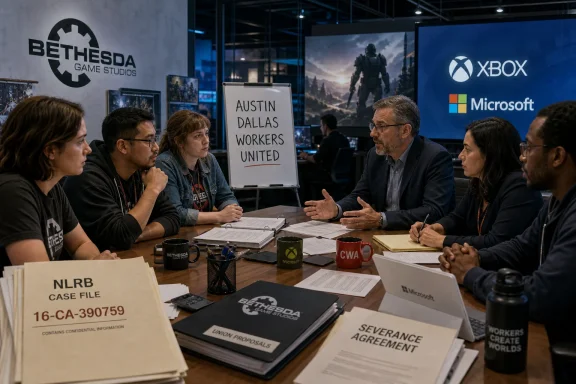
On July 6, 2026, Xbox said it would reduce its team by roughly 3,200 roles over fiscal year 2027. The company said approximately 1,600 roles were eliminated that day. It also announced differing arrangements for four studios: Compulsion Games and Double Fine were planned to transition to independent studios with their IP, catalog, and runway, while Ninja Theory and Undead Labs had entered terms to join new ownership with funding to complete and grow specified franchises. Those announcements should not be mistaken for completed, uniform transfers.
The immediate Texas impact was substantial. Independent reporting put 158 Texas Xbox workers in the first wave and said roughly 146 were represented by the Communications Workers of America (CWA). It also reported that around 94 employees at id Software in Richardson were let go. Those figures make Texas more than a peripheral site in a nationwide corporate announcement. They also show why bargaining over severance, information, potential recalls, and the practical effects of a restructuring has become a central issue for workers.
Xbox’s stated rationale is broader than a single game or studio
Xbox CEO Asha Sharma described the business as unhealthy, saying its margins were three to 10 times lower than comparable platform and publishing businesses. Sharma also cited slower-than-expected growth from Game Pass, multiplatform initiatives, and portfolio investments.
That is management’s assessment and rationale, rather than an independently established diagnosis of every Xbox business line. But it provides important context: the company is presenting the reduction as a structural response to economics, not as a discrete reaction to one underperforming release or one Texas development team.
For players, the announcement creates uncertainty rather than a confirmed list of product consequences. Xbox specifically described two planned independent-studio transitions and two studios in terms for new ownership, but that does not establish the ultimate outcome for each company, project, or employee. Arkane was described separately as beginning a works-council consultation; it was not one of the four studios in the announced independent-transition or new-ownership arrangements.
Development schedules, ownership decisions, support plans, or where games appear could eventually be affected. None of those outcomes follows automatically from the cuts or the announced studio plans. The available record does not establish what will happen to specific games, Game Pass offerings, Windows PC releases, or player accounts.
The more immediate consumer-facing lesson is that major changes to a subscription-and-platform business can have consequences that are not visible in a console dashboard. Game catalogs and cross-platform strategies depend on teams that build, maintain, test, localize, and support products. Layoffs do not prove a particular title will be delayed or discontinued, but they can reduce the organizational capacity behind a portfolio. Users should treat definitive predictions about specific games with caution unless Xbox makes separate, direct announcements.
Why the Bethesda union history matters in Texas
The Texas dispute is tied to a longer Microsoft and ZeniMax story. Microsoft announced an agreement to acquire ZeniMax Media for $7.5 billion in cash on September 21, 2020, then completed the acquisition on March 9, 2021. Keeping those milestones separate matters: March 2021 was the closing date, not the date Microsoft first announced the deal.
Bethesda Game Studios workers later formed what CWA described as Microsoft’s first wall-to-wall game-studio union in July 2024. A majority of 241 developers supported representation. The workers were assigned to CWA Local 2108 in Maryland and Local 6215 in Texas.
That history changes the character of the 2026 layoffs. In a nonunion setting, a company may announce broad employment terms and employees generally receive them individually. In a represented workplace, the employer and union can be required to address bargaining obligations, including the effects of employer decisions, depending on the applicable facts and agreements. Whether Microsoft met its obligations here is the very dispute now at issue; it cannot be assumed from the existence of the union alone.
A syndicated local report attributed a figure of 300 to 350 Microsoft employees across Austin and Dallas to a union representative. That number has not been independently corroborated in the records available here, so it should not be treated as a verified current count for Local 6215. The confirmed picture is narrower but still consequential: a Texas local was part of the Bethesda bargaining-unit structure, and independent reporting found that most of the 158 Texas workers reported in the initial layoff wave were CWA-represented.
An open NLRB case is not a ruling that the layoffs were illegal
CWA filed an unfair-labor-practice charge on July 15, 2026, naming Microsoft, Xbox, ZeniMax Media, Bethesda Game Studios, id Software, and other ZeniMax entities. The National Labor Relations Board lists the matter as case 16-CA-390759 and marks it open.
The docket records allegations including unilateral changes or contract modification, failure to furnish information, refusal or bad-faith bargaining, and coercive actions. CWA has also publicly said Microsoft slow-walked employees at the bargaining table. Taken together, those facts support the basic description of layoffs occurring amid an active bargaining conflict.
They do not establish that Microsoft broke labor law. An NLRB charge records the union’s allegations, not a legal finding. The docket available for this case does not show that the Board has ruled that the reductions were unlawful, that bargaining occurred in bad faith, or that any listed organization committed a violation. Calling the layoffs “illegal” at this stage would turn a contested claim into a conclusion that the record does not support.
That distinction is vital for workers and readers assessing competing accounts. It is possible for a company to face a legitimate financial challenge and still have disputed bargaining obligations around how it implements job reductions. Conversely, a union’s allegation can be serious without being proven. The eventual outcome could include a complaint, dismissal, settlement, or another resolution; the available record does not establish which path the case will take.
The case also should not be read as a complete public account of every employee’s circumstances. Its listed allegations are categories, not a published factual finding on every severance package, every affected role, or every conversation between management and union representatives.
The timing needs more care than many layoff headlines allow
There is a genuine timing tension in the available accounts. Xbox’s July 6 announcement said roughly 1,600 roles were eliminated that day. Independent Texas reporting likewise described affected workers as laid off effective immediately after the announcement.
A later CWA release, however, said the first phase was scheduled to affect 1,600 workers in early September while separately discussing members laid off in July. Those statements may reflect differences among notification dates, role eliminations, final employment dates, or local notice arrangements. The reviewed material does not resolve that question.
The most defensible account is therefore that Xbox announced and began the first 1,600-role reduction on July 6, while precise effective dates may have varied. This may seem like a narrow wording issue, but it is important in a labor dispute. The date an employee receives notice, loses access to systems, stops work, or formally leaves payroll can each matter to benefits, severance, internal placement, and bargaining discussions.
It is also a reason not to use an announcement total as though it explains every local outcome. The planned fiscal-year reduction is approximately 3,200 roles; the 1,600 figure refers to the announced initial action; and the 158 Texas count refers to a reported portion of the first wave. They describe related events at different levels, not interchangeable totals.
Severance remains an area where public claims outpace verification
Severance is one of the clearest places where affected employees need specifics rather than assumptions. Separate reporting said many laid-off U.S. Microsoft employees were offered up to 39 weeks of base pay. That supports the existence of a maximum reported U.S. base-pay provision for many affected employees.
It does not verify that every affected worker received that amount. Nor does it establish the terms for each represented Texas employee. A local report, citing a source close to negotiations, said union-represented employees had severance comparable to nonunion terms and referenced up to 39 weeks of pay plus 16 weeks of outplacement support. The available material does not independently confirm the asserted union/nonunion parity or the 16-week outplacement detail.
The same uncertainty applies to other potentially important provisions. The reviewed record does not establish whether Microsoft and CWA have reached an effects-bargaining agreement, a severance agreement, recall rights, or a first contract for the affected Bethesda and ZeniMax units. It also does not establish specific health-care, stock-vesting, or internal-placement terms.
For affected workers, that means broad corporate reporting should not be substituted for the written terms applicable to their own role and bargaining unit. For outside observers, it means a reported maximum severance number should not be presented as a uniform guarantee.
What this dispute could mean for game workers and platform users
The core question is not whether companies can ever restructure. Xbox’s management has stated that it sees a serious margin and growth problem. The harder question is how a company that has acquired major game studios, recognized a broad developer union, and built a subscription-focused platform handles the human consequences of its reset.
For game workers, the stakes are practical: timely access to information, whether bargaining occurs before consequential changes, and whether layoffs come with understandable, enforceable terms. An open NLRB case means those issues remain contested, not settled.
For the public, the Texas workforce makes visible how the games business is increasingly intertwined with local technology employment. Decisions made at a platform level can quickly affect specialized developers in Richardson and workers connected to a Texas bargaining local, even when the strategy is framed in terms of global subscription growth and corporate margins.
For Windows and Xbox users, the responsible position is to separate confirmed corporate actions from predictions. Xbox has confirmed a large fiscal-year reduction, an immediate first set of role eliminations, two planned transitions to independent studios, and two studios that had entered terms for new ownership. It has not, in the available record, confirmed a specific consumer roadmap resulting from those steps. CWA has made serious bargaining allegations, but the NLRB has not resolved them.
That combination of verified cuts, unresolved labor claims, and uncertain product effects is precisely why the Texas contract campaign deserves attention. It is a test of whether collective bargaining can provide clarity and protections during a platform retrenchment—not proof, yet, of how the legal dispute will end.