
The distinction matters for organizations evaluating HP’s new Granite Rapids WS platform. Phoronix tested the HP-supplied Windows 11 Pro image with all available Windows updates, then performed a clean Ubuntu 26.04 installation using its defaults. That resembles a buyer’s likely first encounter with the hardware, but it does not normalize driver versions, OEM tuning, power policy, background software, or application build options. It measures two complete default environments, not Windows 11 and Linux kernels in isolation.
The comparison is valuable precisely because the Xeon 678X is a serious workstation part: 48 performance cores, 96 threads, 192 MB of cache, a 300 W processor base power rating, support for DDR5-6400 ECC memory, PCIe 5.0, AVX-512, and Intel AMX matrix acceleration. Intel lists a recommended customer price above $4,100 for the CPU alone. In a machine configured with an NVIDIA RTX PRO 6000 Blackwell, operating-system and driver choice can visibly affect costly production jobs.
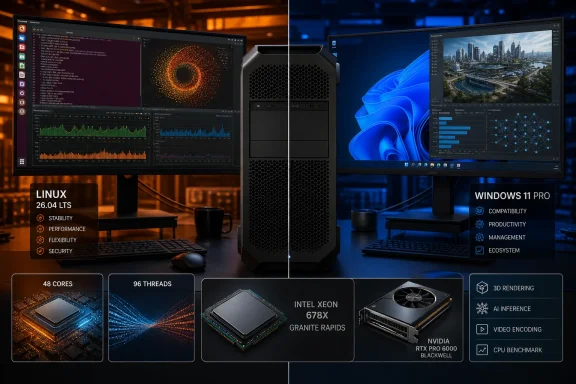 The 9% composite is real, but it blends unequal graphics drivers
Phoronix ran more than 100 benchmarks and reports Ubuntu 26.04 LTS finishing around 9% faster by geometric mean. That is a meaningful result in the narrow sense: Ubuntu was the faster of the two tested configurations across the complete suite.
But Phoronix also discloses a material imbalance that should have been placed next to that final number: HP’s Windows image used NVIDIA’s R582 driver branch, while Ubuntu 26.04 defaulted to the newer R595 branch. The test therefore combines operating-system behavior with a driver generation gap. That is especially important because GPU tests are part of the overall composite, and because the RTX PRO 6000 is not a peripheral detail in this system; it is the main accelerator for many of the workloads a Z4 buyer will run.
A newer graphics driver does not guarantee better results in every application or API. In this test, it clearly did not. Windows 11 was faster in OctaneBench, FluidX3D, GPU-backed Open Image Denoise, and several CUDA or OptiX Blender tasks. Yet Ubuntu led in GravityMark’s Vulkan ray-tracing result, most of the OpenGL-based Unigine Superposition configurations, and IndigoBench’s OpenCL GPU workloads.
The correct conclusion is that the 9% number represents the performance of HP’s then-current Windows image versus a clean, current Ubuntu 26.04 install. It cannot establish that Ubuntu itself is 9% faster on Xeon 678X hardware, and it cannot tell an IT department whether updating the Windows NVIDIA driver to the same-era release would narrow or reverse some GPU results. No second outlet has independently reproduced this exact Z4 G6i configuration or the timing of those driver branches.
For Windows workstation administrators, that is actionable: do not treat the factory image as the performance ceiling. Before deciding a Windows deployment has lost ground to Linux, validate the NVIDIA production driver, BIOS revision, Windows power plan, HP Performance Advisor policy, application plug-ins, and the specific render or encode engine your team uses.
Windows 11 was unexpectedly competitive on Granite Rapids WS
The more interesting finding is not Ubuntu’s expected strength in heavily parallel CPU work. It is that Windows 11 was competitive enough to take credible wins on a platform where Linux often has a clearer advantage.
Phoronix opened with LuxCoreRender and the TSCP chess benchmark, where Windows won multiple tests. It also found mixed OSPRay results: Windows led some real-time volume-rendering configurations, while Ubuntu took the path-tracing and OSPRay Studio work. Open Image Denoise CPU performance was described as broadly similar between the operating systems.
That pattern continues in media work. Windows 11 took most Kvazaar H.265 tests, including slow through super-fast presets, while Ubuntu won the ultra-fast case. OpenAPV results were split depending on input and preset. Ubuntu led the SVT-AV1 runs, which is more consequential for teams using CPU-bound AV1 encoding pipelines than the Kvazaar result alone.
The results underscore why composite scores are a poor procurement shorthand for workstations. A VFX studio may care much more about Blender CUDA and V-Ray GPU behavior than 7-Zip. An engineering team may be concerned with a specific OpenGL visualization workload. A media department may have delivery pipelines tied to H.265, AV1, or hardware encoding. A local AI group may care about the exact model quantization, prompt size, Vulkan implementation, and inference backend.
On Llama.cpp with Vulkan, for example, the results changed by model and task. Windows was faster for text generation and prompt processing with Qwen3.5-9B-Q8_0 and GLM-4.7-Flash-IQ4_XS, while Ubuntu led prompt processing for the gpt-oss-20b-Q8_0 configuration. “Linux is faster for AI” is not supported by this data. Neither is “Windows is faster for AI.” The useful observation is that Windows 11 on this Xeon-plus-Blackwell workstation is viable enough that the software path determines the answer.
Ubuntu’s strongest wins were CPU-bound rendering and throughput jobs
Ubuntu’s advantage becomes much more consistent in CPU rendering. Phoronix recorded Ubuntu wins in Intel Embree, OSPRay Studio, 7-Zip compression and decompression, Stockfish, several ASTC Encoder modes, Blender CPU rendering, IndigoBench CPU mode, Appleseed, and V-Ray CPU mode.
For users whose Z4 G6i is an all-day CPU render node, build server, simulation box, or encoding host, those are the results that deserve attention. The Xeon 678X’s 96 hardware threads reward workloads that scale efficiently, and Linux tooling is often the better-supported path for rendering frameworks, compiler toolchains, batch orchestration, and headless execution. Ubuntu 26.04’s Linux 7.0 kernel is also a current platform release rather than an older long-term-support kernel backport, which reduces the chance that fresh Granite Rapids WS support is being tested through an aging enablement stack.
Still, the test does not establish which component produces the CPU advantage. The clean Ubuntu install and HP’s factory Windows environment differ in more than their kernels. The article does not publish comparable application versions, compiler flags, firmware settings, CPU power-limit readings, measured clocks, scheduler configuration, memory timings under load, or a repeat-run variance. Those omissions do not invalidate the benchmark suite, but they limit root-cause claims.
There is a second issue for buyers looking to reproduce the machine rather than merely compare operating systems. The test unit used 128 GB of DDR5-6400 as four 32 GB DIMMs. Intel’s Xeon 678X supports up to eight memory channels, while HP’s Z4 G6i documentation describes four memory channels and eight DIMM slots. That makes the Z4 G6i a workstation implementation of the processor rather than a fully populated demonstration of the silicon’s platform capabilities. Memory-bound applications should not extrapolate these numbers to every Granite Rapids system, particularly a different motherboard design or an eight-channel configuration.
HP’s platform support is broader than the factory Windows image
HP’s Z4 G6i materials list Windows 11 Pro for Workstations, Ubuntu Linux, or no operating system as configuration choices, alongside Xeon 678X support and RTX PRO 6000 Blackwell availability. The company therefore is not positioning Linux as an unsupported afterthought on this chassis.
The regional HP documentation also carries an important qualification: the Ubuntu Linux option was marked as scheduled for later availability. That leaves unanswered questions for enterprise customers outside that sales region: which Ubuntu image HP will certify, whether it will provide a curated driver stack, whether the NVIDIA branch will match the retail Ubuntu default, and what support obligations apply to customer-installed Linux versus a factory Linux order.
Those details affect deployment more than a benchmark chart. A Windows-standardized business may accept a few percentage points of performance variance to retain Microsoft management tooling, Active Directory and Entra integrations, endpoint security controls, commercial application support, and familiar support escalation paths. A Linux-first render or compute team may value Ubuntu’s stronger CPU results and native developer workflow enough to make that trade willingly.
The benchmark does not justify replacing either environment wholesale. It justifies testing the actual workload on the actual driver stack before a fleet order.
Phoronix’s report contains two naming errors worth correcting
The core identity of the test system is clear from the title, HP configuration material, and Intel’s processor record: it is an HP Z4 G6i with an Intel Xeon 678X. But the Phoronix article twice muddies that record.
Its setup paragraph calls the processor an “Intel Xeon 678W GNR-WS,” even though the product under test is consistently identified elsewhere as the Xeon 678X. Intel’s official processor listing confirms the 678X as the 48-core, 96-thread Granite Rapids workstation SKU. The report’s conclusion then refers to the “HP Z6 G4i,” not the Z4 G6i used throughout the test.
These are editorial errors rather than evidence of a different test platform, but they matter because workstation benchmarks get cited into purchasing discussions and internal test plans. The Z4 versus Z6 distinction can imply a different chassis class, thermal design, expansion configuration, and price tier. Anyone archiving or reproducing the results should record them as the HP Z4 G6i / Xeon 678X / RTX PRO 6000 Blackwell configuration.
The practical result from this first Granite Rapids WS comparison is straightforward: Ubuntu 26.04 delivered the better average across Phoronix’s broad suite, especially for CPU rendering, while Windows 11 remained competitive and periodically faster in GPU, video, and AI tests. The next meaningful data point is not another geometric mean—it is a retest with matched NVIDIA driver generations and the production applications that will actually occupy those 96 threads.