
For Windows enthusiasts and local-AI users, the meaningful part of the announcement is not the reported 5.22 million AnTuTu score. It is Xiaomi’s attempt to build a compact, heterogeneous local-AI system around specialized memory bandwidth — including an AI Cube Prototype mini PC that combines all three chips and is said to sustain 150W while running models as large as 120 billion parameters.
Reuters reported that Xiaomi has contracted TSMC to manufacture the new Xring parts, extending a strategy that began with the company’s first flagship in-house phone processor, the O1, in May 2025. Xiaomi is pursuing the same vertical integration used by Apple, Samsung, Huawei, and major cloud providers: control more of the silicon roadmap so hardware, operating software, AI models, and supply planning can be tuned together.
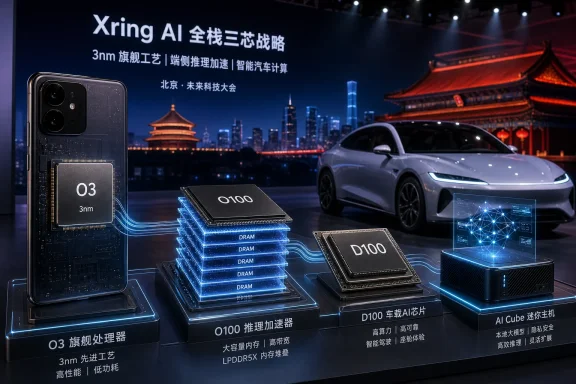 Xring O3 will face its first real test in the Xiaomi 18 Fold
The Xring O3 is Xiaomi’s second flagship smartphone SoC and the only chip in this launch with a near-term shipping home. Xiaomi says it has entered volume production and will debut in the Xiaomi 18 Fold in September 2026. Reports from 21st Century Business Herald and The Paper say the O100 and D100 have completed validation, but will not reach commercial products until 2027.
That timeline changes how the launch should be read. Xiaomi has presented a complete three-tier chip family, but it has not delivered three mature product platforms at once. The O3 will be judged shortly by battery life, sustained gaming performance, modem behavior, camera reliability, thermals, and software support in a foldable phone. The O100 and D100 are forward commitments until Xiaomi identifies final products, configurations, prices, and availability.
The O3’s design is aggressive for a phone processor: six “ultra-large” CPU cores plus four large cores, up to 4.35GHz, 24 billion transistors, a 16-core G2-Ultra NX GPU, and support for LPDDR6 memory at up to 113.8GB/s. Xiaomi says the chip reaches 15,221 in Geekbench 6.5 multi-core testing, versus 11,054 for Apple’s A19 Pro in its comparison. It also puts O3’s single-core score at 3,945, slightly behind the A19 Pro’s 4,019.
That result is a reminder of what benchmark leadership does — and does not — establish. A ten-core all-big-core CPU is well positioned to dominate a multi-core run, particularly one that can exploit every core. It does not prove that the Xiaomi 18 Fold will be more responsive in short, bursty tasks, or more power-efficient over an hour of gaming, video capture, cellular use, or on-device AI work. Xiaomi’s reported 5,228,014 AnTuTu result was obtained under a low-temperature laboratory condition, not a normal phone enclosure in a pocket or a warm room.
Reuters, citing people familiar with the plan, reported Xiaomi expects production in the range of 200,000 to 300,000 O3 chips. That would make O3 a strategically important in-house platform but a limited-volume one compared with Qualcomm and MediaTek’s flagship programs. For now, Xiaomi is using the processor to differentiate selected premium hardware rather than replacing third-party silicon across its phone portfolio.
The memory wall is the actual target
The O3’s most consequential feature is its memory system. Xiaomi is trying to address a constraint that is increasingly visible in both PCs and phones: modern AI tasks often wait on memory movement rather than raw arithmetic throughput.
A processor can have powerful CPU, GPU, and neural cores, but large models repeatedly pull weights and intermediate data through memory. If bandwidth is insufficient or latency is high, adding compute units produces diminishing returns. This is why PC users comparing local LLM hardware often find that unified memory capacity and bandwidth can matter as much as headline TOPS.
Xiaomi says O3 supports LPDDR6 at 10,667Mbps over a 4×24-bit interface, reaching 113.8GB/s. It also lists approximately 60MB of combined cache, including CPU L2, L3, and system-level cache, and claims 82ns static memory-access latency. These are substantial claims for a mobile SoC, although they remain vendor figures until production hardware can be independently tested.
The company also says its O3 neural subsystem delivers 200 TOPS of tensor computation and 3.13 TFLOPS of vector compute. But the more revealing detail is its use of hardware Huffman compression and near-memory storage for its MiMo models. Xiaomi claims that, with MiMo 3B, this reduces memory-bandwidth consumption by 30%, improves first-token response by 40%, lifts inference speed by 45%, and reduces operating power by 26%.
Those figures are useful as an indication of Xiaomi’s engineering direction, but they are not a general performance rating. They apply to Xiaomi’s own 3-billion-parameter MiMo model and an undisclosed test setup. Developers should not translate the claim directly into expected speed for Windows-based tools such as Ollama, LM Studio, llama.cpp, or another model family with different quantization, context length, and runtime behavior.
O100 makes the local-AI pitch more credible — but remains a prototype story
The O100 is the more unusual chip because it is designed for inference bandwidth rather than smartphone general-purpose computing. Xiaomi describes it as a 6nm AI accelerator using wafer-on-wafer 3D stacking, with two DRAM wafer layers bonded directly over an NPU wafer through hybrid bonding.
Xiaomi’s quoted result is 1.22TB/s of near-memory bandwidth — roughly an order of magnitude above the memory bandwidth found in a high-end phone SoC. The company says it uses 14 NPU cores and can reach 330 tokens per second with MiMo 3B. The architecture is intended to cut the physical distance between memory and compute, minimizing the time and energy spent moving model data.
This is a plausible answer to a real bottleneck, and its relevance extends beyond phones. The AI Cube Prototype shown at the event combines O3, O100, and D100 in a mini-PC-like chassis. Chinese outlet ZOL reported that it can sustain 150W and has demonstrated local deployment of a 120B-parameter model. Xiaomi has not announced a retail date, price, ports, storage options, operating system, or a supported developer stack for the machine.
Those omissions are significant. A 330-token-per-second result on a 3B model says little about performance on a 70B or 120B model, where memory capacity, quantization, context length, and active parameters can change output speed dramatically. Nor has Xiaomi disclosed the O100’s total model-memory capacity, its power draw, host interconnect, or whether third-party runtimes will be able to access the accelerator. Until those details arrive, the AI Cube is a technology demonstration rather than a Windows mini-PC alternative or an answer to NVIDIA’s local-AI hardware.
D100 turns the same approach toward Xiaomi’s cars
The D100 is Xiaomi’s automotive AI chip: 3nm, 20 CPU cores, 16 NPU cores, and support for up to 160GB of unified memory, according to the company. Xiaomi says it can deploy a model as large as 200 billion parameters locally and plans to commercialize the part in 2027.
The memory capacity claim is striking, but model parameter counts need context. A 200B-parameter model alone can require about 100GB at 4-bit quantization before accounting for runtime overhead, context memory, safety systems, sensor pipelines, and the rest of an automotive software stack. Xiaomi has not identified the 200B model, its quantization, throughput, power consumption, functional-safety certification, or the vehicle that will ship with D100.
The practical takeaway is that D100 is a capacity claim, not proof that a car will run a 200B model continuously while driving. In autonomous-driving hardware, the relevant measurements are sustained latency, determinism, reliability, sensor integration, thermal behavior, power use, and safety validation. Xiaomi has yet to publish those details.
Lei Jun’s microscopic “OK” is not the product story
36Kr reported that Lei Jun highlighted a 60-micrometer “OK” hand gesture hidden within the O3’s die artwork and joked that owners should not disassemble the expensive processor to find it. The detail gives the launch a memorable visual hook, but it has not been independently substantiated in the wider reporting reviewed so far.
There is also a small attribution wrinkle. Several contemporaneous reports identify Xiaomi vice president and chip-business head Zhu Dan as the executive who presented the three chips at the August 24 event, while Lei Jun discussed the broader investment and strategic direction. That does not disprove 36Kr’s account of the microscopic die marking; it means the Easter egg should be treated as a single-outlet detail rather than the central fact of the announcement.
Xiaomi’s real bet is visible in the commercialization schedule. O3 will either establish that the company can ship a competitive, power-efficient 3nm smartphone platform in its Xiaomi 18 Fold or expose the hard parts that synthetic benchmarks conceal. O100 and D100 will matter later, when Xiaomi must show that its 1.22TB/s bandwidth claim can power accessible products and useful software rather than remain a compelling conference demonstration.